

Tag: abuse narcissistic behavior
Man’s Mother wound
The influence of Narcissistic parenting on their children
Spiritual women are magnets for narcissist
Narcissist facts
Disrupted relationships- Charlie McCarthy/ Parental Alienation
Parental alienation can become particularly severe, leading to complete alienation, interrupted contact, and prolonged legal battles. This level of alienation is often associated with the involvement of a parent displaying Cluster B personality disorders, which include Narcissistic, Borderline, Anti-social, and Histrionic personality disorders. These disorders are characterised by erratic, emotional behaviours that can significantly affect parenting.
In the context of parental alienation, the focus is often on parents with narcissistic or borderline personality disorders, as they tend to be prevalent in these cases.
Narcissistic Personality Disorder (NPD): Narcissistic parents present a facade of perfect, successful parenting to the outside world while behind closed doors, it is marked by fear and control. They intimate: “Grow up and be wonderful, for me.” Traits include entitlement, emotional deprivation, and a lack of empathy.
Borderline Personality Disorder (BPD): These parents fear abandonment and resort to manipulation and control to prevent it. They often use their children as emotional support. Sometimes, they threaten self-harm, even suicide, to maintain control and avoid abandonment whilst appearing very close to their children. This closeness is often a result of a lack of emotional boundaries, known as enmeshment. BPD parents might also engage in Fabricated Illness Syndrome or Munchausen’s Syndrome by Proxy, again to maintain control. They might say: “Bad things will happen to me (parent) if you leave.”
Family System Distortions: Family dynamics become distorted during parental alienation. The role-reversal relationship emerges, elevating the child’s role and causing the targeted parent’s authority to diminish. This is achieved through the child aligning with the alienating parent’s narrative. The alienator (the persecutor) becomes the rescuer, the child (victim) becomes the persecutor towards the targeted parent, and the targeted parent (also the victim) becomes the abuser in the child’s perception due to the manipulations of the alienator. Once the role-reversal relationship is established, the child’s thoughts and feelings intertwine with the alienating parent’s views. The child cannot distinguish their emotions and seeks validation from the alienating parent.
Family Projection: The family acts as a collective and can exhibit cult-like behaviours and shared beliefs passed down through generations, contributing to trauma reenactment resulting from unresolved family issues.
Emotional Cutoff: The targeted parent is completely excluded from the child’s life. This allows the child to avoid triggering anxiety in both the alienating parent and themselves. Sibling relationships are often strained, sometimes undergoing their own alienation in cases of step-siblings, and due to a lack of secure attachment, with children often vying for the alienating parent’s attention.
Understanding parental alienation and personality disorders provides some insight into the complex family dynamics that drive the behaviours that can lead to complete alienation and disrupted relationships.
#charliemccready
#parentalalienationcoach
#alienatedparent
#parentalalienation
#narcissisticparent
#coercivecontrol

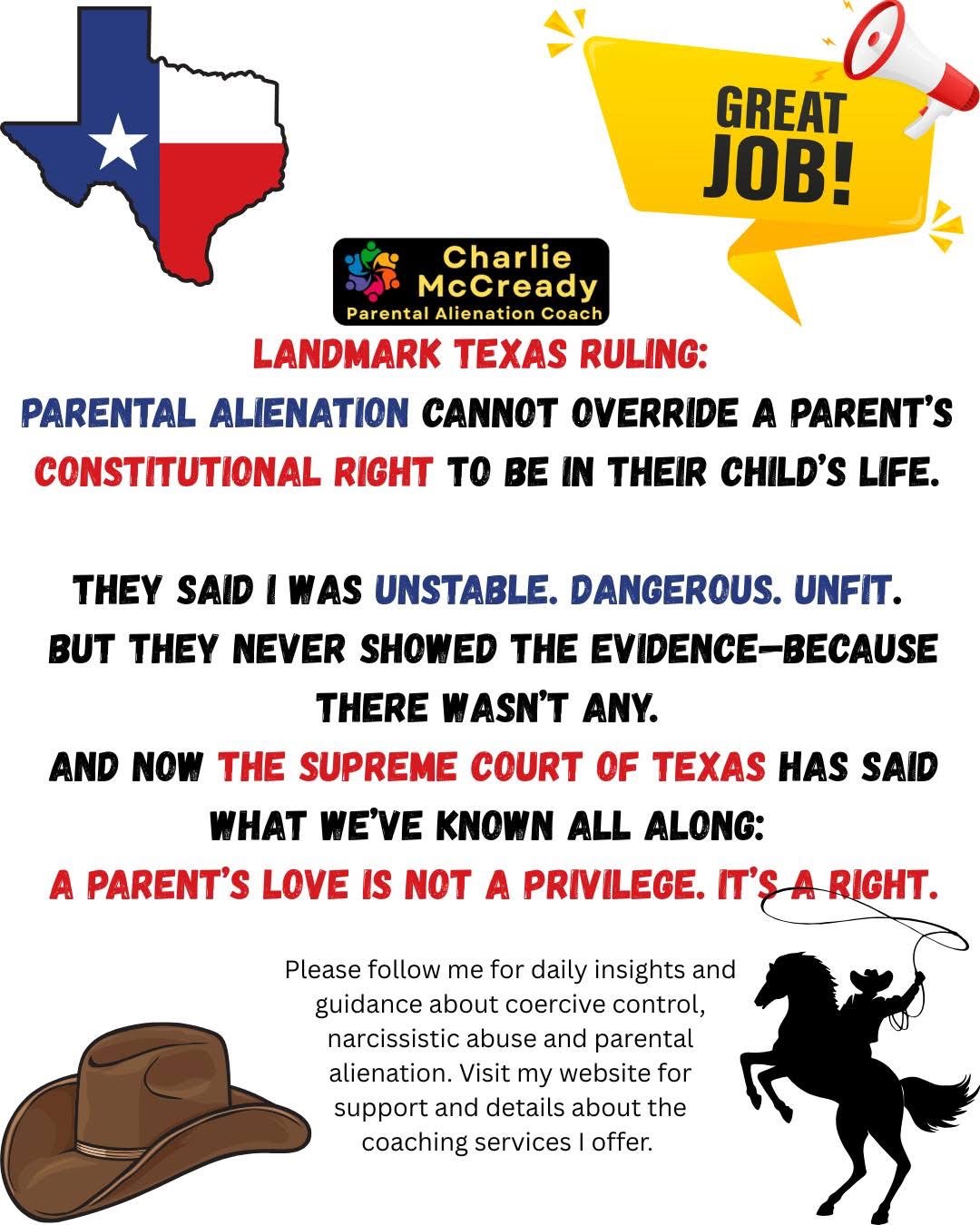
Texas : Ruling on Parental Alienation
Parental alienation isn’t just emotional abuse—it’s a calculated campaign to erase a loving parent from a child’s life. And for too long, those behind it have hidden in plain sight, using the family courts as a weapon rather than a safeguard. But in Texas, something has shifted.
In a recent ruling—Stary v. Ethridge—the Supreme Court of Texas struck down a lifetime protective order that had banned a mother from any contact with her children, despite no clear or convincing evidence against her. The Court affirmed what alienated parents across the world have always known in their hearts: our presence in our children’s lives is not optional, or dependent on the goodwill of an ex-partner. It is a constitutional right.
This isn’t just a win for one family. The ruling sets a higher standard: from now on, no Texas court can impose long-term bans between parent and child without meeting the highest level of proof. This is justice inching closer to where it should be—though for many, tragically, it still comes too late.
If you’re a targeted parent in Texas, or anywhere, let this be a reminder: alienation thrives in silence and delay. You are not overreacting. You are not imagining it. If your child suddenly uses language that sounds rehearsed, if they repeat adult arguments they couldn’t possibly understand, if you’re constantly shut out of decisions, denied visits, or blamed for everything—that is not a child acting freely. That is a child caught in the grip of cognitive dissonance, ‘brainwashing’ … coercive control. It is child psychological abuse and spousal/partner psychological abuse.
I’m sure you are reading this because you know that parental alienation is a form of domestic abuse. Often misunderstood, misdiagnosed, denied, and incredibly poorly supported as a result. Courts in Texs can now, and must, consider the psychological abuse involved—modifying custody arrangements, ordering therapy, and holding alienating parents accountable. This is great news!
But none of this happens without action. Keep records. Stay calm. If you’re going the legal route (you might know my feelings about the current state of our family courts) seek advice from professionals who understand the damage alienation causes. And never, ever let someone convince you that your child is better off without you, just because the current system hasn’t caught up with this truth yet.
Your love and resilience matters—more than alienating parents would ever want to admit.
#charliemccready
#parentalalienationcoach
#traumabonding
 GreatCosmicMothersUnite