

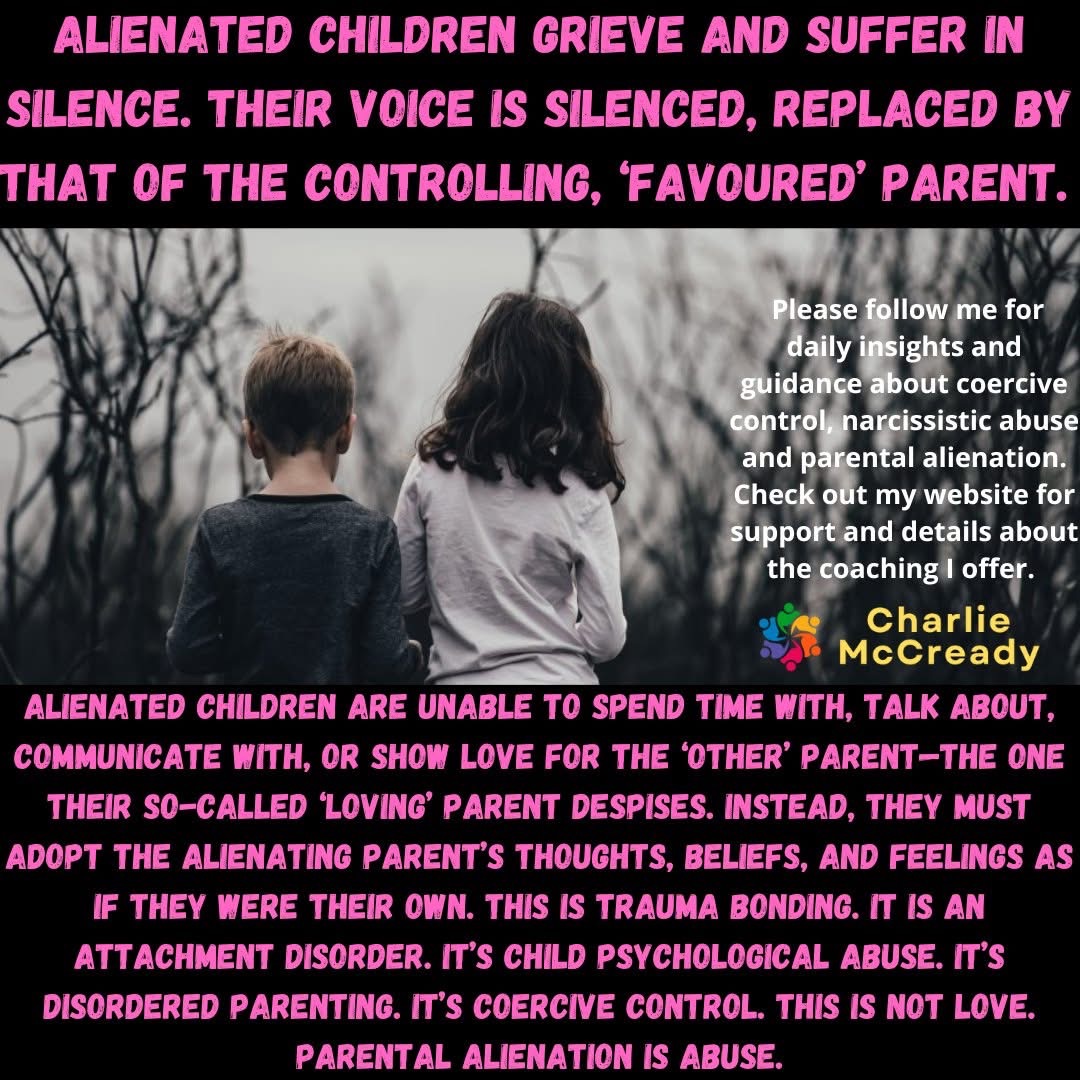
Many alienated children know, deep down, that they have one parent’s love. Often, it is the parent who loves conditionally—the one often exhibiting toxic, narcissistic, or borderline personality traits—from whom they crave affection, sacrificing their happiness and their relationship with the other parent in the process. Children inherently desire love from both parents. A child does not naturally reject a parent, even an abusive one (which I’ve covered in other posts), and needs to be far better understood.
The targeted parent, like the child, has likely been operating in survival mode within a toxic home environment. If the healthier-minded parent chooses to leave because the home life has become unbearable—recognising that it is harmful for the child too—the fears triggered in the toxic parent can escalate alienating behaviours, which may have already been in play, either overtly or covertly. At this juncture, if not before, the previously loved parent is demonised by the toxic parent, who now positions themselves as the best mother or father in the world.
The child, who may have long craved the love and attention of the toxic parent, may become enamoured with the newfound closeness and the secrets (often lies and delusions) shared by that parent. Yet, they are also scared and confused. They might begin to question whether they misjudged their other (target) parent: Have they truly been abandoned? Did that parent ever love them? This internal conflict often manifests as anger or loyalty to the alienating parent, masking the deeper grief they experience. Their grief may not be overt; instead, it can be expressed through rage, confusion, and compliance, making it difficult for others to see the silent suffering beneath the surface. And they probably are not getting the opportunity (little or none), to believe anything other that what the alienating parent is telling them.
These negative beliefs, reinforced by lies and the alienation tactics of triangulation (obstruction of contact and divide-and-rule), become ingrained. The toxic parent, now playing the roles of victim and hero, often becomes the child’s closest confidant.
In coping with this turmoil, the child may resort to psychological ‘splitting,’ using their anger and hurt feelings as justification for rejecting
the other parent. They adopt the thoughts, beliefs, and behaviours of the toxic parent, believing they have consciously chosen this alignment without external influence. They think it is entirely their decision to turn their back on the other parent. However, what they receive from their aligned parent is not love; it is manipulation. The alienating parent seeks to use the child as a weapon to inflict the maximum emotional pain on the other parent, removing the beloved child from that parent’s life in the most dramatic way possible.
My posts are here not to alarm or upset but to spread awareness about what’s known as ‘parental alienation’ and to provide guidance to those who are going through it, as I did myself. Apart from these daily posts, which I hope help you know you’re not alone, and to better understand it’s an attachment disorder, a pathology, it’s not you; please reach out if I can help with the coaching I offer.
#charliemccready
#parentalalienationcoach
#abuseinthefamily
#pathogenicparent
 GreatCosmicMothersUnite