Charlie McCready- All is right in the end

I love this saying: Everything will be right in the end. If it is not right, it is not the end. It has been attributed to many, including Oscar Wilde, John Lennon, Paulo Coelho, and it featured in the film, ‘The Best Exotic Marigold Hotel’ based on a book by Deborah Moggach. ⁠

Nobody’s life is ever 100% perfect. Life comes with challenges. Parental alienation is ‘up there’ as one of the most challenging. Alienation from our children because of the psychologically manipulative and malicious behaviours of the other parent, wilfully damaging the relationship of their child/ren with us, makes us feel helpless and heartbroken and all through it, we need to stay positive, hopeful and strong. So when I first heard this quote, in the film, I found it reassuring. It’s an uplifting film – set in an Indian retirement home. All the characters are seeking a better life in some way. Sonny Kapoor (Dev Patel) runs his family’s hotel, which is centuries-old and ramshackle but charming. Despite his challenges, he stays positive, believing all will be okay in the end. ⁠

Interestingly, one of the story’s characters in a loveless marriage to an absolute harridan (switch this for alienating parent/narcissist) finally breaks and says: “Do you have any idea what a terrible person you have become? All you give out is this endless negativity, a refusal to see any kind of light and joy, even when it’s staring you in the face, and a desperate need to squash any sign of happiness in me or …. anyone else. It’s a wonder that I don’t fling myself at the first kind word or gesture that comes my way, but I don’t … out of some sense of dried-up loyalty and respect, neither of which I ever bloody get in return.” His wife totally ignores his outburst, changing the subject. This sums up how these people don’t acknowledge the harm they cause others. They deflect and project. ⁠

We owe it to ourselves to be resilient and practise self-care, self-love, and self-respect. We need to show our child/ren the way to behave – not like the alienating parent. Remember: Everything will be right in the end. If it is not right, it is not the end.⁠

#charliemccready

#parentalalienationcoach

#pathogenicparent

#narcissisticparent

#emotionalabuse

Mental & Legal Professionals fail our children/ Parental Alienation

It’s crucial for mental health professionals and family courts to look beyond the “voice of the child.” While a child’s expressed wishes are important, they can be influenced by various factors, including enmeshment with one parent and coercive control dynamics. In these situations, the child might be manipulated or pressured into expressing negative feelings or rejection towards the other parent. Covert psychological abuse and trauma bonding are central elements of these dynamics. These behaviours are subtle, they may even look like love, closeness, and care, making them challenging to detect.

Due to ongoing manipulation and control, trauma bonding occurs when the child becomes emotionally attached to the alienating parent, further reinforcing their unjustified, ‘coached’ negative perceptions of the other parent.

Therefore, mental health professionals and family courts have a duty of care to conduct thorough and impartial assessments, looking beyond appearances. Failing to do so inadvertently allows what could be seen as a form of legal kidnapping, where a child is unjustly separated from a loving parent. It’s essential that professionals consider the broader context, potential manipulation, and the child’s best interests to ensure fair and just outcomes in such sensitive cases.

#charliemccready

#parentalalienationcoach

#FamilyCourt

#divorce

#highconflictdivorce

#traumabonding

From victim to persecutor : Narcissist Characteristics

Carl Jung, the renowned psychiatrist, believed that we start life as a blank canvas, and our experiences gradually add colours to it. He introduced the concept that our minds are composed of two archetypes: the persona and the shadow self. The persona, derived from the Latin word for ‘mask,’ represents the image we present to the world and how we want to be seen. Our shadow aspects are the parts of ourselves that we learn to hide as we grow, experience life and learn the ‘rules’ about good and bad, right and wrong – and behaviours we feel we should hide in the shadows. These concealed feelings can transform into ‘dark’ emotions, which manifest as health issues, mood swings, fears, and mental health challenges. It might seem easier to ignore these shadows, but they keep showing up and growing until we confront them. As Carl Jung aptly said, “That which we do not bring to consciousness appears in our lives as fate.” We all have dark and light aspects. If we learn to accept our shadows and where they came from, they will no longer frighten or ‘overshadow’ our lives. We can embrace them/our wholeness.

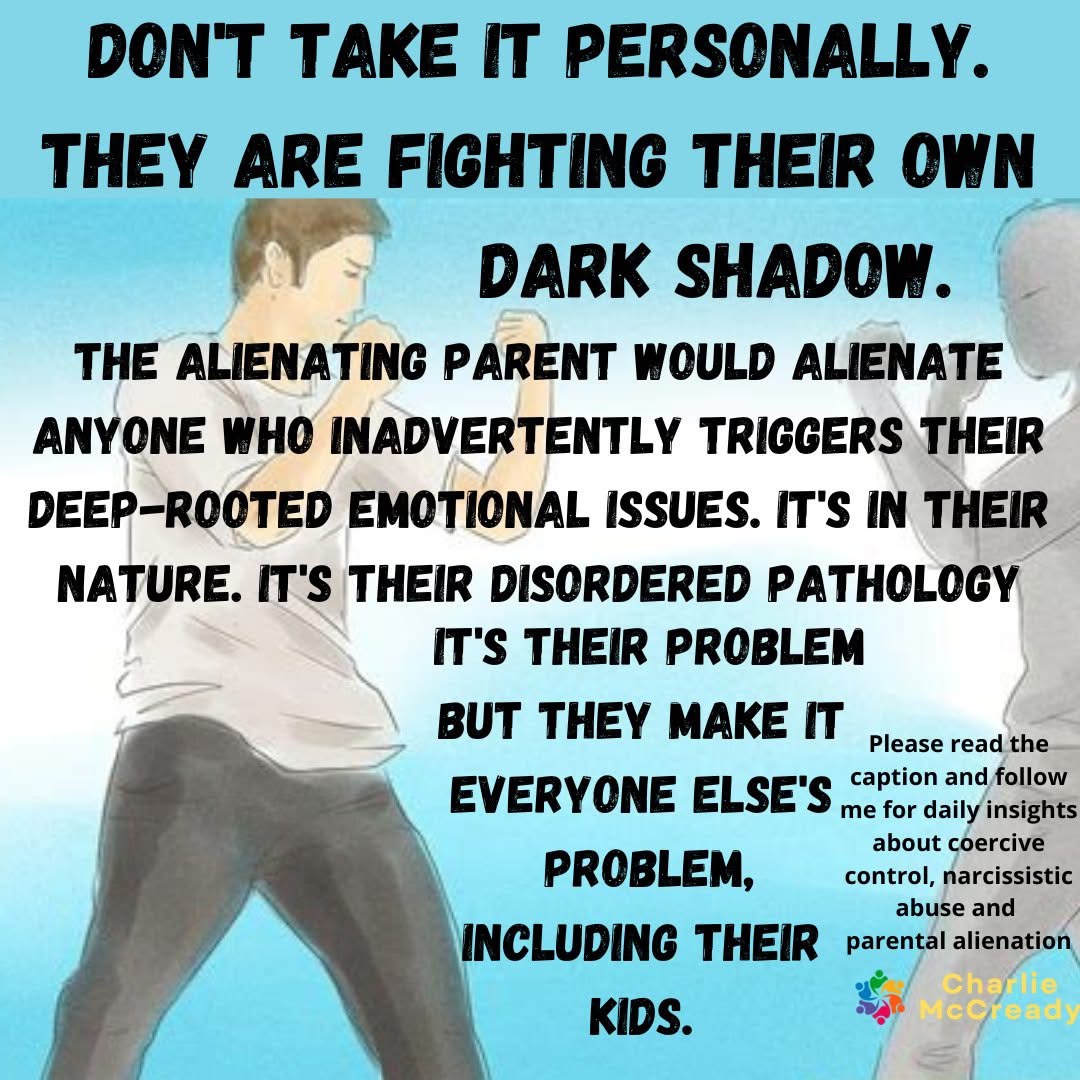
Parental alienators and those who profess to be strong, right, and best – including our leaders and governments – put up a front to cover deep wounds, traumas, victim patterns, and shadows. Until they heal, they can’t help others as they like to think they can. They often have hidden agendas and look for a saviour or support system. When we no longer fulfil their agenda, they shift from victim to persecutor and make us their targets. The deeper their wounds, the more vicious their attack. They are essentially battling their own projections, their shadows. We can try to practise loving detachment when we find ourselves in this abusive situation, especially concerning alienated children. Sending our love. Being loving. Striving to be happy. We must not allow others’ judgments and opinions to define our identity; they only define themselves. Most cannot see beyond their trauma and hurt and operate from this shadow place. We can heal our shadow aspects and love ourselves to better love others.

Just as we cannot deny the existence of the ‘dark side of the moon’ or have yin without yang, we must acknowledge that life encompasses both light and dark experiences. We all have those ‘dark’ days and experiences. It’s part of life. If we bury the stuff we don’t like or don’t feel comfortable with, it just rots and festers. It is hard but much better to unearth, accept, and even learn to love them. This process begins with acknowledging that the bad experiences do not define us. We are not parental alienation; it happened to us and our children. We are not defined by the rage, grief, and loss inflicted upon us by this experience. Recognising these experiences for what they are—events that occurred, feelings that were felt—is the first step. Viewing these experiences, even the traumatic and heartbreaking ones like alienation, as part of a journey that has yet to reach its destination allows us to learn acceptance. To deny these feelings and our ‘shadow self’ is to deny a part of ourselves, including how these experiences have shaped us. These events happened, and self-criticism serves no one. There is no need for shame; instead, work towards releasing the grief, guilt, and anger. Find strength within and shine your light not only for yourself but also for your child.

#charliemccready

#parentalalienationcoach

#traumabonding

#narcissisticabuseawareness

#narcissisticparent

#parentalalienation

#parentalalienationawareness

The Alienator – Charlie McCready

At the core of parental alienation lies a troubling truth: the alienating parent often harbours a profound animosity towards their ex-partner that eclipses their love for their child. This dynamic can be unsettling, as it reveals how personal vendettas can overshadow the fundamental duty of nurturing a child’s emotional and psychological well-being.

An alienator typically views their ex as an adversary rather than a co-parent. This perspective often stems from unresolved conflicts, feelings of betrayal, or even jealousy. Rather than seeking to heal or move forward, they channel that pain and perceived wrongs into a relentless campaign against their former partner. Their fixation on undermining the other parent can manifest in various ways—through manipulative narratives, distorted truths, and emotional coercion, all designed to create distance between the child and the targeted parent.

This hatred can be so consuming that it clouds the alienator’s ability to see the child’s needs clearly. They may project their bitterness onto the child, expecting them to take sides in a conflict that has little to do with the child’s own feelings or experiences. In doing so, the alienator denies their child the love and support they desperately need from both parents. The alienating parent may profess love for their child, but it is conditional and subject to the child’s allegiance to them and their distorted worldview.

The impact on the child can be profound and damaging. As the alienator fosters feelings of fear, resentment, and distrust towards the other parent, they may inadvertently instil in the child a skewed understanding of relationships. They may be led to believe that expressing affection for the targeted parent is a betrayal of their ‘favoured’ parent, reinforcing a toxic dynamic that prioritises control over emotional honesty.

Ultimately in their obsessive pursuit of revenge or validation, alienators are willing to sacrifice their child’s mental health and happiness. Recognising this truth is crucial for understanding the dynamics of parental alienation. It highlights the urgent need for intervention, support, and education for both parents and professionals.

#charliemccready

#parentalalienationcoach

#gaslightingawareness

#narcissisticabuseawareness

#pathogenicparent

Undoing the program of Parental Alienation – Charlie McCready

There is a time when the alienated child just cannot hear anything that is contrary to what their alienating parent has told them. It’s just too confusing. It means undoing all that programming, picking through all the lies, and manipulation, the denial of a relationship with a loved parent, and all the sadness and guilt associated with the way they were coerced into behaving. There may be times when a child can’t bear to hear ‘I love you’ from a parent they’ve rejected. It can potentially create anxiety, with the result the child may even reject the parent more. Sometimes, the attempt to make regular and/or daily contact with an alienated child has even been misconstrued as harassment. It is beyond cruel to not be able to tell our loved ones that we love them, but we have to wait for the right moment, the right conditions. That’s not normal, but it’s where we’re at, and learning about this pathology, much of which is counter-intuitive, is, I hope, helpful, which is why I post every day. It’s a ‘handle with care’ situation. ⁠

If you are going through parental alienation, know you’re not alone. I’ve been through it myself. Personally and professionally, I have over 20 years of experience. I am reunited with my children and here to offer support with daily posts on social media and also with the coaching I offer. Feel free to reach out to me anytime.⁠

#charliemccready

#parentalalienationcoach

#narcissisticabuserecovery

#narcissisticparent

#pathogenicparent

#coercivecontrol

Alienating parent : Manipulative & Narcissist- Charlie McCready

Alienating parents often possess highly manipulative and narcissistic traits. They charm and flatter in a way that serves their objectives. Unfortunately, this can obscure their abusive behaviour. The result is that they often go unchecked, and those they abuse (psychologically, financially, narcissistically) struggle to find support, as others find it difficult to believe that such a charming person could be capable of abuse. This enables and perpetuates the cycle of abuse.

What’s going on with them? Narcissistic tendencies and manipulative charm often serve as powerful tools for alienating parents while working against the target parent. Narcissistic people frequently possess an inflated sense of self-worth, enabling them to appear confident and persuasive. This charisma can be particularly effective in manipulating situations or people. They may employ tactics like gaslighting, denying their harmful behaviour or distorting the truth. This can lead the target parent to doubt their own perceptions and feelings. Alienating parents often use their charm to win over friends, family members, or professionals involved in legal or custody matters. Consequently, these people may side with the alienating parent, reinforcing the false narrative against the target parent. Manipulative charm allows them to present themselves as cooperative and reasonable, especially in front of authorities or during court proceedings. This can make it challenging for the alienated/target parent to substantiate their claims, potentially leading to decisions favouring the alienating parent.

Narcissistic alienating parents may distort the situation to depict themselves as victims, falsely asserting that they are protecting their child from the target parent’s alleged harm. This can sway sympathies and perceptions against the target parent. They may divert attention away from their own actions by focusing on the perceived flaws or mistakes of the target parent, further reinforcing the negative narrative.

Narcissism and manipulative charm are potent tools in the arsenal of alienating parents, allowing them to maintain control over the narrative, shape perceptions, and conceal their abusive behaviour. This dynamic poses significant challenges for the target parent in proving their case and safeguarding their relationship with their child. Raising awareness about the insidious tactics employed by alienating parents, along with providing stronger support mechanisms within family court systems, is crucial in breaking the cycle of abuse and ensuring that the voices of alienated parents are heard and respected. I’m here, posting daily, to spread awareness and provide some validation to those of you going through this, as I did myself. And, please do reach out if you’re interested to know about the coaching I offer, or check out my website and YouTube videos too.

#charliemccready

#parentalalienationcoach

#traumabonding

#narcissisticparent

#healingjourney

Brainwashed- Charlie McCready

The moment an alienated child begins to grasp the reality of their situation—a stark realisation that they have been indoctrinated, coached, – brainwashed – by the very parent they believed was protecting them—can be profoundly upsetting. It’s as if a veil has been lifted, exposing a painful truth that shatters the illusions they have held onto – sometimes for a very long time. They may have fought against really believing the truth, because with it comes a mix of difficult emotions: a deep sense of betrayal, anger, sadness and regret.⁠

The weight of the false narratives they’ve embraced can press heavily on their heart. They reflect on the hurtful words they’ve been taught to say, the anger they’ve expressed, and the love they’ve withheld from the parent who only ever wanted to care for them. The loss of precious time spent in conflict can be an agonising weight to bear. For them as for us. They mourn the memories that could have been—birthdays, holidays, and simple moments of family life. With each recollection, they may also grapple with feelings of foolishness for having believed the lies and allowed themselves to be swayed into a camp that vilified the other parent. ⁠

It’s a painful cognitive dissonance—the love/loyalty they’ve had for their alienating parent now colliding with the guilt of having rejected the other. they may feel not only betrayed by the parent who manipulated them but also a realisation that they have been used as a pawn, they’ve been weaponised. This can lead to feelings of anger towards both themselves and the alienating parent. However, with time, they can unearth the truth, reconnect with the love they’ve always held for their other parent, and reclaim their sense of self. The journey ahead may be challenging, it’s like a detoxification, and it can also be a path to rediscovering love, trust, and the potential for meaningful reconnections.⁠

#charliemccready

#parentalalienationcoach

#abuseinthefamily

#pathogenicparent

#coercivecontrol