Family Therapist- Charlie McCready

CAFCAAS stands for “Children and Family Court Advisory and Support Service.” It is a government organization in England that provides advice to family courts and works to promote the welfare of children involved in family court proceedings, such as divorce, child custody disputes, and other related matters. CAFCAAS officers provide independent assessments, reports, and recommendations to assist the courts in making decisions that are in the best interests of the children involved.

It’s astonishing that, in this case, a junior civil servant working in a stressful envivonment, underpaid, under-trained, and under-resourced, can make a decision that overrides expert advice from a doctor working in mental health with years of experience. On top of this, the assessment made by CAFCASS, saying there’s no sign of parental alienation, came after about four years of parental alienation. This parent had not been in this child’s life. The alienation had been intense. This is what should be investigated. But it’s not. The child says the other parent does not influence them, and CAFCASS listens to that and nothing more. It’s not questioned as to why this child is in therapy for depression and anxiety. It couldn’t be because they’ve been coerced into hating and rejecting a parent who loves them, possibly? Or that they’re under a lot of pressure at home from the alienating parent? No. It all gets blamed on the parent who is not even in their life. How convenient. They will even blame the ‘target’ parent for going to court to fight for justice as a reason the children are stressed. Yes, they are stressed, but why does this parent have to go to court to see their children? The problem is there is no measure or standardised definition of parental alienation and, therefore, no specialist training. I am sure this will change. But at the moment, the ‘target’ parent is really cast adrift. The (indoctrinated) child’s decision to cut a loving parent out of their life should be challenged. People who can make such life-changing decisions about our families should be trained to spot signs of parental alienation and have the means to address it.

#charliemccready

#parentalalienationcoach

Spousal & Child Psychological Abuse via Narcissist

I post daily, spreading awareness about parental alienating behaviours, trying to empower you with a greater understanding, hoping to uplift you a little, and letting you know you’re not alone.

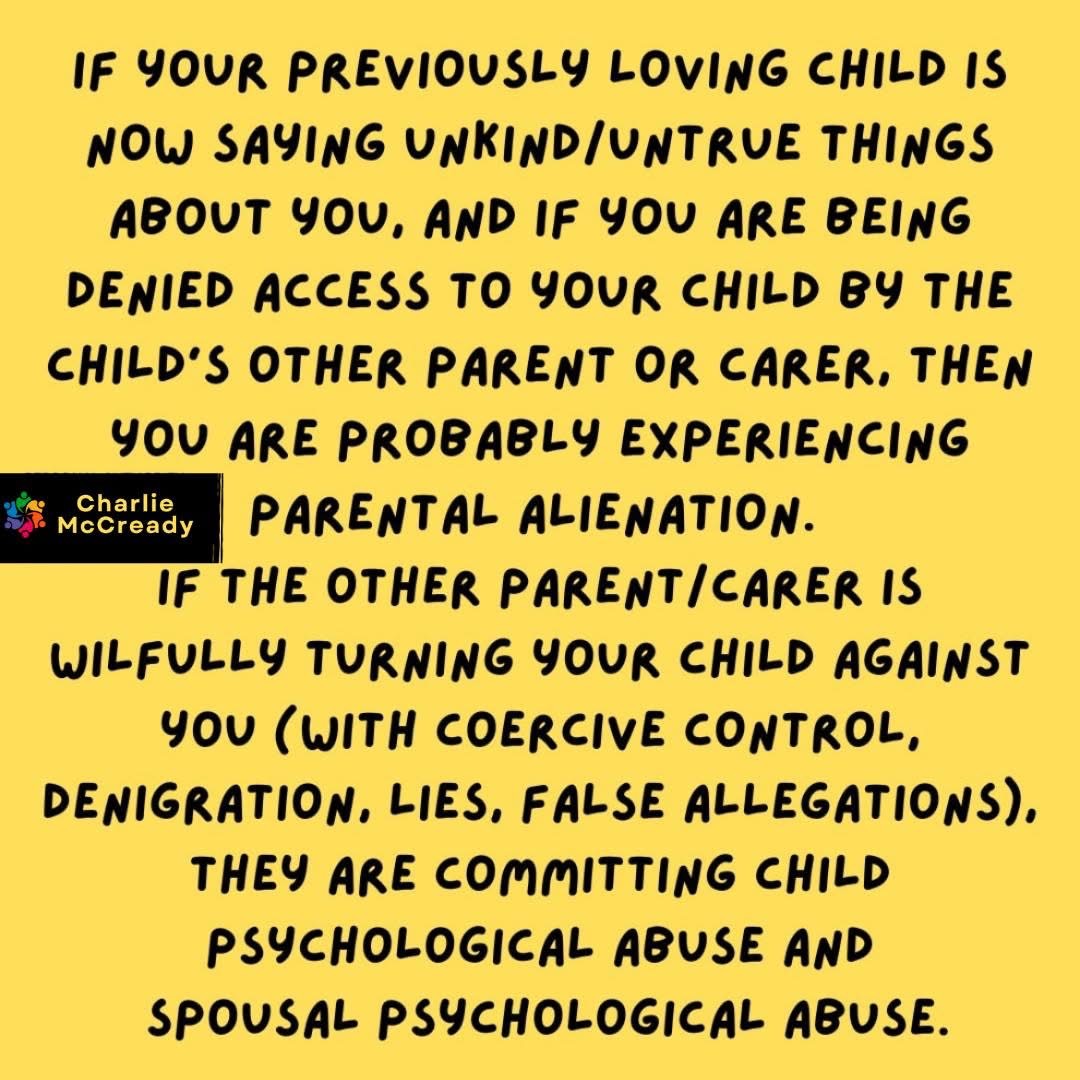
Parental alienation, often termed pathogenic parenting or an attachment disorder, encapsulates manipulative behaviours and psychological dynamics within familial relationships. A previously loving child will begin to change their behaviours, generally around the time of their parent’s separation or divorce, though it may have begun unnoticed earlier. If challenged, there will be denials by the other parent or caregiver that they unduly influence the child.

Their tactics often include coercive control, where the pathogenic parent exerts undue influence over the child through various forms of psychological manipulation (punishment/reward), intimidation, and threats. Coercive control serves to instil fear and dependency in the child, thereby undermining their relationship with the targeted parent.

Furthermore, the pathogenic parent engages in denigration, systematically disparaging the targeted parent in the child’s eyes through a campaign of lies, false allegations, and character assassination. By poisoning the child’s perception of the targeted parent, the pathogenic parent perpetuates a cycle of emotional abuse, both towards the child and the targeted parent.

Parental alienation shares parallels with Stockholm syndrome, wherein the child develops a skewed allegiance to the pathogenic parent out of fear, dependency, and perceived survival. This complex interplay of coercive control and psychological manipulation constitutes not only child psychological abuse but also spousal psychological abuse, as the targeted parent is subjected to ongoing trauma and victimization.

Parental alienation represents a severe breach of trust, perpetuating cycles of trauma and dysfunction. Recognising the insidious nature of these behaviours is crucial in addressing and combatting them, as it requires a comprehensive understanding of the underlying dynamics and a concerted effort to prioritise the well-being of both the child and the targeted parent.

#charliemccready

#parentalalienationcoach
#alienatedchild

#narcissisticabuseawareness

#narcissisticparent

Living Bereavement- Charlie McCready

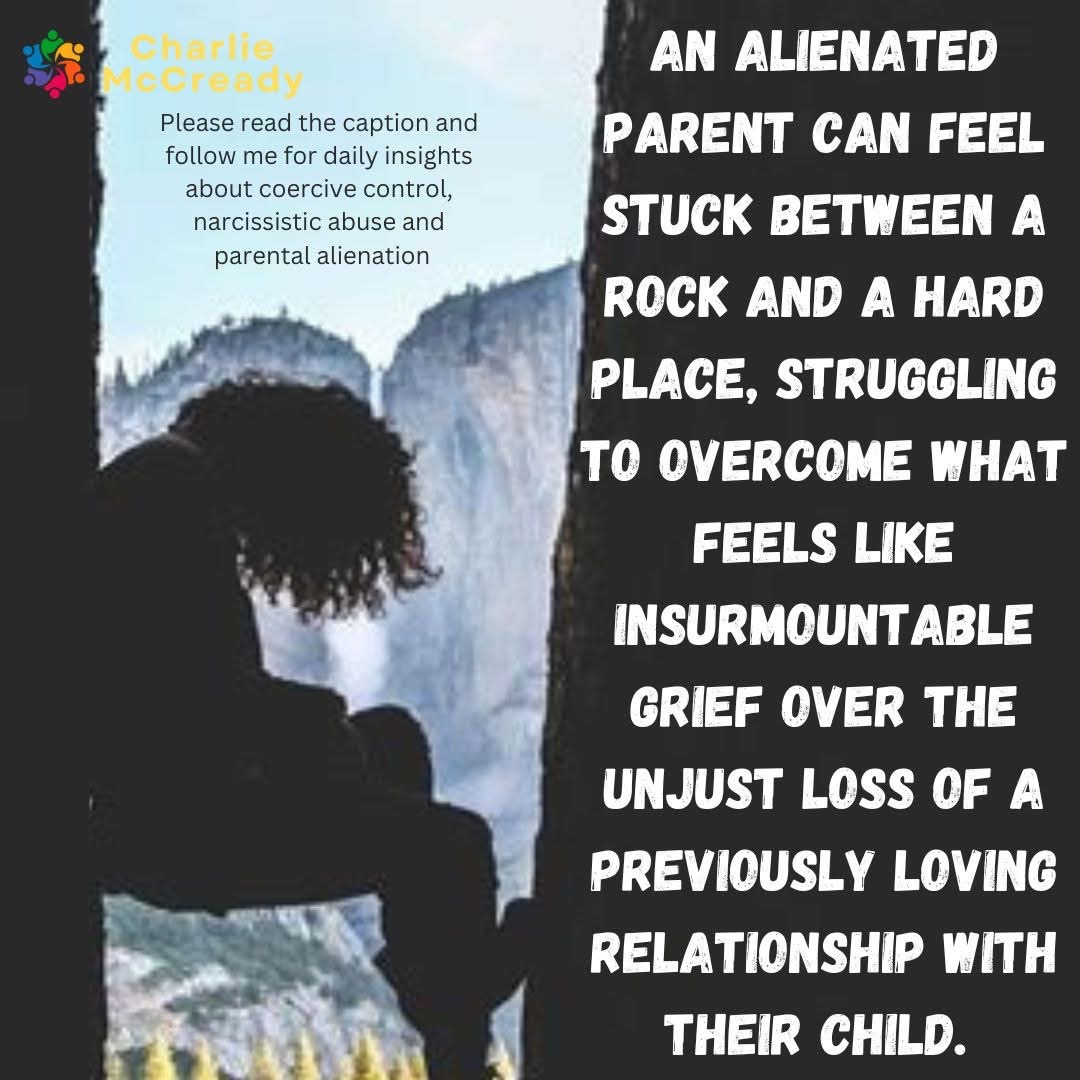
An alienated parent experiences profound emotional turmoil, feeling trapped between a rock and a hard place. They are often isolated from their child due to the alienating tactics of the other parent, which can lead to overwhelming loneliness and confusion. The deep sense of loss, akin to a ‘living bereavement’, encompasses not just the physical absence of their child but also the loss of the once-strong emotional bond. The alienated parent feels helpless, unable to protect their child from further harm, and may experience anguish and betrayal as their child parrots negative statements from the alienating parent.

To navigate this hugely difficult situation, alienated parents can seek support through counselling to express their emotions, develop coping strategies, and gain perspective. In the case of the coaching I do, I sometimes work in small groups, and I offer 1:1 coaching too. Sometimes the ‘target’ parent will be accompanied by a partner, a parent (grandparents suffer too), and I have given coaching to alienated children too. They are not always willing to talk at first, but often open up and find it is a neutral space where they can talk freely, and I can guide them towards seeing the bigger picture.

Prioritising self-care, both physically and emotionally, is crucial. Learning about parental alienation, maintaining boundaries, and considering legal recourse when necessary can empower. Focusing on reconciliation rather than retaliation when interacting with alienated children is crucial. Recognising and addressing these complex emotions is the first step toward healing and potentially rebuilding the parent-child relationship.

These daily posts are here to spread awareness, inform and (where possible) uplift. Please don’t hesitate to contact me directly if I can help you with coaching. There’s more information on my website. I am also working on a series of e-guides (downloadable online guides), the first one is available now for the price of a few coffees.

#charliemccready

#parentalalienationcoach
#highconflictdivorce

#parentalalienation

#parentalalienationawareness

Brutality of being alienated/ targeted – Charlie McCready

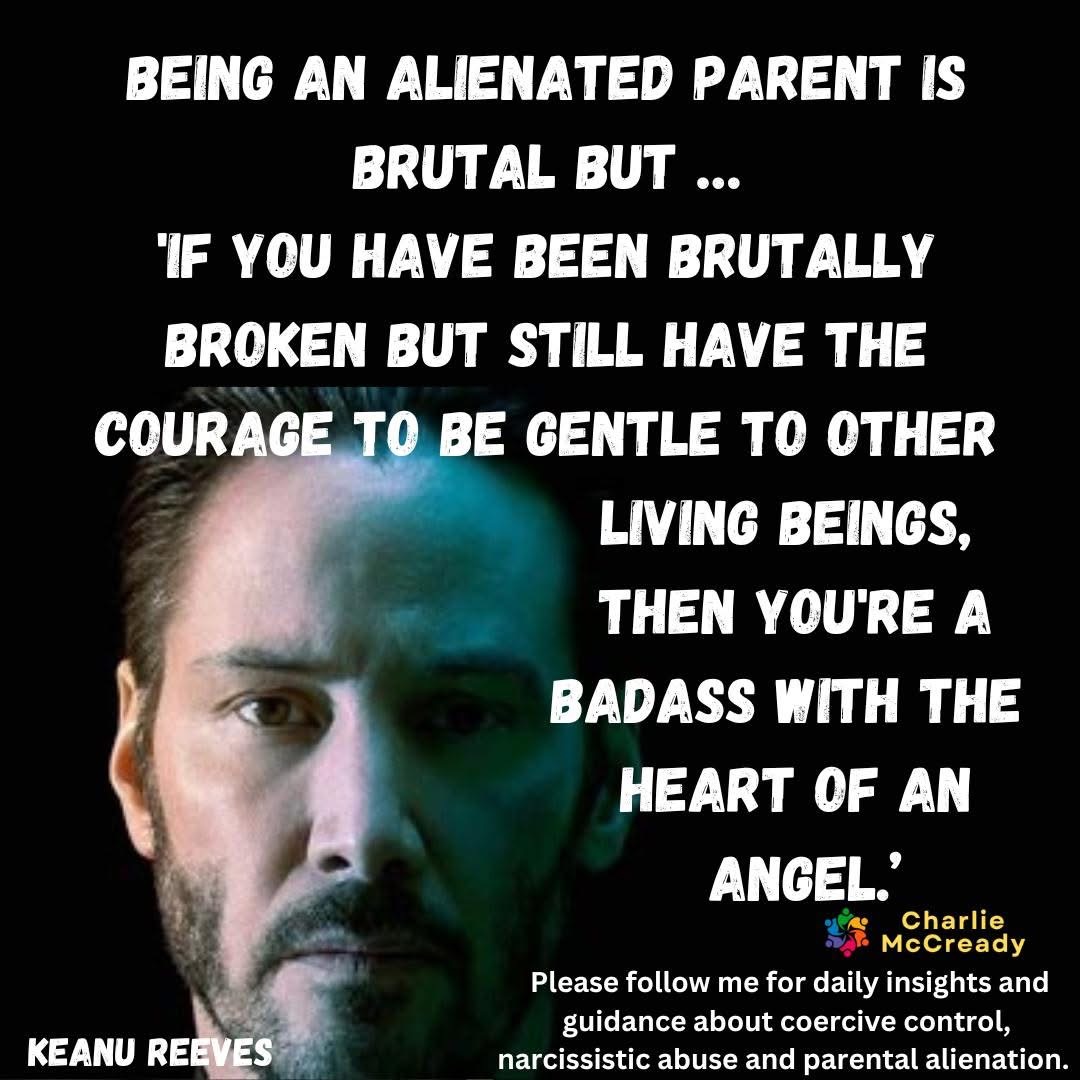
Being an alienated parent is brutal. It’s a unique trauma, leaving you caught between deep grief, searing injustice, and the unrelenting confusion of watching those who should support you turn a blind eye. It’s not just about losing a child; it’s about facing spousal or partner psychological abuse, which in turn becomes psychological abuse against your child. And despite this, if you choose to stay kind, to refuse to let bitterness corrupt you, to remain open-hearted despite your pain—that, in the words of Keanu Reeves, makes you a true badass. And I agree. ⁠

Keanu Reeves is no stranger to tragedy. Having lost his best friend, his partner, and their unborn child, he could have succumbed to bitterness and isolation. Instead, he became known for his humility, kindness, and resilience. His quote speaks to your journey, if you are an alienated parent (step-parent, grandparent, or child). Despite being ‘brutally broken’, the courage to keep showing up, offering love, and being a safe harbour for others is a powerful statement of your amazing, strong, beautiful character.⁠

In a world that often misjudges the alienated parent, where your efforts are dismissed or misunderstood, choosing to still show compassion and not lash out takes incredible strength. Like Reeves’ iconic roles, where characters break free from oppressive systems—like in The Matrix—alienated parents must summon that inner resolve, facing a relentless enemy not with anger, but with unwavering integrity.⁠

If you follow my posts, you’ll know I’m a big fan of The Matrix. I often compare the experience of an alienated child to that of being trapped in the fabricated world of the film. The alienating parent constructs an ‘unreality’ and the child is programmed to believe a distorted version of the truth. They’re caught in a world where up is down, love is hate, and rejection is loyalty. Like stepping out of The Matrix, the day they finally take their own ‘red pill’ and see the truth will be disorientating and painful. But you, standing steadfast in your love, are the lifeline they need when they’re ready to break free.

It’s the hardest path to take—to keep being gentle when the world has been anything but. Yet by doing so, you not only hold space for your child’s eventual awakening but also set yourself free from the trap of reactive anger and despair. True strength is knowing your worth without needing others to acknowledge it, and offering love without expecting anything in return.

In choosing to embody the strength and gentleness Keanu describes, you’re not just surviving—you’re transforming grief into power, and that makes you a true badass with the heart of an angel.

NB: Hollywood attracts people with talent—and a fair degree of narcissism too. Beneath the glitz and glamour, it’s a world full of manipulation, deceit, and image control. Many stories are now emerging about abuse, blackmail, and betrayal in an industry where ruthless self-interest is often the norm. While shocking, I hope this exposure is part of the detox the world needs. But even in such darkness, there are a few lights—you are one of them.

#charliemccready

#parentalalienationcoach
#alienatedchild

#narcissisticabuseawareness

#parentalalienationawareness

Lawyers & Parental Alienation- Charlie McCready

Does anyone care to comment? When I have more time, I’d like to gather more data on what alienated parents have actually experienced in the family court system. How long did it take? What was the outcome? How much money was spent? Did it lead to reunification? If the court ordered contact, was it enforced—and if so, how did that go?

Alienated parents often pour their life savings into a legal system they once believed would protect their rights and their children’s well-being—only to emerge financially drained, emotionally shattered, and, in many cases, no closer to justice.

This highlights the urgent need for reform. Lawyers dealing with these cases should be trained to recognise attachment disordered parental alienation – the false narratives and coercive, manipulative behaviours that drive it. The legal system must do better, not only for parents who are being erased from their children’s lives but, most importantly, for the children themselves—caught in a battle they never chose.

Perhaps we expect too much. Perhaps we should know better by now. After all, injustice isn’t confined to family courts or parental alienation. Look at the wider world—those who commit crimes often walk free, while those who expose them suffer the consequences. The alienated parent is no different: seeking truth in a system that too often fails to protect the innocent while enabling the abuse.

I don’t mean to sound cynical. I try to stay focused on solutions. But we shouldn’t have to ‘fight’ to see our own children in a court of justice—because we are not criminals. We are parents. Parental alienation isn’t simply a legal matter; it’s a psychological and relational issue—one that the law is often ill-equipped to handle. And for many, prolonged legal action is not only financially impossible but also emotionally destructive. While sometimes necessary, court should be a last resort, used only when every other effort to protect a child’s well-being has been exhausted.

If you are going through what’s commonly known as ‘parental alienation’, know you’re not alone. I’ve been through it myself. Personally and professionally, I have over 20 years of experience. I am reunited with my children and here to offer support with daily posts on social media and also with the coaching I offer. Feel free to reach out to me anytime.

#charliemccready

#parentalalienationcoach

#parentalalienation

#FamilyCourtReform

Parental Alienation- Dark Art / Charlie McCready

A “dark art” typically refers to a skill or practice that is secretive, manipulative, and often unethical—used to achieve a hidden or harmful agenda. Parental alienation fits this definition all too well. It is a calculated, determined, often vengeful process of coercive control, where one parent systematically turns a child against the other through psychological tactics such as outright lies and false narratives, to create a negative perception of the targeted parent.

It isn’t just about badmouthing the targeted parent. It’s about controlling what the child sees, hears, and believes. It’s about triangulation—restricting, monitoring and totally cutting off communication, distorting memories, and ensuring the child feels guilt or fear at the mere thought of loving the alienated parent. The child becomes trapped in a world where rejecting one parent feels like the only way to survive.

This level of manipulation doesn’t come from nowhere—it stems from dark personalities. Those who engage in parental alienation often exhibit traits associated with narcissistic, antisocial, or psychopathic tendencies. They lack empathy, thrive on control, and are skilled at deception. To them, the child isn’t a person with independent needs and emotions but a tool, a weapon to be wielded against the other parent. They rewrite reality, gaslight anyone who questions them, and use charm or intimidation to ensure their narrative prevails.

But the alienator’s influence doesn’t stop there. Like any master of manipulation, they extend their reach beyond the child—pulling professionals, family courts and even other family members into their illusion. Teachers, therapists, and legal authorities who should be protecting the child often become unwitting allies in the deception, reinforcing the alienation rather than challenging it. This is the true dark magic at play: turning enablers into weapons, leaving the real victims—alienated children and their targeted parents—isolated, disbelieved, and struggling against an invisible force few truly understand.

When I went through this myself, I felt utterly alone. There was little awareness, even less support. No, let’s make that zero support in my experience. That’s why, I’ve dedicated myself to helping hundreds of alienated parents navigate this traumatic situation. The fact that my work as a parental alienation coach is still so needed shows how far we have to go. Please do reach out if you’re interested in my 9-step program or 1:2:1 coaching. More and more alienated children are coming forward too, which I take to be a positive sign. Their bravery is helping validate this form of abuse.

#charliemccready

PA Psychological Abuse NOT love

A parent asked me whether a child of 12 is allowed to speak in an English family court and decide which parent they wish to live with. I answered: A 12-year-old’s wishes are considered in English family courts, though typically, they’re not allowed to speak, as it is deemed too stressful. The court weighs their views alongside factors like maturity, needs, and the broader welfare checklist, often relying on CAFCASS to communicate the child’s preferences. HOWEVER, concerns remain about how courts handle cases of parental alienation, as they may prioritise the status quo (even if detecting an attachment disorder/trauma bonding, coercive control) over addressing the negative impact of alienation, leading to unresolved co-parenting issues and unpunished false allegations. Sorry to say. ⁠

I’ve covered ‘the voice of the child’ in many other posts, but to answer more fully here: ⁠

The court will take into account the child’s preferences, but it’s not the only factor. The court considers the child’s maturity and understanding. A 12-year-old’s views are likely to be given substantial weight if the court believes the child understands the situation and the implications of their choice.⁠

Under the Children Act 1989, the court follows a welfare checklist to determine the child’s best interests. This includes factors like the child’s needs, the likely effect of any change in circumstances, and the capability of each parent to meet the child’s needs. The Family Justice System places significant emphasis on the child’s voice being heard. A child aged 12 can speak in court in England, but it is not typical. The court typically prefers other methods that are less stressful for the child. The child’s wishes are more often communicated to the court through a representative of CAFCASS (Children and Family Court Advisory and Support Service) or a similar intermediary rather than the child speaking in court. CAFCASS may speak with the child and provide a report to the court on what the child wants and what they believe is in their best interests.Ultimately, while a child can express a preference, the final decision is made by the judge, who should prioritise the child’s best interests, following the welfare checklist under the Children Act 1989.

In most countries, including the U.S., Canada, Australia, and many European nations, children’s views are considered in custody cases, particularly as they get older. However, it is rare for children to speak directly in court. Typically, their preferences are communicated through trained professionals who are tasked with representing the child’s best interests.

I’m sure you know, if you are reading this, there are significant concerns about how family courts handle cases of parental alienation. In some cases, courts recognise the trauma bond and attachment disorder associated with parental alienation, but may still choose to allow the child to remain with the alienating parent, believing that child’s expressed (though coerced) wishes, and keeping the status quo, is more important for the child’s well-being. Unfortunately, this decision often leaves a loving parent without a meaningful relationship with their child. Courts sometimes hope the alienating parent will eventually co-parent in good faith, but this rarely happens and is seldom enforced in the same way as financial obligations. Moreover, even when false allegations from the alienating parent are proven untrue, they often carry no consequences despite causing significant delays and worsening the situation for all involved.

This systemic injustice must be addressed. Parental alienation is a form of abuse that leaves loving parents without a relationship with their children and inflicts lasting harm. As more people become aware of its devastating impact, recognition of parental alienation is growing, despite pushback from those who feel angry and concerned about the increasing awareness. Just as other forms of abuse have been recognised and challenged, change is coming. Awareness is rising, and more resources are available to help those affected. The fight for justice continues, and alienated parents should know they are not alone. I’m here to help too with spreading awareness and the coaching I offer.

#charliemccready

#parentalalienationcoach
#FamilyCourtReform

#parentalalienation

#coercivecontrol

Disordered Parenting / Recovery – Charlie McCready

I hope these words, shared with permission, bring you comfort. I know how hard it is—the uncertainty, the second-guessing, replaying failed or missed moments. It’s easy to be consumed by anger, grief, and the injustice of it all. Rising above it is unimaginably hard, but your happiness matters. And there is hope. ⁠

The story of this previously alienated mother shows that even after years of alienation, reconciliation is possible. Her child’s words—acknowledging the manipulation and indoctrination – must have confirmed her worst fears. Alienation is real! But the love was always there too! They’ve just been coerced and indoctrinated into feeling they do not, or should not love us. Let this remind you: love can persist, even through the darkest times.

#charliemccready

#parentalalienationcoach
#overcomingadversity

#EmotionalAbuseAwareness

#parentalalienation

Charlie McCready-Alienating any threat to their ego, hidden agenda & control

Parental alienation involves psychological abuse, and coercive control. It involves dark dynamics where people, often driven by insecurity, unresolved trauma, narcissism, attachment disorders (and more), resort to manipulation and cruelty to maintain dominance.

In these toxic relationships, some perpetrators perceive their victims as threats to their control, ego, or hidden agendas. This perception becomes the breeding ground for intensified abuse and manipulation. The more control slips through their fingers, the more they tighten their grip, all driven by the irrational fear of losing what they believe is rightfully theirs. Or wishing to punish.

And when victims, often after enduring prolonged suffering, gather the courage to sever ties with their oppressors, the reaction is often volatile. Furious at the prospect of losing their grip on power, the perpetrators retaliate with even greater ferocity. They see the victim’s actions as challenging their supremacy and respond by escalating the abuse, seeking to reassert their control.

This vicious cycle perpetuates the suffering of those ensnared within it. Victims find themselves between the desperate need for liberation and the dread of the backlash they may face when attempting to break free. The emotional scars from these abusive relationships can run deep, and the healing journey can be long. It’s incredibly helpful to surround yourself with people or be in communities where others understand what you’re going through. You can find strength in understanding the pathology and knowing you are not alone. You can reclaim your life. And so can the children.

#charliemccready

#parentalalienationcoach
#mothersmatter

#FathersMatterToo

#FathersMatter

#overcomingtrauma

Charlie McCready – Surviving Child Psychological Abuse

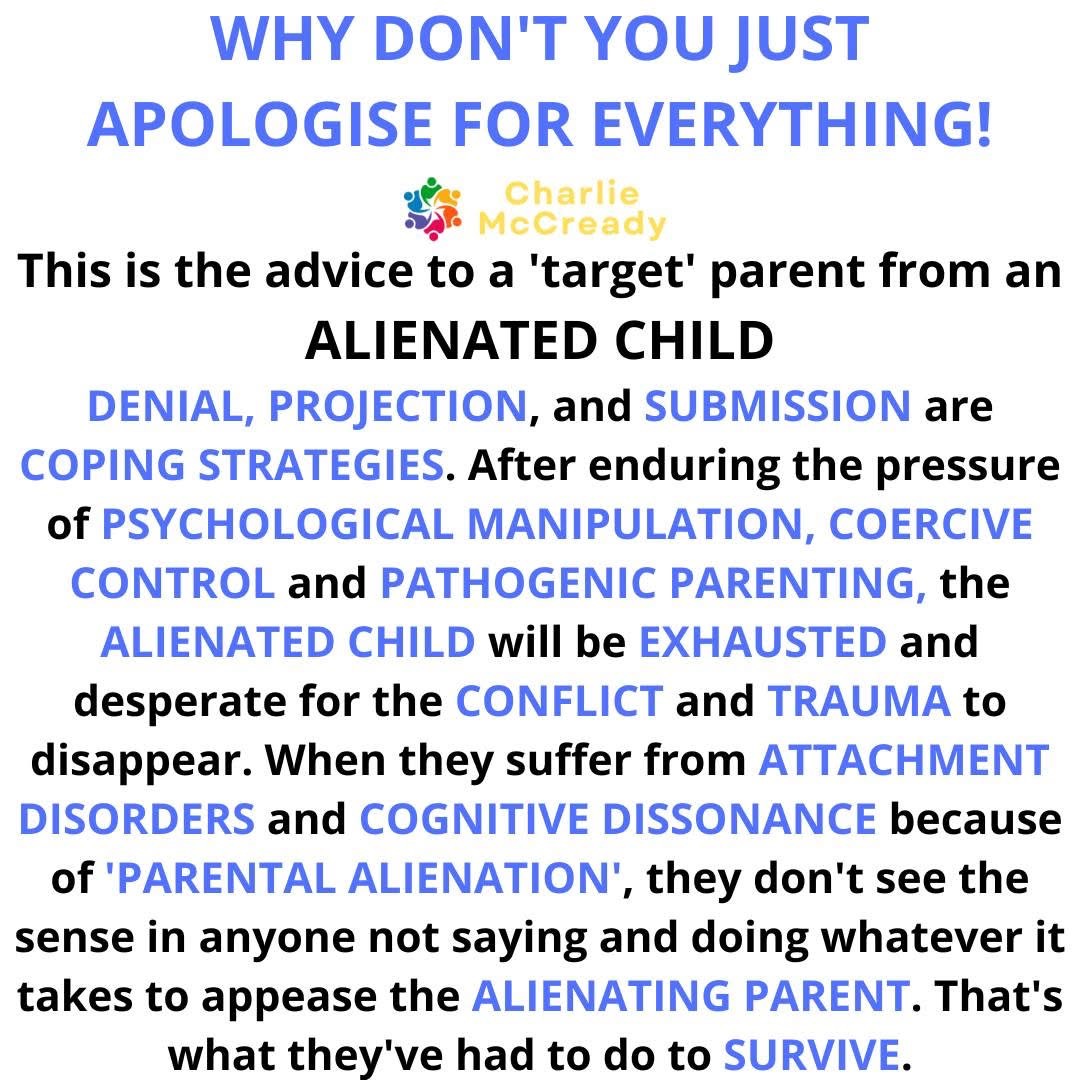
This question to a ‘target’ parent from an alienated child sounds like a desperate plea: “Why don’t you just apologise for everything?” After enduring relentless psychological manipulation, coercive control, and pathogenic parenting, the alienated child is left emotionally drained and yearning for peace. Denial, projection, and submission may become their coping mechanisms as they struggle to navigate the toxic dynamics imposed upon them. The child may become parentified because of the infantile behaviour of their alienating pathogenic parent whose psycho-emotional needs demand obedience, unquestioning loyalty, and sacrifice. The needs and wishes of the parent are prioritised over those of the child, and justifications and excuses on the hero/victim theme will be employed. In the grip of attachment disorders and cognitive dissonance, the child finds it increasingly difficult to resist the demands of the alienating parent.⁠

This is a relationship that’s based on fear, intimidation, bribery, threats, and control but with enough promise of love and care to keep them stuck and hoping for better. The emotional manipulation involves gaslighting, blameshifting and guilt-tripping. The trauma bond created by this kind of disordered, abusive (often narcissistic) parenting creates an experience for the child akin to that of Stockholm Syndrome, entrapping the child in a cycle of fear, intimidation, and control. Despite the toxicity of the relationship, the entrapment becomes thought of as safer than the alternative (freedom) and it can lead the alienated child to defend and protect their aligned parent even when things don’t really make sense (cognitive dissonance). Their compliance comes about through a longing to fix things and for love and survival (identification with an aggressor).

They become so accustomed to placating the alienating parent that they cannot comprehend why the ‘target’ parent resists. Also, all wrongs have been projected onto the ‘target’ parent. In their quest for survival and a semblance of normalcy, they can become so accustomed to submitting and placating the domination, tantrums, drama and conflict that often surrounds the alienating parent, they think it’s easier for the ‘target’ parent just to capitulate as they do, and apologise for everything, believing this will bring an end to their suffering.

However, I’m sure you know, as an alienated parent, surrendering to manipulation is not the solution. It doesn’t end there. It (typically) just continues. The children should know this too, but it’s hard for them to ‘break free’ from the coercive control and psychological abuse inflicted on them. But we can show them. Maintaining integrity, being non-reactive, creating boundaries, and refusing to apologise for injustices we did not commit, we can show our strength, and show our children the way towards healing and liberation from the trauma bonds.

#charliemccready

#parentalalienationcoach

#traumabonding

#coercivecontrol

#narcissisticparent