Love is Love – Charlie McCready

Grief and loss are heavy, and we feel like we’re only half-alive, barely observing a world carrying on without us, as we’re without the ones we love. It’s an abyss, and incredibly hard to see anything good. The trouble with this is that it’s self-fulfilling and keeps us stuck. It’s more a prison than an abyss. There is an escape route, in fact, the door is open, we can leave whenever we choose. Sometimes we don’t want to leave, we want to stay in our grief. It feels like we’re keeping the love close, to feel the pain of the love that was close. But we can connect in a much better way. We can connect with good feelings. With alienation, the intention is to hurt us. Often (not always), these are hurt people hurting others. We deserve better than that. We are not victims, we have just been caught up in the pathology, as have our children. But we do ourselves a disservice to be stuck in the pathology (which was its intention) and our children too. To see us beaten and hurt doesn’t help them. In fact, it might make them feel worse – guilt, shame, anxiety. All these are negative feelings and no good for any of us. Breathe. Be calm. Focus on what is good in your life. Focus on happy memories if you must look back, but try to be present. There is still love. In small kindnesses from others, and from the kindness you give others. In so many ways. Life is a gift. You are in charge of how you feel. So, try to feel good today, and the next day, and the next. If you have angry thoughts about a situation or person, refocus your mind. Listen to some music that lifts your mood, watch a comedy sketch, call a friend, walk in nature … lift your mood. If you don’t feel that great about the future, make yourself a coffee and take a moment just enjoying that, clearing your mind. It’s a discipline, but it’s also self-love. Love is love. Choose love. Choose loving thoughts as much as possible. Then you open the door to a better frame of mind, a better day, a better life. One day at a time.

#charliemccready

#parentalalienationcoach

#healing

#overcomingadversity

Craig Childress PsyD- BPRS

Heads up – incoming.

You will want to familiarize yourself with a rating scale: the Brief Psychiatric Rating Scale (BPRS), “one of the oldest most widely used scales to measure psychotic symptoms.”

Wikipedia BPRS
https://en.wikipedia.org/wiki/Brief_Psychiatric_Rating_Scale

The professional article is online and provides the BPRS manual of anchor points for 24 symptoms.

BPRS Article & Manual
https://www.researchgate.net/publication/284654397_Brief_Psychiatric_Rating_Scale_Expanded_version_40_Scales_anchor_points_and_administration_manual

The items of primary relevance are 9) Suspiciousness and 11) Unusual Thought Content (delusions). The clinical concern is for a possible persecutory thought disorder (in the allied parent transferred to the child; i.e., a shared/induced persecutory delusion).

I will be recommending that the BPRS rating scale be applied in all child custody conflicts involving severe attachment pathology displayed by the child (i.e., a child rejecting a parent).

I recommend BPRS ratings for items 9) Suspiciousness and 11) Unusual Thought Content (delusions).

I also recommend BPRS ratings for 3) Depression (grief response), 2) Anxiety (phobic response), 6) Hostility (anger response), and 20) Uncooperativeness.

We need to get clarity on the child’s symptoms. We accomplish that by using a reliable symptom documentation instrument, i.e., the BPRS.

You’ll begin to hear me reference the BPRS. You should familiarize yourself with the anchor points for the relevant sub-scales of 9) Suspicousness and 11) Unusual Thought Content (delusions).

As a lay person, you can apply the anchor points to the child’s symptom presentation to indicate your perspective and reporting on the child’s symptoms.

However, ultimately we will want a formal mental health assessment of the child’s symptoms using the BPRS to anchor our understanding for the nature, scope, and severity of the child’s symptom presentation.

Craig Childress, Psy.D.
Clinical Psychologist
WA 61538481
OR 3942 – CA 18857

The Alienating Parent thinks they are a good person

Abusive people who lie, cheat manipulate, and hurt others with impunity, and no accountability or guilt, sometimes actually think of themselves as victims. No matter how badly they treat people, it’s not their fault. It’s your fault. In fact, the problem probably started when you started noticing their abuse. And to add to this problem, the fact they get away with their abuse, without facing punishment or consequences, the fact they can carry on, in their minds, justifies their behaviour. The alienating parent often genuinely believes they are right and good. Wow!

The concept of cognitive dissonance can help us get our heads around this. To resolve any discomfort from being ‘in two minds’, people tend to either adjust their beliefs or justify their actions. The alienating parent may engage in self-justification, convincing themselves that their actions are for the child’s well-being. They may genuinely believe that they are protecting the child from the other parent’s perceived harm or influence. This self-justification can lead them to see their behaviour as morally justified. They also often adopt a victim mentality, perceiving themselves as hard done by or failed or hurt in the past, and this somehow excuses/accounts for their current behaviour. It can also lead them to cast blame on you. It is a way of deflecting responsibility. They deny and project their negative qualities onto you, rather than face their own flaws and shortcomings. Some alienating parents lack self-awareness and may not recognise the harm they’re doing to their children. The alienating parent typically resists counselling or any situation where they may have to confront their behaviours, and in this way, they can carry on in their belief that they are right, and you are wrong.

While I hope this explanation helps shed light on the mindset of abusive or alienating individuals, it does not justify, excuse or condone the harm they cause to others, especially children caught in the middle. My wish is that if you understand these psychological dynamics, it can be enlightening, even empowering, enabling you to navigate the situation with more clarity and compassion, both for yourself and for your child. Most importantly, know that you are not alone, and there is hope for positive change. The love and bond you share with your child can endure, even in the face of alienation. Stay resilient, focus on your child’s well-being (where you can), and yours too, and believe in the possibility of reunification and healing in the future. Your unwavering love and commitment can significantly impact your child’s life. Strive to be happy.

#charliemccready

#parentalalienationcoach

#alienatedparent

#FamilyCourt

#parentalalienation

April Fools – Charlie Mc Cready

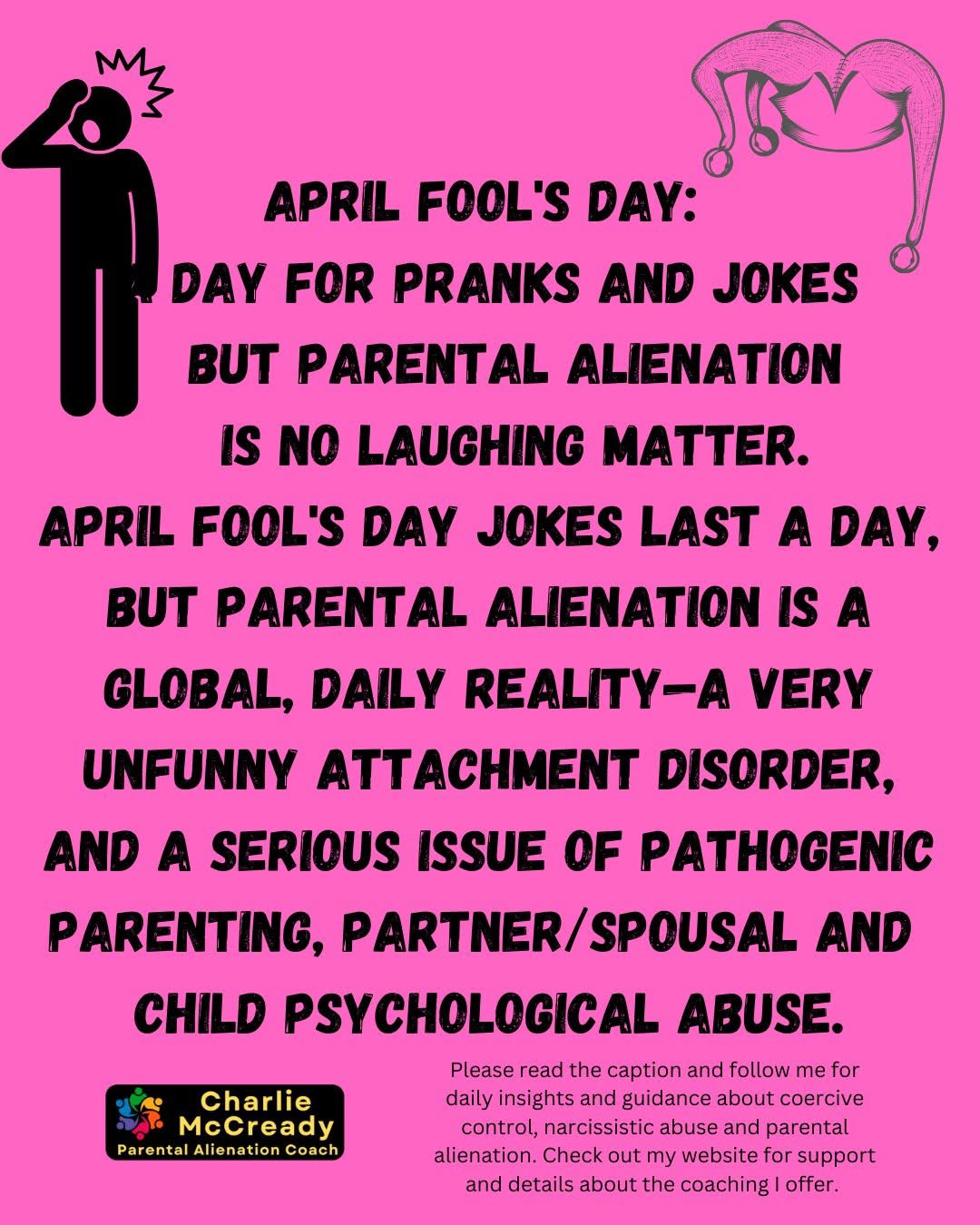
April 1st is a day marked by pranks and jokes, a time for lighthearted fun. But there’s nothing amusing about the widespread misunderstanding, misdiagnosis, and denial of parental alienation—a serious attachment disorder caused by pathogenic parenting. This form of partner/spousal psychological abuse and child psychological abuse is too often overlooked or underestimated, as children are manipulated into rejecting a loving, non-abusive parent. While April Fool’s Day jokes may be forgotten by the end of the day, the damage caused by this unrecognised emotional abuse (commonly known as ‘parental alienation’) lasts far longer. The cost of ignoring it is no joke—and its impact is anything but harmless.⁠

If you are going through parental alienation, know you’re not alone. I’ve been through it myself. Personally and professionally, I have over 20 years of experience. I am reunited with my children and here to offer support with daily posts on social media and also with the coaching I offer. Feel free to reach out to me anytime.⁠

#charliemccready

Watching your child love your abuser

There’s a pain not many people talk about—

Watching your child light up for someone who once dimmed your entire soul.

They laugh with them.

Hug them.

Draw pictures for them.

And you smile. You nod. You support the relationship because you know—deep down—your child deserves love from both parents.

But inside?

It hurts.

Because you remember the manipulation.

The gaslighting.

The tears you cried behind closed doors.

The way you used to shrink yourself to survive in a love that was never safe.

And now that person—

The one who tore you apart in quiet, calculated ways—

gets to be the “fun parent,”

the highlight reel,

the weekend hero.

You don’t want to poison your child’s view.

You don’t want to project your pain.

So you carry it.

Quietly.

Gracefully.

Alone.

And still—you show up.

You show up to parent-teacher conferences, to exchanges, to birthdays, to moments that require more emotional strength than anyone sees.

Because you know love isn’t proven by being loud.

It’s proven by staying steady.

And even when it breaks your heart,

you choose your child’s peace over your own pride.

But that doesn’t mean it’s easy.

It means you’re doing something most people couldn’t.

You are healing in real time—

While sitting across from the person who once broke you,

And choosing, every single day, to not let that brokenness touch your child.

And that, mama, is power.

Fear your children believe they stayed attached Narcissist

When You’re Afraid Your Child Will Believe the Narcissist’s Version of You

There’s a fear that keeps you up at night.

Not the fear of doing this alone.

Not even the fear of starting over.

But the fear that one day… your child will believe the version of you that the other parent has created.

The exaggerated stories.

The twisted narratives.

The subtle digs disguised as jokes.

The lies wrapped in just enough truth to sound believable.

You hear your child repeat things you never said.

You see the hesitation in their eyes, wondering who to trust.

And it breaks something in you.

Because you’ve spent years becoming the parent you needed. You’ve poured your whole heart into showing up with honesty, grace, and consistency. And still—there’s this ache… that all of that could be undone by someone who’s more interested in control than connection.

But here’s what’s true:

Time tells the truth.

Your child may not see it now.

They may be swayed by charm or confusion or fear of upsetting the wrong person.

But one day, they’ll notice.

They’ll notice who picked them up on the hard days.

Who listened instead of lectured.

Who stayed soft when it would’ve been easier to shut down.

They’ll see the difference between love that performs and love that protects.

So keep going.

Keep showing up with steady love and quiet truth.

You don’t have to fight for your child’s loyalty—just be the safe place they’ll always come back to when the masks fall.

And when they ask the hard questions later?

You’ll have something the other parent never will:

A clear heart and a life that proves your love.

Family Court – Sharon Stone’s experience/ Charlie McCready

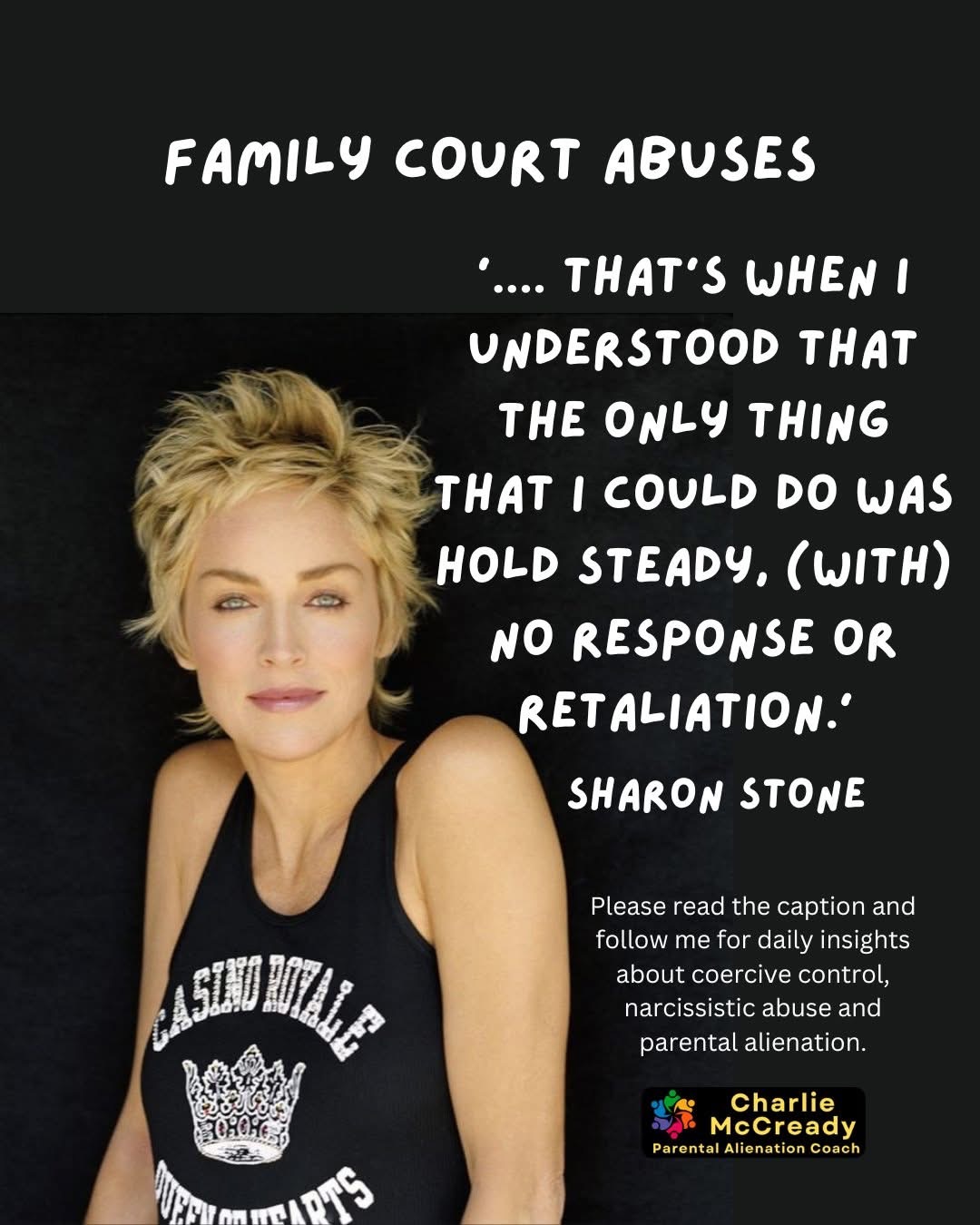
Sharon Stone said during an interview with Bruce Bozzi on his Table for Two podcast that she believes she lost custody of her son because of a ‘kind of abuse by the (family court) system.’ And, in a Saturday Times article, Jan 2024, Sharon Stone talked about how, in 2008, she lost custody of her son, Roan, then 8, whom she shares with Bronstein, after a four-year custody battle following their divorce. She said, ‘… I had envy. Envy of the way they manipulated the court system. And envy is a deeper thing than jealousy. It’s dangerous. It’s in your bones …’ She sees it as the worst period of her life. ‘I was trying to recover from a nine-day brain bleed … and then someone takes your kid … and then they continued by trying to take my reputation ….’ The judge asked her young son, ‘Do you know your mother makes sex movies?’ She says of that horrific experience: ‘And that’s when I understood that the only thing that I could do was hold steady, (with) no response of retaliation.’

I often write about this non-reactive response in posts. It’s difficult because the provocation is immense, the injustice and grief almost unbearable. But the problem is that if we react negatively (in anger or in-kind), the focus is directed to that rather than the root cause of the problem. The alienating parent then sits back and says, ‘See!’

I hope it’s true her son has now changed his name from Roan Bronstein to Roan Joseph Bronstein Stone. Thanks to Sharon Stone for sharing her story and spreading awareness about spurious, devastating family court rulings.

#charliemccready

#parentalalienationcoach

#parentalalienationawareness

#FamilyCourtCorruption

#familycourt