Craig Childress PsyD ParentChild Contact Problems

If a psychologist uses the terms – “parental alienation” – “resist-refuse dynamic” – “Parent-Child Contact Problems” – they are ignorant – they lack knowledge or information.

Google ignorant: lack of knowledge or information

The reason they have to use made-up pathology labels is because they are ignorant about real things – they are awful psychologists – ignorant like a rock.

It’s the trans-generational transmission of trauma. It’s child psychological abuse (DSM-5 V995.51). It’s attachment pathology, a problem in love-and-bonding. It’s spousal abuse using the child as the weapon (DSM-5 V995.82). It’s a cross-generational coalition and emotional cutoff (Minuchin, Bowen, Haley, Madanes; family systems). It’s a shared (induced) persecutory delusion (DSM-5 297.1). It’s a false (factitious) attachment pathology imposed on the child for secondary gain to the allied parent (FDIA: DSM-5 300.19).

There’s a lot of things it is – real things – diagnosable and treatable things.

Unless… you don’t know what those things are. If you lack knowledge and information about real things, you have to hide your ignorance behind things you simply make-up – like “parental alienation” – “resist-refuse dynamic” – “Parent-Child Conflict Problems.”

Here’s a tip… if a pathology exists ONLY in the family courts, it’s not a real pathology. Use the DSM-5 to identify (diagnose) pathology. Start there.

DSM-5 297.1 Delusional Disorder (shared); persecutory type.

DSM-5 300.19 Factitious Disorder Imposed on Another

DSM-5 V995.51 Child Psychological Abuse

DSM-5 V995.82 Spouse or Partner Abuse, Psychological

Start with applying the established knowledge of the DSM-5 diagnostic system to identify (diagnose) what the problem (pathology) is.

If you still need new forms of pathology to explain what the pathology is – then – and only then – propose your new “resist-refuse dynamic” as a new pathology unique in all of mental health.

After applying the DSM-5. Not before. Not instead of. After applying established knowledge. Start with the DSM-5.

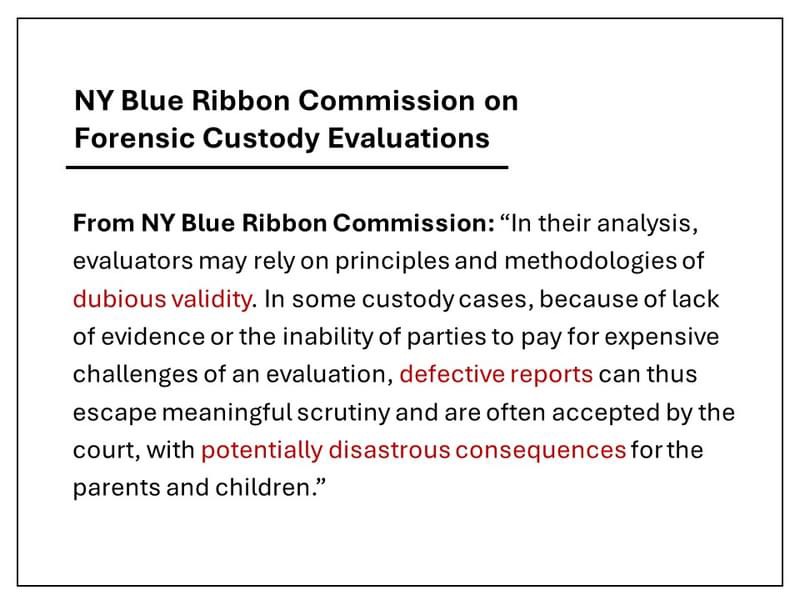
We need standards – forensic custody evaluators are the worst psychologists imaginable – ignorant like a rock.

It’s a “tell” on professional ignorance. If the professional has to use made-up pathology labels… they lack knowledge or information… they are ignorant by definition of the English language.

If you, the patient, have to explain the pathology to the doctor, the doctor lacks knowledge or information… they are ignorant by definition of the English language.

How did you wind up with so many ignorant and incompetent doctors in the family courts? Just lucky?

Luck had nothing to do with it. They were allowed to experiment on you and your children with a new assessment approach they call a “forensic custody evaluation” – it was a complete failure.

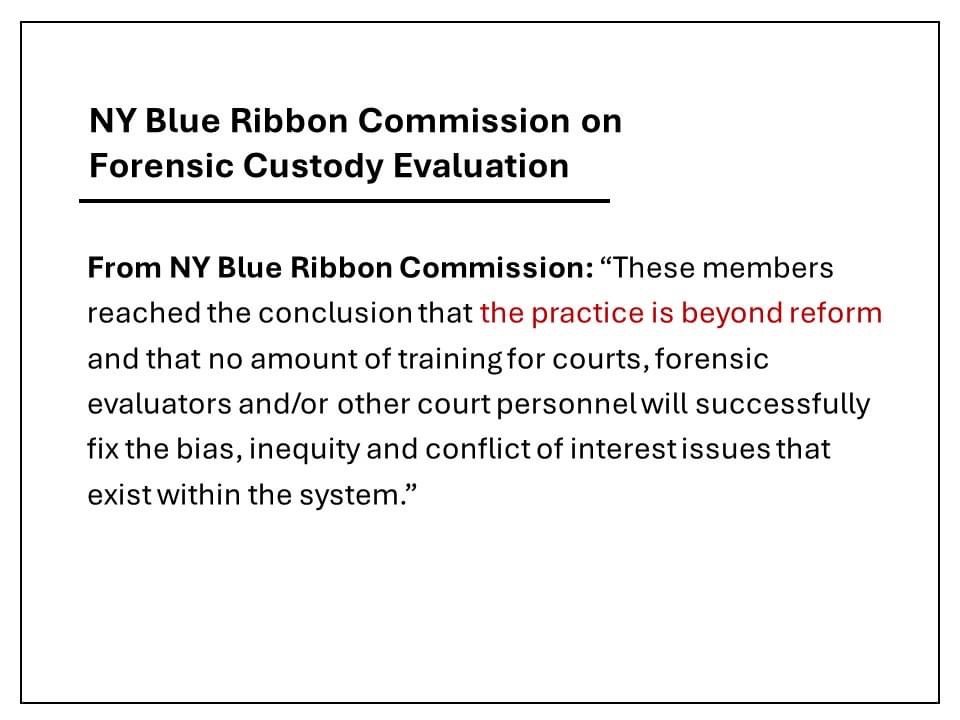
Their experiment failed. They left the practice of healthcare to enter a quasi-judicial role. That was a wrong thing for doctors to do.

The gave themselves permission to make up an entirely new type of assessment – not a diagnostic assessment as is done in all the rest of healthcare – the forensic psychologists decided to do something… different.

Clinical psychologists identify (diagnose) what the problem is and then they fix the problem (treatment).

Forensic custody evaluators do something different. They DON’T identify (diagnose) what the problem is and they DON’T fix it (treatment).

That is different – NOT to identify the problem and NOT to fix the problem IS different than what other doctors do, that’s for sure. It’s also entirely worthless.

Clinical psychologists diagnose child abuse when it is present, and clinical psychologists protect the child.

Forensic custody evaluators do something different. They DON’T diagnose child abuse when it is present (they don’t diagnose anything) and they DON’T protect the child from child abuse.

That too, is different – and dangerous to children.

They experimented on you and your children with a new approach to assessment and service delivery… for you alone. Their experiment failed – miserably failed – completely failed.

As a result of their failed experiment, the lives of thousands and thousands of children and parents were irrevocably destroyed.

While the forensic custody evaluations made money – lots of money – from their failed experiment on you and your children.

Did they tell you it was an experimental approach? Did they tell you that you had an alternative, a clinical diagnostic assessment of the problem? Or did they ONLY offer you ONE choice, their experimental approach to assessment that they simply made-up?

The forensic custody evaluators withheld clinical diagnostic assessments from the courts and parents – giving courts and parents ONLY one choice – their experimental approach to assessment… that they simply made-up.

It failed.

Lives – children’s lives – were irrevocably destroyed as a result.

Why were they allowed to experiment on children and parents?

Why are they allowed to continue?

They are ignorant, incompetent, and unethical. They are the worst psychologists imaginable… and they are all you have. How did you get so lucky?

Why are you the only parents for any pathology who must educate your doctors about what the pathology is?

Craig Childress, Psy.D.

Clinical Psychologists, CA PSY 18857
Targeted Parents / Charlie Mc Cready

As an alienated parent, you might be up against manipulative tactics that encourage your child to engage in behaviours you find unacceptable, especially when it involves badmouthing and rejecting you. The alienating parent often uses these tactics to curry favor, painting themselves as the ‘good’ parent in contrast to your ‘strict’, ‘old-fashioned’ or ‘uncool’ demeanor. This manipulation is not in the child’s best interest. In a healthy co-parenting arrangement, both parents work together to teach their children the right way to treat others and navigate life. Unfortunately, in cases of parental alienation, this collaboration is absent.

Parenting an alienated child requires a counterintuitive approach. It’s natural to want to defend yourself against constant criticism, but your actions speak louder than words. If ever, and whenever you have time with your child, focus on making them feel loved, supported, and safe. Let them feel heard. If they cross boundaries, gently but firmly remind them: “That isn’t a nice thing to say,” “That isn’t true,” or “Remember the rules in my house, please.” Maintain these boundaries with a light touch, drawing a line in the sand while staying strong and loving.

Showing up with love, kindness, and a positive attitude is crucial. Make your time with your child joyful and free of negativity and confrontation. When they leave their time with you feeling loved and happy, they will be more likely to want to spend time with you again. This positive experience can help them question the alienating parent’s narrative and see through the manipulation.

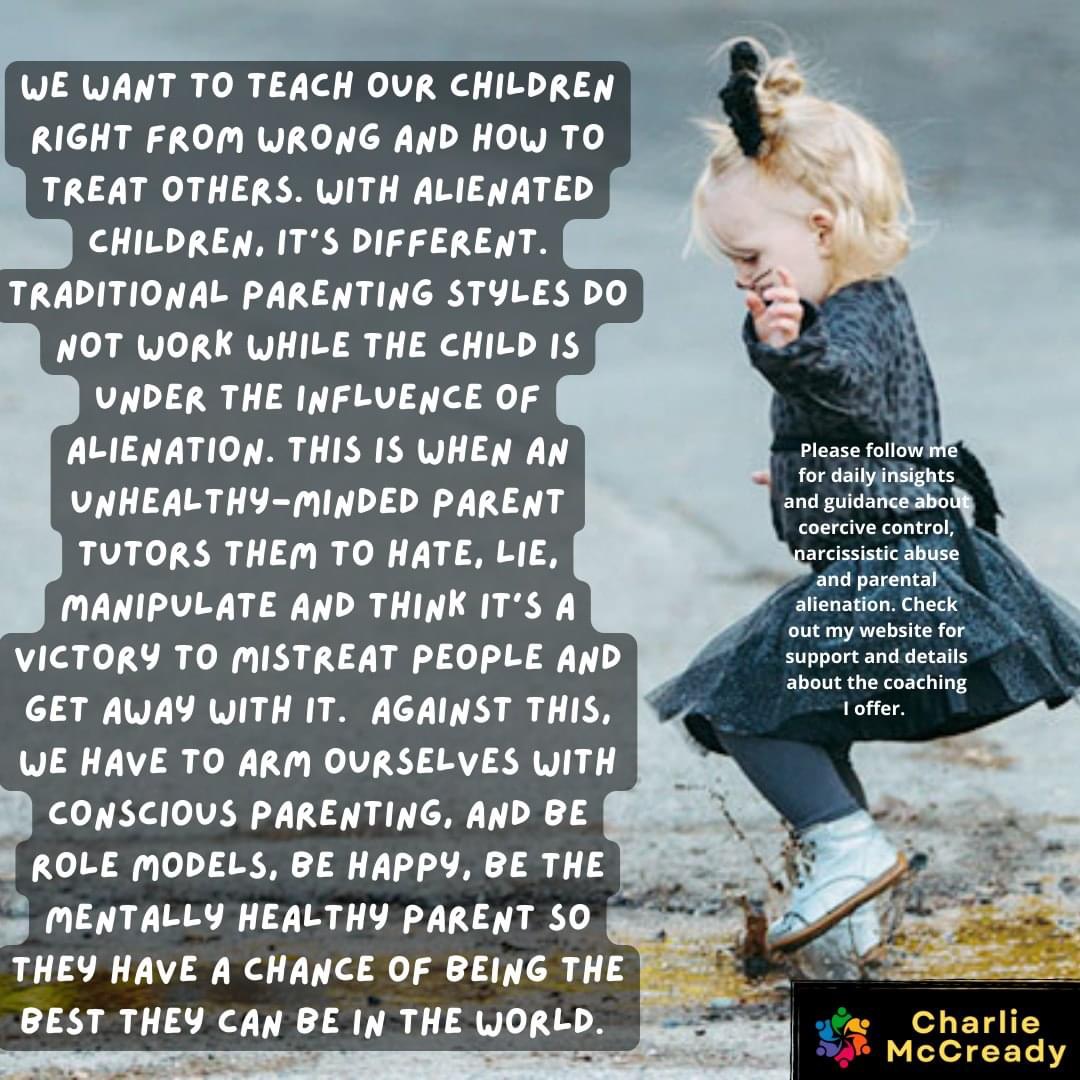
Traditional parenting styles often do not work with alienated children because the natural attachment bonds with your child are under attack. You are effectively parenting with your hands tied. By adapting your approach, arming yourself with conscious parenting, and being a role model of mental health and happiness, you give your child the best chance to resist the negative influence of the alienating parent and develop into their best selves.

#charliemccready

#parentalalienationcoach

#parentalalienation

#parentalalienationawareness

#consciousparenting

#narcissisticparent

#FathersMatter

#mothersmatter

#childcustody

Enablers of Psychological Abuse in PA cases

The alienating parent often deludes even seasoned professionals. Their convincing presentation of events, coupled with their projection of all wrongdoing onto the targeted parent, can lead professionals to overlook the true dynamics at play. Furthermore, the weaponization of children by the alienating parent exacerbates the complexity of the situation. Indoctrinated and manipulated, the children become unwitting accomplices in the alienation process, aligning themselves with one parent while turning against the other. Professionals often tend to prioritise the perspective of the alienated child, failing to recognise the coercive control and psychological abuse they have been subjected to. In many cases, professionals focus on the false allegations and fabricated stories rather than scrutinising the person who is refusing to co-parent and collaborate and who is, in reality, inflicting the harm and perpetuating the alienation. This can usually be attributed to a lack of understanding and training in identifying and addressing parental alienation. Not to mention that many professionals in these fields are often overworked, underpaid, and understaffed, further hindering their ability to address complex family dynamics adequately.⁠

It’s critical to acknowledge that parental alienation constitutes a form of familial abuse characterized by coercive control, psychological manipulation, and long-lasting harmful effects on children. This includes spousal psychological abuse directed towards the targeted parent and child psychological abuse inflicted through manipulation and coercion by the alienating parent. Leaving a child in the care of an alienating parent who engages in such abusive behaviour is itself abusive and perpetuates the cycle of harm. Failure to recognize and intervene in cases of parental alienation not only harms the targeted parent but also perpetuates the horrendous psychological abuse inflicted upon the child. We need systematic change. ⁠

#charliemccready #9StepProgram #parentalalienationcoach #parentalalieantionischildabuse #parentalalieantionischildabuse #parentalalienationawareness #parentalalienationisreal #parentalalienation #highconflictcoparenting #coparenting #coparentingwithanarcissist #CoParenting #highconflictdivorce #divorce #familylaw #familycourt #childabuse #narcissisticfather #narcissisticmother #narcissisticparent #narcissticabuserecovery #narcissist #narcissists #narcissisticabuseawareness #narcissisticabuserecovery #narcissisticpersonalitydisorder #narcissisticpersonality #alienatedchild #narcissism #narcissismawareness #alienatedmother #alienatedfather #alienated #alienatedparent

Jealously , Fear & Control of the Vengeful of the Alienator

The jealousy of the alienating parent often arises from their sense of insecurity and fear of losing the child’s affection. They harbour an irrational belief that the child’s love for the other parent diminishes their own importance. This fear of being replaced or marginalised triggers a toxic response, leading the alienating parent to resort to manipulative tactics.⁠

The alienating parent’s jealousy is often masked as concern or protectiveness, veiling their actions under the guise of love. They convince themselves that by severing the child’s bond with the targeted parent, they are protecting the child from perceived harm or influence. In their distorted view, they justify these harmful behaviours as acts of love, even though, in reality, they are causing significant emotional harm to the child.⁠

This jealousy-driven pathology fuels the alienating parent’s determination to annihilate the parent-child relationship in any way possible. They employ various techniques, such as spreading false narratives, denigrating the targeted parent, and manipulating the child’s emotions, all with the goal of eroding the child’s trust and affection for the other parent. This jealousy often leads to a power struggle within the alienating parent, where their need for control overrides the child’s well-being. The alienating parent’s inability to cope with their jealousy and fear results in a destructive cycle where the child becomes trauma-bonded, a pawn in their emotional battles.⁠

We need to spread awareness about alienating behaviours. We need psychological intervention and legal support to break the toxic cycle and safeguard the child’s emotional and mental well-being. It needs to be recognised as early as possible because once the child is alienated, they become entrapped in the pathology and unnaturally aligned with one parent against the other. It is really quite tragic because they would benefit from NOT alienating themselves from a parent who loves them, and who they do love (but are not allowed to love as part of their allegiance to the alienating parent) and who they would benefit from not alienating themselves from – more than they know. ⁠

#charliemccready #9StepProgram #parentalalienationcoach #parentalalieantionischildabuse #parentalalienationawareness #parentalalienationisreal #parentalalienation #highconflictcoparenting #coparenting #coparentingwithanarcissist #highconflictdivorce #divorce #familylaw #familycourt #childabuse #narcissisticfather #narcissisticmother #narcissisticparent

#narcissisticabuseawareness #narcissist #narcissists #narcissisticpersonalitydisorder #narcissisticrelationship #narcissisticabusesurvivor #narcissism #narcissismawareness #alienatedchild #alienatedmother #alienatedparent #alienatedfather #alienatedparent #alienated

Estrangement -PA / Charlie McCready

It’s such a ‘handle with care’ situation and often counterintuitive. But some alienated children aren’t ready to be ‘love bombed’, and sometimes the most innocent and casual contact can be twisted out of shape into ‘harassment’. This is shocking because we almost don’t recognise the child they’ve become, and the rejection is painful. We also know this is not their authentic selves. The dynamics between the alienated child and the rejected parent become incredibly complex and sensitive. Every case is unique, and individual circumstances may vary, but although we want to put things right, tell our truths, and we want to reunite and be happy with them in our lives again, we have to be so patient, and approach with empathy and caution. Some children respond to contact, or the idea of reunification, with anger. There’s a ton of guilt there. There are loyalty bonds with the ‘aligned’ parent, the lies they’ve swallowed whole, and the deeply ingrained beliefs and narratives that have been instilled in them.

It’s important to recognise that expressing love and a desire to reconnect with the child can also plant a seed of hope and may eventually have a positive impact. Over time, consistent and genuine efforts to maintain a loving connection can help the child start to question their cognitive dissonance with the alienating narratives and make their own judgments based on their experiences and observations.

#charliemccready

#parentalalienationcoach

#parentalalienation

#highconflictcoparenting

#custody

#parentalalienationawareness

#FathersMatter

#mothersmatter

#custodybattle

#FamilyCourt

Family Enablers – Charlie McCready

Do you have an experience of family and friends being supporters/enablers of the alienating parent? It can be shocking and hurtful. My own twin brother and sister-in-law did this to me. I was really surprised and disappointed to discover what they truly thought of me. It turned out they thought I’d stolen money from my mother and that was the reason I had done, in their eyes, quite well in the world. In fact, it was the other way around, pure projection, possibly to cover up their own issues, sense of lack, jealousy and whatever else was going on with them. My sister-in-law frequently communicated with my ex, and it seemed they spent many a happy hour on the phone discussing my various faults and wrongdoings. But the point is that, our own family, and our friends, may turn out not to like us or respect us very much when push comes to shove. Going through a traumatic experience, you find out who your true friends are, and your family can be the most hurtful of all. Because there’s an expectation that they’ll have our backs, they’ll make an effort to understand it from our point of view and support us. You may find out otherwise because some of them will take sides against you, aligning with the alienator. Grandparents may do this because it’s their best means of seeing their grandchildren, and they might blame us for all the problems, just as the alienating parent does. It adds insult to injury, as many things do in this experience. But we find out the truth. And that’s no bad thing. We learn to cut ties where necessary, pull up the drawbridge, gather strength, and choose to just be around the people who treat us as we deserve to be treated. With love and respect and kindness, and as we treat those people, too.

#charliemccready #9stepprogam #parentalalienationcoach #ParentalAlienationAwareness #parentalalienationisreal #parentalalienation #parentalalienationischildabuse #highconflictcoparenting #coparenting #coparentingwithanarcissist #highconflictdivorce #divorce #FamilyLaw #familycourt #childabuse #narcissisticparent #narcissisticfather #narcissisticmother #narcissisticabuseawareness #narcissisticabuserecovery #narcissist #narcissisticabusesurvivor #narcissism #narcissismawareness #narcissists #narcissisticpersonalitydisorder #narcissisticrelationship #alienatedchild #alienatedmother #alienatedparent #alienatedfather

Reconciliation- Charlie McCready

It is hard for an alienated child, especially in adolescence, to become independent of the alienating parent and reconcile with us. They have such a burden of guilt, and they also fear rejection and retaliation – they know, just as much as we do, just how badly, frighteningly, and abusively the alienator can behave when upset or triggered. But at some point, when more mature, given some distance from the alienator, and with an innate curiosity about their ‘other’ parent, things can change. Even before, they may find living with the alienator intolerable, and they seek emancipation. Sometimes the child discovers the alienating parent is incapable of the emotional support the child needs. Or they get rejected by the alienator. The alienated child can return more easily when the ‘target’ parent remains welcoming, stable, and happy to receive them, without drama or retribution. This child may or may not be willing to come to terms with their enmeshment in their alienating parent’s pathological behaviours. They may need support with this. And It will help if the ‘target’ parent has done what they could to understand alienation from all perspectives. The child may not want to discuss it, but our understanding helps. We’ve not given up and have done all we can to remain strong, happy, resilient, and absolutely there for our ‘lost’ child whenever they’re ready to return and reconcile. They know we don’t put any guilt or blame on them or expect them to explain themselves, and we don’t tell them the pain it put us through or insist they hear our side of the story. We may even have to let them unburden themselves of all the false narratives they’ve been fed but not react with anger, remembering this was a form of psychological abuse and coercion inflicted on them. They’ll need time to unload and reprogramme. If we’ve done the emotional work and built up our resilience and understanding, we’ll be better equipped to deal with this (it’s not easy, the temptation is strong to put things right and tell our truth). You will see their love for us wasn’t destroyed. It was tampered with and obstructed. And they will see we never stopped loving them either.

#charliemccready

#parentalalienationcoach

#parentalalienation

#parentalalienationawareness

#FamilyCourt

#custodybattle

#custody

#FathersMatter

#mothersmatter

Bridge over troubled water – Charlie McCready

The most profoundly healing and helpful thing we can offer our alienated child/ren is our own healing. That is the same whether they’re currently in our lives or not. It doesn’t help them to know we’re in pain (angry, grieving, holding onto the past) and it doesn’t draw them back to us, quite the opposite. They also suffered and if they’re ever aware of the part they’ve played (or been induced into playing) there’s enormous guilt and grief and shame for them too. We subconsciously hold onto grief as a reminder, a bridge of sorts to the old life we miss, our alienated child. We feel the void, the ache in our hearts as a physical sensation that, in some ways, we find it hard to let go of, almost as if to do so means we’re forgetting, not doing enough, and we’re not allowed to be happy without feeling guilty. But we owe it to ourselves, and our child/ren to be happy and lead the way. It’s not selfishness. It’s strong and it’s loving. Even without children around, we can start working on ourselves. Healing ourselves is also the way to heal the world. One person at a time, the more we heal, the more people around us can too. It has a ripple effect. Someone has to stop the generational trauma – let it be you. Psychologist, D.W. Winnicott, said we don’t need to be perfect parents, we just need to avoid harming our children. Most of us have childhood wounds, and if we don’t sort them out, we can inadvertently pass them down. As we say, hurt people hurt people, so do healed people heal people.

#charliemccready

#parentalalienationcoach

#parentalalienation

#FamilyCourt

#alienatedparent

#FathersMatter

#mothersmatter

Forensic Custody Evaluation-Craig Childress

Wanna see something?

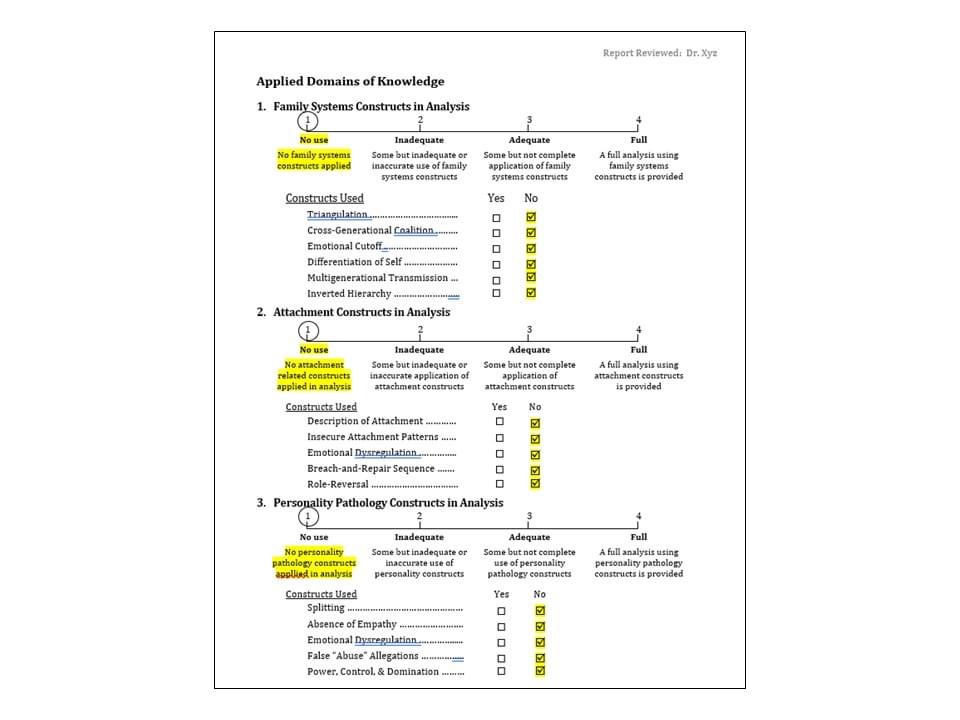
When I conduct a line-by-line review of a forensic custody evaluation, I generate a Checklist of Applied Knowledge at the end of my review.

The Checklist of Applied Knowledge provides a structured way to document compliance with Standard 2.04 and the application of the “established scientific and professional knowledge of the discipline” as the bases for their professional judgments.

It’s a 4-page checklist with a one-page written Summary. Here’s the written Summary for a recent review:

______________________________

Checklist of Applied Knowledge for Dr. Xyz

A Checklist of Applied Knowledge was used to evaluate Dr. XYZ’s application of the established scientific and professional knowledge of the discipline as the bases for her professional judgments. Based on a review of Dr. XYZ’s report, no domain of established professional knowledge was evident in application as the bases for her professional judgments.

Applied Knowledge:

• Family Systems: Despite Dr. XYZ being tasked with assessing a family conflict, no family systems constructs were evident in her reporting or analysis.

• Attachment: Despite Dr. XYZ assessing severe attachment pathology being displayed by the children toward their father, no application of attachment constructs was evident in her reporting or analysis of the family conflict.

• Trauma Pathology: Despite Dr. XYZ assessing issues of possible child abuse, as well as issues of possible spousal abuse, no constructs from complex trauma or child abuse were evident in her reporting or analysis of the family conflict.

• Personality Pathology: Despite indicators in the reported data of possible personality pathology in a parent (possible narcissistic-borderline-dark personality pathology), no constructs from personality pathology were evident in her reporting or analysis of the family conflict.

• Child Development: Despite assessing childhood pathology across multiple child developmental levels, no constructs from child development were evident in her reporting or analysis.

• Self Psychology: Despite assessing the psychological development of children within the parent-child relationship, no constructs from self psychology were applied regarding the psychological development of children in the parent-child psychological relationship.

• DSM-5 Diagnostic System: No diagnostic constructs from the DSM-5 were applied, despite multiple relevant differential diagnoses including:

1) a possible shared shared/induced persecutory delusion (DSM-5 297.1)

2) a possible factitious attachment pathology being imposed on the child for secondary gain to the parent (DSM-5 300.19),

3) possible psychological child abuse (DSM-5 V995.51)

4) possible spousal psychological abuse of the father by the mother using the children’s induced pathology as the spousal abuse weapon (DSM-5 V995.82)

.

Diagnostic Formulation

No diagnosis was provided by Dr. XYZ. No discussion of any diagnostic issues was provided. No theoretical orientation was evident in case formulation, and no organized case formulation was offered.

Treatment Plan Formulation

No treatment plan formulation was offered.

_____________

Hello, I’m Dr. Childress. It’s a pleasure to meet you. I’ve been asked by an attorney in this matter to review your report.

Craig Childress, Psy.D.

Clinical Psychologist, CA PSY 18857