Weaponized Children – Charlie McCready

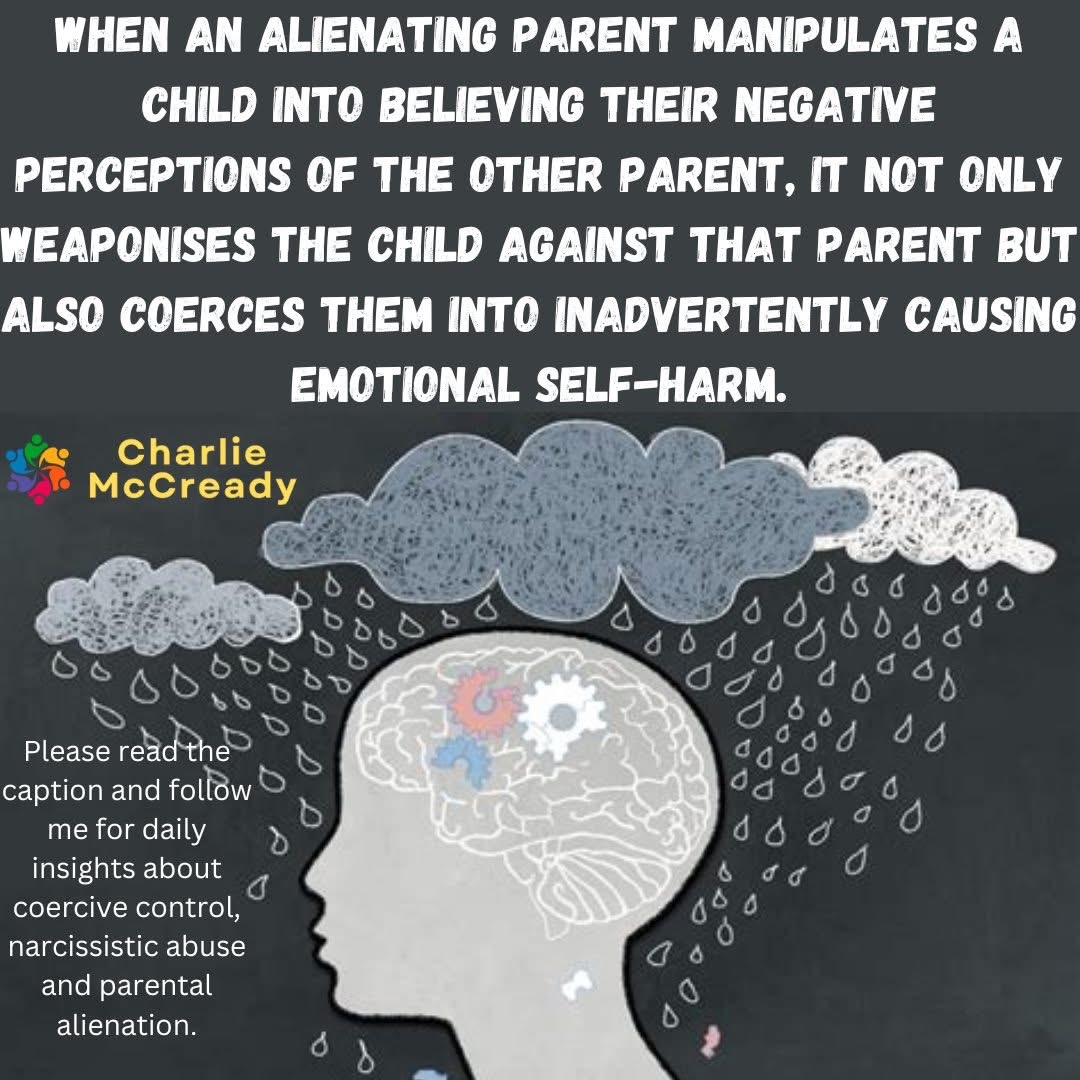
Emotionally self-harming behaviour in an alienated child, driven by the coercive control of a disordered, alienating parent, reflects the painful clash between their genuine affection for a targeted parent and the manipulated negative perceptions imposed by the alienator. This internal conflict, known as cognitive dissonance, creates distress and confusion as the child tries to reconcile their love for the targeted parent with the false narrative they’ve been coerced into accepting. This conflict not only impairs their emotional well-being but also impacts their neurological functioning. Negative thinking patterns about a parent they love can distort their brain’s perception of reality, disrupting healthy neural pathways and perpetuating emotional distress, ultimately compromising their overall emotional development.

Coping mechanisms for these detrimental effects involve a range of approaches, some of which are positive and constructive, while others might be less so.

Therapeutic interventions that promote critical thinking, self-awareness, and emotional regulation can play a pivotal role in helping the child navigate their conflicting emotions. Encouraging them to express their feelings openly and safely explore their emotions within a therapeutic setting can gradually help untangle the web of manipulated beliefs.

Additionally, nurturing healthy relationships with extended family, friends, and professionals who provide unwavering support and encourage positive interactions can serve as protective factors against the emotional self-harm imposed by the alienating parent’s control. Engaging in creative outlets, physical activities, and hobbies that offer a healthy way to release emotional tension and boost self-esteem can also contribute to their overall well-being. However, it’s essential to recognise that not all coping mechanisms are beneficial; some children might turn to negative coping strategies like alcohol or drugs to numb their pain, which can further compound their emotional challenges and hinder their growth. Thus, providing guidance and support to help them choose healthier ways to manage their emotions becomes paramount in their healing journey.

My posts are here not to alarm or upset but to spread awareness about what’s known as ‘parental alienation’ and to provide guidance to those who are going through it, as I did myself. Apart from these daily posts, which I hope help you know you’re not alone, and to better understand it’s an attachment disorder, a pathology, it’s not you; please reach out if I can help with the coaching I offer.

#charliemccready

#parentalalienationcoach

#childrensrights

#mothersrights

#fathersrights
Charlie McCready- Lawyers $$$$

Does anyone care to comment? When I have more time, I’d like to gather more data on what alienated parents have actually experienced in the family court system. How long did it take? What was the outcome? How much money was spent? Did it lead to reunification? If the court ordered contact, was it enforced—and if so, how did that go?⁠

Alienated parents often pour their life savings into a legal system they once believed would protect their rights and their children’s well-being—only to emerge financially drained, emotionally shattered, and, in many cases, no closer to justice.⁠

This highlights the urgent need for reform. Lawyers dealing with these cases should be trained to recognise attachment disordered parental alienation – the false narratives and coercive, manipulative behaviours that drive it. The legal system must do better, not only for parents who are being erased from their children’s lives but, most importantly, for the children themselves—caught in a battle they never chose.⁠

Perhaps we expect too much. Perhaps we should know better by now. After all, injustice isn’t confined to family courts or parental alienation. Look at the wider world—those who commit crimes often walk free, while those who expose them suffer the consequences. The alienated parent is no different: seeking truth in a system that too often fails to protect the innocent while enabling the abuse.⁠

I don’t mean to sound cynical. I try to stay focused on solutions. But we shouldn’t have to ‘fight’ to see our own children in a court of justice—because we are not criminals. We are parents. Parental alienation isn’t simply a legal matter; it’s a psychological and relational issue—one that the law is often ill-equipped to handle. And for many, prolonged legal action is not only financially impossible but also emotionally destructive. While sometimes necessary, court should be a last resort, used only when every other effort to protect a child’s well-being has been exhausted.

If you are going through what’s commonly known as ‘parental alienation’, know you’re not alone. I’ve been through it myself. Personally and professionally, I have over 20 years of experience. I am reunited with my children and here to offer support with daily posts on social media and also with the coaching I offer. Feel free to reach out to me anytime.

#charliemccready

#parentalalienationcoach

#parentalalienation

#parentalalienationawareness

#alienatedchild

Disordered Pathogenic Parenting – Charlie McCready

In many cases (though not all of course), the alienating parent operates from a place of deep-seated emotional neediness rooted in their own childhood experiences. If they lacked sufficient love and secure attachment during their formative years, they may have developed an attachment style characterised by anxiety or insecurity. This void creates an overwhelming desire for their child to fulfil unmet emotional needs—an expectation for unwavering loyalty and affection.⁠

In this dynamic, the child becomes a vessel for the parent’s unresolved trauma and unfulfilled desires. The alienating parent may project their need for love onto the child, expecting them to provide the unconditional support and affirmation they missed out on. This demand can manifest as controlling or possessive behaviour, where the parent subtly or overtly communicates that love and loyalty come with conditions: to reject, demonise, or distance themselves from the other parent. Truly a cruel thing to inflict on a child – some do this unconsciously, others quite deliberately. ⁠

For the child, if they do not comply or fail to provide the desired level of loyalty, it may trigger the alienating parent’s fear of abandonment and inadequacy. They might respond with manipulation, guilt, or emotional coercion, reinforcing the notion that the child’s love is contingent upon rejecting the other parent. The underlying message is clear: the child must choose sides and prioritise the alienating parent’s needs or risk losing the affection and approval they crave. Again, this is disordered, pathogenic parenting. ⁠

Ultimately, this creates a toxic cycle of dependence and alienation, where the child feels torn between their natural bond with both parents and the appalling expectations imposed by the alienating parent. It undermines the child’s sense of autonomy, fosters confusion, and cultivates a skewed perception of love—one that is contingent on loyalty rather than the unconditional acceptance and support that every child deserves.⁠

#charliemccready

#parentalalienationcoach

#parentalalienation

#alienatedchild

The Blessings of Being Rejected by your child

Watching your child(ren) go through so much of life enmeshed with a parent who abuses them , to savage you … is the Hell on Earth no one wants or deserves .

That said , I have been on my own since 1993 . As the toxic RX increased the unpleasant side effects of being the target physically, I had no one who cared .

Realizing the blatant abuse and X’s desire to recreate as much of my trauma of childhood , I could more easily distance myself

youtube.com/watch

Conditioning – Charlie McCready

Children are like sponges, absorbing not only information but also behaviours exhibited by the adults around them. The way parents interact with each other significantly influences how children perceive relationships and interpersonal dynamics. This subtle process, known as “Modelling Behaviour,” lays the groundwork for how children may later respond to challenges like parental alienation.⁠

Children are incredibly perceptive observers of their parents’ actions and interactions. As they witness how adults communicate, resolve conflicts, and treat one another, they internalise these behaviours as normal or acceptable. Parents are role models, demonstrating how their children should engage in relationships, express emotions, and handle disagreements. When one parent engages in negative behaviours like badmouthing, denigrating, or criticising the other, children unconsciously learn that these behaviours are acceptable and permissible, and in the case of alienating behaviours, the child may be encouraged and rewarded for emulating them. ⁠

When parents consciously exhibit kindness, respect, and empathy toward each other, they create a foundation for their children to build upon. Children growing up in an environment where healthy communication and conflict resolution are the norm are more likely to carry these positive traits into their own relationships as they mature. But as an alienated parent, remember that your disposition and actions, even from afar (children are sponges; they watch and pick up on things), can guide your child’s emotional growth and cultivate positive relationships throughout their life.⁠

#charliemccready

#parentalalienationcoach

#childrensrights

#fathersrights

#mothersrights

Controlling the Child to harm the other parent./Charlie McCready

An alienating parent is not providing unconditional love. They are controlling and behaving selfishly. A loving parent does not work towards eliminating the other parent, a loving, available, good parent (and often their extended family, too), from the child’s life because that is definitely not in the child’s best interests. In contrast, a ‘target’ (alienated/rejected) parent often ‘lets go’ because they love SO MUCH. This act of ‘letting go’ (or necessary detachment) is a powerful demonstration of genuine love because this parent refuses to play the alienating parent’s tug of war game if it creates further trauma and harm to their child. This is LOVE, LOVE, LOVE. Fear and control and anger, coercive control, indoctrination, lies and ‘brainwashing’ are not loving behaviours. The child is confused and enmeshed by the twisted narratives and lies they hear, and cognitive dissonance and splitting are coping mechanisms, as is their anger. The (alienated) children would like nothing more than for their parents to coexist and co-parent amicably, fostering a healthy environment for everyone’s mental and emotional well-being so they can get on with their lives. Even if parental harmony remains elusive, the toll of ongoing conflict on a child’s mental health is undeniable. Unfortunately, the alienating parent often remains indifferent to this toll. Unfortunately, they literally don’t care. However, as the child matures, they may come to realise the destructive nature of these actions, prompting a journey toward understanding, forgiveness, and healing. It’s of paramount importance to be strong, stay loving, and not succumb to angry, provoked reactions. Near or far, be the healthy-minded parent in the child’s life. Even if there’s no contact at the moment, focus on being happy, on being there whenever the child/adult knocks on your door again.

#charliemccready

#parentalalienationcoach

#alienatedparent

#narcissisticparent

#gaslighting

#emotionalabuse

Parental Alienation & Personality Disorders -Charlie McCready

The link between personality disorders, codependency, and parental alienation reveals a complicated web of psychological interactions. Parents with personality disorders, particularly Cluster B personality disorders like narcissistic, borderline, histrionic, and antisocial personalities, often exhibit extreme and erratic behaviours that can significantly impact their children. These disorders are characterised by difficulties controlling anger, vindictiveness, impulsive outbursts, rage when criticised, lack of empathy, and aggressive behaviour. Parents who emphasise the faults and flaws of the other parent, create an environment where children feel compelled to align with them (the emotionally unstable parent) in an attempt to placate them. This behaviour contributes to alienating children against the other parent over time. Parents with personality disorders tend to overlook their own problematic behaviour, making it challenging to acknowledge their contribution to any problems.

Co-dependency, which often results from insecure attachment patterns, can further intensify the negative impact of parental personality disorders. Co-dependent people (parents) tend to derive their sense of self-worth from others (their children), making them susceptible to enabling or engaging in alienating behaviours. This perpetuates a cycle of emotional turmoil for children caught in the crossfire.

#charliemccready

#parentalalienationcoach

#codependency

#attachmentdisorder

Alienating Parents often cluster B type personality/Charlie McCarthy

I completely understand how exasperating it is to deal with a narcissistic, alienating ex who’s manipulating everyone around them. It’s not just the grief of being separated from your child—it’s the sheer injustice of watching people fall for the charade while you’re left struggling to get anyone to see the truth. Narcissistic abuse is extremely difficult to cope with because these people are highly manipulative and incredibly skilled at twisting the narrative to make themselves look like the victim (when they’re not playing the hero). ⁠

Even when they’re not actively abusing you or undermining your role, they’re out there putting on a performance—telling everyone how selfless and devoted they are, how they would never do anything to harm the children. They know exactly how to play the part of the good parent, saying all the right things while you’re painted as the unreasonable, difficult one. It’s maddening because, deep down, you know what they’re really like, but every time you try to show it, they seem to be one step ahead, even making you look like you’re overreacting or being irrational.⁠

I also know how hard/impossible it has been made to put the children first when you’re pushed to the sidelines and/or shut out of their lives. It’s not that you don’t want to be there or aren’t trying—sometimes, they’ve built up so many barriers that it feels impossible to stay connected or even be involved. And meanwhile, the alienator is the one controlling the narrative, telling everyone that you’re the problem, that you’re the one who doesn’t care. It’s hell, I truly understand. I’ve been there too. ⁠

The truth is, these alienating parents are always thinking about themselves—whether they’re badmouthing you to your child, tearing down your reputation, or just telling anyone who’ll listen what a wonderful parent they are, despite you – what martyrs! They never really stop being abusive; they just switch gears. When they’re not actively being selfish or controlling, they’re busy making sure everyone sees them as the opposite—calm, reasonable, and, of course, completely selfless. Enough to drive us mad! And they don’t mind that, at all.

I see you. I understand the pain and the frustration of watching someone who’s caused so much damage keep getting away with it. It’s not your fault. You’ve been fighting a battle where the rules keep changing, and the truth is constantly distorted to suit them. But the fact that you’re here, still holding on, reading these posts … says so much about your strength and love. Don’t ever doubt that.

#charliemccready

#parentalalienationcoach

#coercivecontrol

#narcissisticparent

#emotionalabuse

#traumabonding

#parentalalienation

#mothersmatter

#FathersMatterToo

#FathersMatter

Attachment Disorder in Parental Alienation

Children with Secure Attachments feel supported and protected, possessing self-respect and trust in their close relationships, fostering positive interactions with others and academic success. However, when subjected to parental alienation by a narcissistic/borderline parent with disorganised attachment tendencies, the child experiences emotional manipulation and psychological abuse. This engenders anxiety-driven attachment behaviour triggered by the “target” parent’s presence or mention, leading the child to respond in ways pleasing to the alienating parent and resulting in the absence of secure attachments.⁠

Parental alienation disrupts the attachment cycle, eroding the child’s trust in themselves, the world, and others, ultimately fostering an insecure or disorganised attachment style. Insecure, anxious children become hypervigilant around parents, hoping for loving moments while guarding against potential hurt.⁠ Lacking empathy, alienating parents may not recognise their child’s anxiety unless mirroring their own. The perceived threat lies in the child’s relationship with the ex-spouse and their proximity. The alienating parent conditions the child to soothe their anxiety, inducing symptoms when mentioning the targeted parent, reinforcing that their attention comes when rejecting the other parent, detrimentally affecting the attachment relationship.⁠

Alienating parents amplify the child’s stress, grief, and confusion while projecting blame on the targeted parent, damaging attachment bonds and leading to detachment. However, this adaptive behaviour can turn maladaptive if habitual or extreme.⁠

Insecure, avoidant children may learn that emotional closeness is unsafe, fostering extreme independence. Children manipulated into denigrating a parent often experience guilt, internalising blame. Alienating parents suppress the child’s grief by attributing negative emotions to the targeted parent, inducing blame and distancing for self-preservation. Many children conditioned to believe the alienating parent due to survival instincts, are unsure who to trust – themselves or their parent.

#charliemccready

#parentalalienationcoach

#attachmentdisorder

#mothersrights

#fathersrights

Trauma Bonds

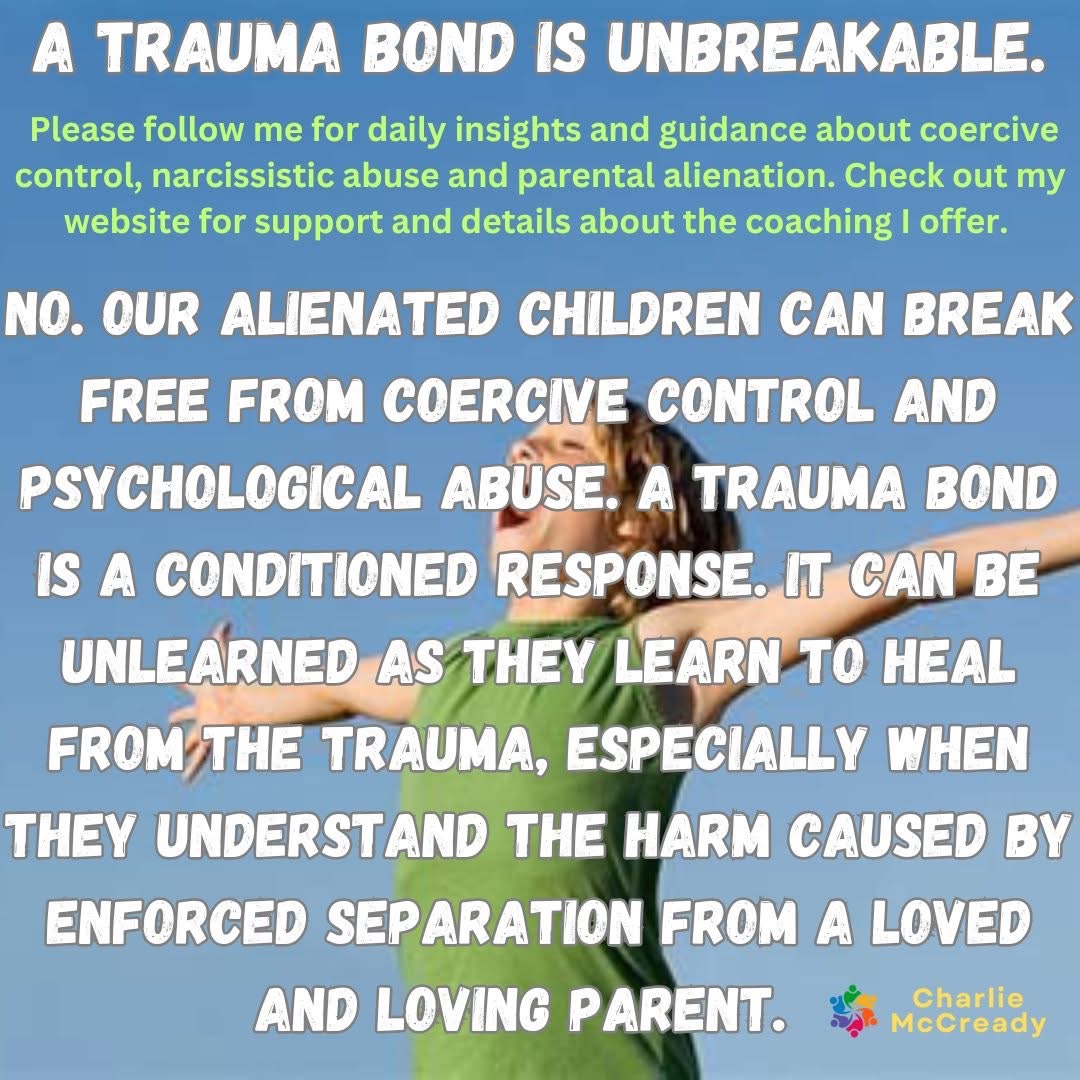
While a trauma bond can be strong and challenging to break, it is not necessarily unbreakable. With time, understanding, and support, alienated children can break free from the coercive control and psychological abuse of parental alienation.⁠

Trauma bonds form due to the conditioned response to an abusive and controlling parent creating a sense of dependency, attachment, and even loyalty. The alienating parent’s manipulation and exploitation of the child’s emotions may strengthen the bond.⁠

The first step is for the alienated child to recognise and understand the dynamics of the trauma bond. This involves gaining insight into the tactics used by the alienating parent, the impact on their well-being, and the unjust nature of the enforced separation. Trauma bonds often involve a sense of diminished self-worth and distorted identity, but an alienated child can rebuild their self-esteem, establish a solid sense of self, and reclaim their autonomy and agency.⁠

Healing from the trauma associated with parental alienation involves processing and addressing the emotional wounds inflicted by the alienating parent. Trauma-focused or cognitive-behavioural therapy can help a great deal. ⁠

Establishing and enforcing healthy boundaries is essential for breaking free from the cycle of coercion and control. The child needs to develop a sense of self-protection and learn to set limits on manipulative behaviours or interactions.⁠

Lastly, but most importantly, establishing or re-establishing a healthy and supportive relationship with the targeted parent is crucial in breaking the trauma bond. The child needs validation, understanding, and unconditional love from the parent they were alienated from, which can aid in healing.⁠

Each individual’s healing journey is unique, and the outcome may vary but with the right resources and a commitment to healing, alienated children can break free from the trauma bond and rebuild their lives with healthier relationships and a stronger sense of self.⁠

#charliemccready

#parentalalienationcoach

#traumabonding

#traumabond

#coercivecontrol