Craig Childress- Consultations

Consultation

I have my first week of the month consultations with the general public next week. My case manager, Maggie, has sent out the intake and consents forms to the scheduled people.

I don’t know what people want to talk with me about until I talk to them. So I offer general public consults the first week of every month to talk to people who want to talk to me. I’ll be holding my October consults next week.

Most of the time, I meet, we talk, and that’s my last involvement in their matter. Sometimes, after talking, the person talks to their attorney or involved mental health people and a second meeting is set up with Maggie between me and the relevant professionals.

My primary practice right now is serving as a second-opinion to attorneys regarding mental health reports in their matters. I apply the established scientific and professional knowledge of the discipline to the information I’m asked to review.

There’s an attorney in a matter who believes that the application of the established knowledge from professional psychology would benefit the court in its decision-making. The attorney submits the information to me for my review and I apply the established scientific and professional knowledge from clinical psychology to the information I’m asked to review.

Except for any parents, attorneys, or mental health professionals in Oregon. Sorry Oregon, you’re dark to Dr. Childress. I will provide no consultation to any Oregon resident, attorney, or mental health professional from now until forever. Talk to your licensing board about why they don’t want you consulting with Dr. Childress about your matter.

If you are a parent, I will speak with you once to find out what you want to talk with me about – but I’m not licensed in your state. My contact with you is limited. I can, however, talk to your surrounding professionals all you want, but just not so much with you.

If you’re a CA resident, I can possibly do more with you because I’m licensed in CA… but I can probably not do too much because I live in Washington state.

If you’ve spoken with your attorney and you think that you may want to involve my consultation in your matter to assist the court with its decision-making, you can schedule the first meeting with your attorney and me so we all meet together the first time.

If you know what you want, we can talk about what you want. If you don’t know what you want, we can talk about what you may want.

There’s all sorts of helpful informational Handouts on the Attorney Resources page of my Consulting Website (drcachildress-consulting.com). There’s also information for mental health professionals on the Mental Health Consultation page of my Consulting Website.

If you’re a mental health professional with a difficult case of family conflict and you’d like consultation, you can schedule a consultation time during the first week of any month though the Scheduling Calendar on my Consulting Website.

Consultation is a good thing. It’s indicated as appropriate in Standards 2.01(a)(c)(d) of the APA ethics code, and is specifically addressed in Standard 3.09 Cooperation with Other Professionals

3.09 Cooperation with Other Professionals
When indicated and professionally appropriate, psychologists cooperate with other professionals in order to serve their clients/patients effectively and appropriately.

The National Academies of Sciences, Engineering, and Medicine produced a paper on Improving Diagnosis in Health Care in which they recommend consultation.

From Improving Diagnosis in Health Care: “Clinicians may refer to or consult with other clinicians (formally or informally) to seek additional expertise about a patient’s health problem. The consult may help to confirm or reject the working diagnosis or may provide information on potential treatment options. If a patient’s health problem is outside a clinician’s area of expertise, he or she can refer the patient to a clinician who holds more suitable expertise. Clinicians can also recommend that the patient seek a second opinion from another clinician to verify their impressions of an uncertain diagnosis or if they believe that this would be helpful to the patient.”

Improving Diagnosis in Health Care
https://www.ncbi.nlm.nih.gov/books/NBK338596/

Diagnosis guides treatment. The treatment for cancer is different than the treatment for diabetes. What is the diagnosis guiding the recommendations and treatment interventions being made for your family?

Are they making recommendations for cancer or diabetes? What is their diagnosis of the problem (pathology)?

Is the diagnosis a shared (induced) persecutory delusion? Is the diagnosis Child Psychological Abuse (DSM-5 V995.51)?

Was a proper risk assessment for possible child abuse conducted?

Or perhaps you want to talk with me about ADHD. Or perhaps you want to talk about autism-spectrum issues. Or perhaps you want to talk about depression or anxiety disorders. Or perhaps you want to talk about baseball. It’s your time to talk with me about anything you want to talk about. I’ll meet with anyone once to find out what you want to talk about – except if you live in Oregon.

Good luck Oregon.

All mental health professionals have duty to protect obligations. Did they conduct a proper risk assessment for child abuse to the appropriate differential diagnoses for each parent?

Craig Childress, Psy.D.
Clinical Psychologist, CA PSY 18857
Opinions – Child Psychological Abuse

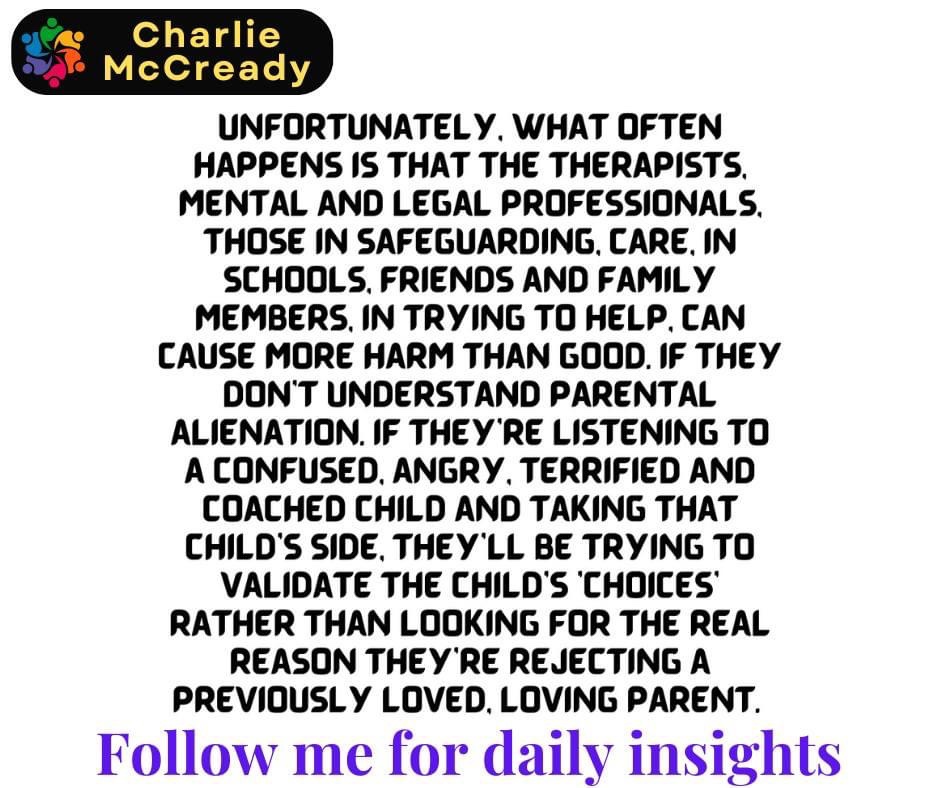
Well-intentioned professionals, therapists, legal experts, friends and family members, can inadvertently worsen the situation. This occurs when they do not understand parental alienation. They often, not without reason, prioritise the child’s perspective, not taking enough into account the covert, coercive, harmful influence of an alienating parent, almost indoctrinating this child. The child may seem highly passionate and plausible. They may express confusion, anger, fear, but not so much of the manipulation. By validating the child’s apparent “choices,” people who could otherwise be more supportive of all the victims of alienation (not just the child) often overlook the deeper causes behind the rejection of a previously cherished and caring parent.

charliemccready #

Incompetent and Unethical – Craig Childress, PsyD

I think I’m going to talk about your surrounding mental health professionals this Sunday over Coffee & Crumpets w/ Dr. Childress here on Facebook Live.

What do you do about the involved mental health people surrounding you? They might be custody evaluators (I hope not), they might be “reunification therapists” (there’s no such thing), they might be individual child therapists who are colluding and participating in the psychological abuse of the child.

What do you do about them? I should talk about that this Sunday over coffee.

You want documentation of their diagnosis and treatment plan. They don’t have one and they will resist telling you what their diagnosis and treatment plan is – BUT – you will want to challenge their diagnosis as a misdiagnosis and you will want a second opinion.

Think healthcare – think medical doctors. If the doctor says you have cancer and you don’t think so, what do you do? You get a second opinion. That’s what you want to do, you want a second opinion on their diagnosis because you believe they have misdiagnosed (misidentified) the pathology (problem) in your family.

And they have. The pathology in the family courts is a shared (induced) persecutory delusion and false (factitious) attachment pathology imposed on the child by a pathological narcissistic-borderline- dark personality parent.

Did the involved mental health professionals conduct a proper risk assessment for possible child abuse to the appropriate differential diagnosis for each parent?

No they did not.

Did the involved mental health professionals conduct a proper assessment for a possible shared (induced) persecutory delusion?

No they did not.

Did the involved mental health professionals misdiagnose (misidentify) the pathology (problem) in the family?

Yes, they did.

Was it a negligent misdiagnosis?

Google negligent: failing to take proper care in doing something.

The allied parent is accusing the targeted parent of abusive-range parenting that is creating the child’s attachment pathology toward the targeted parent – a two-person attribution of causality.

The targeted parent is accusing the allied parent of psychologically abusing the child by creating a shared (induced) persecutory delusion and factitious attachment pathology in the child for secondary gain to the pathological allied parent – a three-person triangle attribution of causality.

A proper risk assessment for possible child abuse needs to be conducted to the appropriate differential diagnosis for each parent. Was a proper risk assessment conducted by the involved mental health professionals?

No. You will want to begin the process of exposing their negligent misdiagnosis resulting from their practice beyond the boundaries of their competence in 1) the diagnostic assessment of delusional thought disorders, 2) their diagnostic assessment and treatment of attachment pathology, and 3) their diagnostic assessment and treatment of family systems pathology.

All ethics codes for all professionals have Standards prohibiting practice beyond the boundaries of competence based on their education, training, and experience.

The assessment for a possible persecutory thought disorder is a Mental Status Exam of thought and perception – Martin, 1990 – they are dead in the water.

Mental Status Exam
https://www.ncbi.nlm.nih.gov/books/NBK320/

Their additional absence of competence in attachment pathology and family systems layers on additional violations to ethical standards of practice.

Because they are incompetent, they have misdiagnosed the pathology in the family and are treating cancer with insulin… and the patient is dying because of their negligent (failure to take proper care) misdiagnosis.

You will want to begin collecting your documentation to challenge their diagnosis and subsequent “treatment” plan by obtaining their diagnosis and treatment plan… in writing.

They will resist. They must disclose their diagnosis and treatment plan. Ask for a Treatment Progress Update report, then watch them avoid providing one.

You will need to become familiar with the laws in your state regarding disclosure of information – if you share consent rights for the child’s treatment, then you have the right to know what the child’s diagnosis and treatment plan are.

Think healthcare – think medical problems. If your child has a medical problem, you have the right to know what the diagnosis and treatment plan is. Same exact thing, you don’t need to prove something to someone, you just need them to do their job.

What is their diagnosis and treatment plan? Get that in writing. Then challenge it as a misdiagnosis because they failed to conduct a proper risk assessment to the appropriate differential diagnosis for each parent.

Understand this… if they believe a shared delusion, they become PART of the shared delusion, they become part of the pathology. When that pathology is child abuse, they become PART of the child abuse – they – the involved mental health people become participants in the psychological abuse of the child…

…because they are practicing beyond the boundaries of their competence in violation of ethical standards of practice for their profession.

I should talk about that this Sunday over coffee, what do you do about your involved mental health people?

You have rights. They have obligations.

A patient should NEVER have to explain the pathology to the doctor, they should already know. If you have to explain the pathology, document that you are explaining it to them – learn Letter to a Stranger.

WrightsLaw Letter to a Stranger
https://www.wrightslaw.com/advoc/articles/Letter_to_Stranger.html

You’re not writing to the involved mental health person, you’re documenting them into the record for the magistrate who will hear their malpractice lawsuit, or board complaint, or court testimony.

Plan ahead. The pathogen can’t. Stop being now-reactive. You’re the healthier parent. We need your leadership for the family. You need support. Let’s get you the support you need.

We’ll start by getting rid of the incompetent and unethical child abusing mental health people that surround you. The mental health professional should NEVER be a participant in the psychological abuse of their client-child… but they are.

They deserve to lose their licenses for practice beyond the boundaries of competence in violation of ethical standards, resulting in their collusive participation in the psychological abuse of the child… and the spousal psychological abuse of the targeted parent.

You have rights. They have obligations. We’ll talk more on Sunday over coffee here on Facebook Live at 8:00 Pacific.

Craig Childress, Psy.D.
Clinical Psychologist, CA PSY 18857
Targeted Parent – 16 years of Alienation

I’m finally 57 I always knew I would be 57 when my son turned 18. I never expected to go through 16 years of high conflict custody dispute. I never expected to have my stress turned against me to have teachers turned against me to have my hairstylist testify against me to tell the court that I was ‘late to my appointments to get my hair done’ as if that mattered, I have been through every possible kind of torture in a custody fight. I was sued by a Jewish attorney and a Jewish father to take away the Jewish holidays. Who does that? Eventually, my therapist told me I had the worst divorce she’s ever seen in 40 years and she was on a call list by the state bar and worked with a lot of attorneys so she had seen a lot of stuff. The only way to combat alienation is to heal your own heart first to find some measure of joy that you can call your center of gravity and build outward. Stress is always used against you. Facebook posts are always used against you. We should try to create a hotline to help each other and may be man it or woman it once a week. Even zooms can be recorded so you we’d need a nondisclosure agreement just so that we can talk to each other without taking a risk that somehow were being stalked, because I was stalked online by my exes attorney. They paid money to look at everything I ever posted online and they used everything they could against me, but it’s finally over. My daughter no longer speaks to me. It’s been five years and my son has said that he’s never coming to visit me ever again which I believe is true so I have to rebuild my life now it’s taken 16 years to get to this point and the only thing I can do is clean my garage get rid of the debris of my life and move forward. It hurts, my son said to throw away the family pictures and all of his toys and clothes and he’s never coming back. I believe him and I packed up his room. We’ll see what happens. “Half A Life” I lost half their childhoods and all the rest of my daughter’s life. Utterly unfair.

Professional Obligations- Craig Childress PsyD

Wikipedia Denial: “Denial or abnegation (German: Verleugnung, Verneinung) is a psychological defense mechanism postulated by psychoanalyst Sigmund Freud, in which a person is faced with a fact that is too uncomfortable to accept and rejects it instead, insisting that it is not true despite what may be overwhelming evidence.”

Going forward, you should become familiar with the construct of psychological defenses. They were first identified by Freud and then received subsequent elaboration by others.

At the bottom is denial. This is the symptom currently in evidence by the forensic psychologists. This is a symptom feature of the pathology. It’s a psychologically primitive pathology, so there’s a lot of “primary process” thinking that includes the psychological defense of denial of information they find too distressing.

One defense up from denial at the bottom is projection. That’s where the person takes their own dark material (their “shadow”) and project it onto others, they see themselves, their own motivations when they see others.

Projections always occur to some extent whenever our statement begins “You…” – all the time there will be a portion of projection involved. We don’t know about the other, we only have information from us, and how we organize that information will always influence how we see the out-there.

We can never escape some degree of projection, that’s what Gestalt therapy utilizes. Gestalt therapy understandings for projection and psychological integration are currently contained in the approach of Internal Family Systems Therapy (Schwartz), it’s a good approach.

The psycho-therapeutic question is the extent of the person’s projected material, called their “transference” in psychoanalysis. When their internal projected material becomes too large, it damages their responding to actual reality out there.

When it is severely pathological, the projected internal material loses contact with out there, and the out-there becomes entirely self-generated from the inside of the pathological mind. That’s what we call the symptom of “projection.” As psychotherapists, we use this feature a lot.

“They…” tells us more than you understand. It always tells us something. Sometimes it tells us a lot.

Here, in the family courts, we have a pathological narcissistic-borderline-dark personality parent accusing the other parent of abusing the child. Holy cow – holy cow – holy cow.

BUT… the mental health people in the family courts, they are called “forensic” psychologists, are ignorant like a rock. Because of that, they are not recognizing the severity of the situation (child abuse) and are not responding to protect the child (and parent).

That is bad. So bad. So very-very bad. But they won’t stop. They continue to remain ignorant. They continue to refuse to diagnose the child psychological abuse that is occurring. They continue to collusively participate in the child abuse.

They are in denial regarding the seriousness of the situation and regarding their professional obligations.

There is also parallel process that is incredibly precise in this set of circumstances. Parallel process is when the same pathology (in this case, the collapse of narcissistic personality pathology into a shared persecutory delusion) shows up in the same (parallel) symptoms at two different levels.

When the mental health people start fighting about what the child’s diagnosis is, called “splitting” into a polarized perception, that’s parallel to the splitting symptom in the family, in the parent. Marsha Linehan calls that “staff splitting” – when the mental health people organize into “sides” in conflict about the patient.

It’s time you become familiar with the psychological defenses of denial and projection. The definition of a delusion is a fixed and false belief that is maintained – despite – contrary evidence. No amount of contrary evidence will ever change a delusion because… that’s what makes it a delusion by definition of a delusion – despite contrary evidence.

There is zero point arguing with a delusion. The issue is to identify it first. Everyone has beliefs. Beliefs differ. Sometimes, however, the person’s perceptions contain too much of their own projected inside material and they’ve lost contact with what’s actually out here.

At some point, some people lose entire contact and the world becomes their belief. That’s called a thought disorder, a problem (pathology) in thinking and perception. The assessment for a possible thought disorder is a Mental Status Exam of thought and perception (Martin, 1990).

The key feature is how their minds handle the contrary information, do they process it, does it affect their thoughts and perceptions somehow, or does it just bounce off and fall to the floor unprocessed and unresponded to.

The MSE of thought and perception is a clinical interview approach that is exceedingly linear, it is examining the thinking system, specifically the linear-logical reasoning systems since we’re looking for a possible thought disorder.

In a linear-logical clinical examination of their reasoning systems, the mind with a thought disorder will jump sideways into what’s called “associational thinking” that’s based on connections between emotions.

That’s an intrusion of the emotional system into the logical reasoning system to derail thinking to respond to the emotional content provoked by the thought. For therapeutic purposes, the topic at the point of derailment into associational thinking is the point of the unresolved trauma.

For diagnostic purposes, the derailment of linear-logical reasoning into associational-emotional thinking is the evidence of the thought disorder.

In the family courts with the pathological parent, the type of thought disorder is called a delusion, a fixed and false belief that is maintained despite contrary evidence, and the type of delusion is called a persecutory delusion, a fixed and false beliefs in supposed victimization.

Delusions are psychotic disorders – out of touch with reality. These delusions in the family courts are not schizophrenia-type delusions, the persecutory delusion present in the family courts is of unresolved trauma origin. The unresolved childhood trauma of the pathological parent has created personality pathology in a particular pattern (narcissistic-borderline-dark) that collapses into persecutory delusions under stress.

There are two dangerous pathologies involved – Child Psychological Abuse (DSM-5 V995.51) and Spouse or Partner Abuse, Psychological (DSM-5 V995.82) of the targeted parent by the allied parent using the child as the weapon. Both of these dangerous pathologies (there are three dangerous pathologies, suicide, homicide, and abuse) need a proper risk assessment.

In all – all – cases of severe attachment pathology surrounding court-involved custody conflict, a proper risk assessment needs to be conducted to the appropriate differential diagnosis for each parent.

The ONLY cause of severe attachment pathology is child abuse range parenting by one parent or the other. The only diagnostic question is – which parent is abusing the child?

A child abuse diagnosis should always be returned surrounding severe attachment pathology because that’s the only thing that causes severe attachment pathology. The only question is, which parent?

Craig Childress, Psy.D.
Clinical Psychologist, CA PSY 18857
Charlie McCready – Child Psychological Abuse

The realisation that a parent has deceived them is horrifying. It’s no easy feat to come to terms with the lies fed to them to create a distorted picture of one of their parents – and often that entire side of the family too. They may remember how they felt at first when the alienating behaviours started, the times they felt conflicted and torn between their love for both parents and the requirement, encouragement and reasons given by one not to love the other, and their desire to please the parent who seemed so rightfully angry.

At first, there’s a profound sense of disbelief and shock that a parent they trusted manipulated them into believing a web of lies that poisoned their perception of a parent they had loved and wouldn’t have chosen to reject without their encouragement, coercion and false narratives. Anger quickly follows. It’s a betrayal that cuts deep as they grapple with the enormity of the lies. It hurts as they try to find a way to understand the fact their love and loyalty were exploited for selfish motives.

There’s grief too. A mourning for the time lost, and the version of their life that could have been, the innocence lost too. It’s a terrible realisation that their childhood was not what it should have been as they discover the extent of the deception. They may struggle to reconcile the person they are today with the person they could have been if they’d been allowed to make their own judgments and decisions.

Shame and self-blame can follow because they wonder how they were so easily misled. How can they ever trust their judgement again? Why didn’t they see the truth sooner? It’s a heavy burden to bear, feeling as though they played a role in their manipulation and the grief and anger they feel now that their rejected parent was put through because of the alienating behaviours of their trusted parent.

Ultimately, there’s a yearning for clarity and truth, even as the reality is painful to accept. Although the journey towards understanding and acceptance is fraught with complex emotions, it can also be liberating, as they break free of coercive control and deception. They can reconstruct their identity and life as they unpick the lies.

Baiting

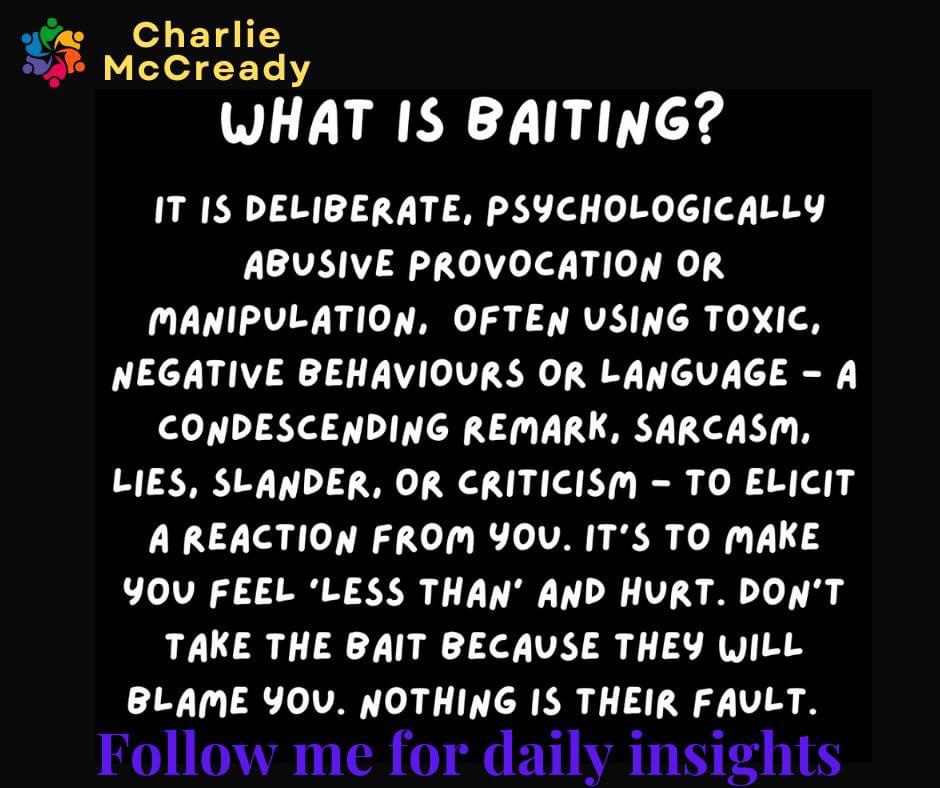
Baiting is a deliberate and psychologically abusive tactic used by the alienating parent against a ‘target’, rejected parent who is already dealing with the immense pain of losing their child or having their relationship obstructed or damaged, as well as facing the injustice of false narratives and lies spread to others, including family courts. This manipulation involves employing toxic behaviours or language, such as condescending remarks, sarcasm, lies, slander, or criticism, to provoke an emotional reaction from the targeted parent. The aim is to make the targeted parent feel inferior and hurt, feeding into the alienator’s desire for control and power over the situation. By not taking the bait and refusing to engage in the provocations, the targeted parent can avoid falling into the trap set by the alienator. Alienating parents often use baiting to shift blame onto the targeted parent, deflecting responsibility for their actions and maintaining a sense of superiority. Awareness of this tactic and maintaining emotional composure can help the targeted parent protect their well-being and focus on advocating for the truth and the child’s best interests during this horrendous and challenging ordeal.⁠

Charlie McCready

Child Psychological Abuse – Trust

When the fog starts to lift for an alienated child, a whole new level of hell emerges.

The alienating parent who has put so much time and effort into brainwashing, bullying, guilting and coercing their child to their side will hyper focus their wrath on the very child they claim to covet.

Like someone flipped a switch, they will withdraw their conditional love for good.

Equivalent to their ex partner, once they lose the control they so desperately desire, they will cast their child aside.

The perceived betrayal of their child seeing through the vail of delusion will draw out their real face, fangs and all.

The utter disbelief that “their” child would actually question their motives and methods is too much to take. After all, nobody can call out a narcissist. Nobody.

The flood of emotions for this child is immense. The grief and anger for all of the time lost with a parent they were convinced didn’t love them.

The disbelief that someone they love and trusted with their whole heart would take so much advantage of their naïve nature and blind loyalty to punish their other parent and use them as a vessel of vengeance.

Crushed by all the instances they were callously told their other parent “doesn’t love you”, or that their other parent “abandoned” them.

All of the efforts put into convincing them their other parent was dangerous.

All of the silent treatment when they didn’t comply and withdrawn “love” that washed them with severe anxiety when they thought they might lose the love of “the only parent who TRULY loves them”.

So begins phase two- when they nervously seek out their alienated parent they do so knowing they’ll lose the alienator.

After all, they’ve spent their childhood thinking one parent didn’t love them, and didn’t want them based solely on the word and actions of their alienating parent.

They were encouraged to reject that parent with impunity and they participated wholeheartedly all based on falsehoods.

In accepting their lost parent they will potentially spend the remainder of their life, again, without a parent.

It’s literally heartbreaking. I will never be able to wrap my head around being so cruel to your very heart and soul.

Alienating parents

The motivations and psychological processes of alienating parents can vary, making it challenging to generalise their behaviour. In some cases, alienating parents may genuinely believe their lies, deluding themselves into thinking they are protecting their children or acting in their best interest. These individuals might have convinced themselves that the target, alienated parent is a danger or unworthy of the child’s love, and they may genuinely believe the false narrative they have constructed. Their actions may be driven by cognitive dissonance, where they unconsciously justify their behaviour to align with their self-image as a “good” parent, even as their actions cause harm.⁠

On the other hand, some alienating parents may knowingly lie and manipulate the situation to further their agenda and “win” at all costs, even if it means hurting their children in the process. This behaviour can stem from deep-seated resentment, anger, or a desire for revenge against the target parent. These individuals may display narcissistic or sociopathic traits, seeking to control and dominate others, and believe that alienating the child is a way to achieve this control. They may even derive pleasure from causing pain to the target parent and feel powerful when manipulating the child’s emotions.⁠

Sometimes, the alienating parent’s behaviour may be a combination of self-delusion and calculated manipulation. They might have started with negative emotions towards the target parent but then become consumed by those feelings, weaving a web of lies and distortions to reinforce their beliefs and justify their actions. This complex mix of cognitive dissonance, narcissism, and calculated manipulation can create a toxic environment for the child, where they are caught in a battle between their parents.⁠

The consequences of parental alienation on the children and the target parent can be severe and have long-lasting emotional and psychological effects. Understanding the dynamics of parental alienation and its impact on all parties involved helps develop effective interventions to address this form of emotional abuse.

charliemccready