Charlie McCready – Alienating Parents

Alienating parents typically refuse to be accountable or engage in self-reflection. Instead, they project blame onto others, particularly the ‘target’ parent, as well as anyone else who triggers their unhealed trauma. Self-reflection can be deeply uncomfortable. We all tend to bury stuff we can’t deal with at the time.

Bruce Lipton, a renowned cellular biologist and author, has shed light on the impact of early programming on our subconscious minds. According to Lipton, approximately 70% of our subconscious programming consists of negative or disempowering beliefs and patterns, many of which are acquired before we’re 7 years old. This programming, often rooted in transgenerational trauma, shapes our perceptions and behaviours throughout life. Shocking, isn’t it? But whatever it is we’ve picked up – inherited programming that’s not even true about ourselves, but merely other people’s beliefs and prejudices or ‘issues’ passed down to us – we need to heal from so that we also don’t want to download any that onto our children.

Therefore, moments of personal struggle, such as during a high-conflict divorce, present an opportunity for deep introspection and growth. It is like work. It’s not a walk in the park. But if we can do that deep dive and find out what it was that led us into an abusive relationship, or why we didn’t put up better boundaries, it can help us understand/accept where we are now. Acceptance is not easy to achieve, but it’s a great step towards healing and creating healthier, happier, more fulfilling lives, even despite adversities.

#charliemccready

#parentalalienationcoach

#parentalalienation

#FamilyCourt

#fathersrights

#mothersrights

#parentalalienationawareness

#childcustody

#healingjourney

#divorce

#selfcare

#alienatedparent

Parental Alienation- More than a phase – Charlie McCready

The people who say ‘it’s just a phase’, ‘enjoy your freedom’ and things like this probably mean well but totally misunderstand the pain and trauma of parental alienation, the not knowing when/if we’ll see our children again. It’s not empty nest syndrome, either. Nor is it estrangement when a child has a justified reason for not wanting to see a parent. Alienation is unjustified, coerced, and psychological abuse from a parent with an attachment disorder, narcissism, and/or a vengeance campaign against a loved/loving parent. I’ve taken inspiration from Simone de Beauvoir’s quote: ‘“Her wings are cut, and then she is blamed for not knowing how to fly.” Our children have their wings clipped, certainly. It is covert abuse, and so many people don’t get it. Even people who really should get it. Others suffering from alienation as a knock-on effect, such as grandparents, understand it (though not all), but friends and others say these things to us from a place of kindness but ignorance. They don’t mean to hurt us more with their lack of understanding. May they never know how far off the mark they are.

#charliemccready

#parentalalienationcoach

#parentalalienationawareness

#parentalalienation

#alienatedchild

#childabuse

#FamilyCourt

#FathersMatter

#fathersrights

#mothersrights

#custodybattle

Sharon Stone – Family Court – Charlie McCready

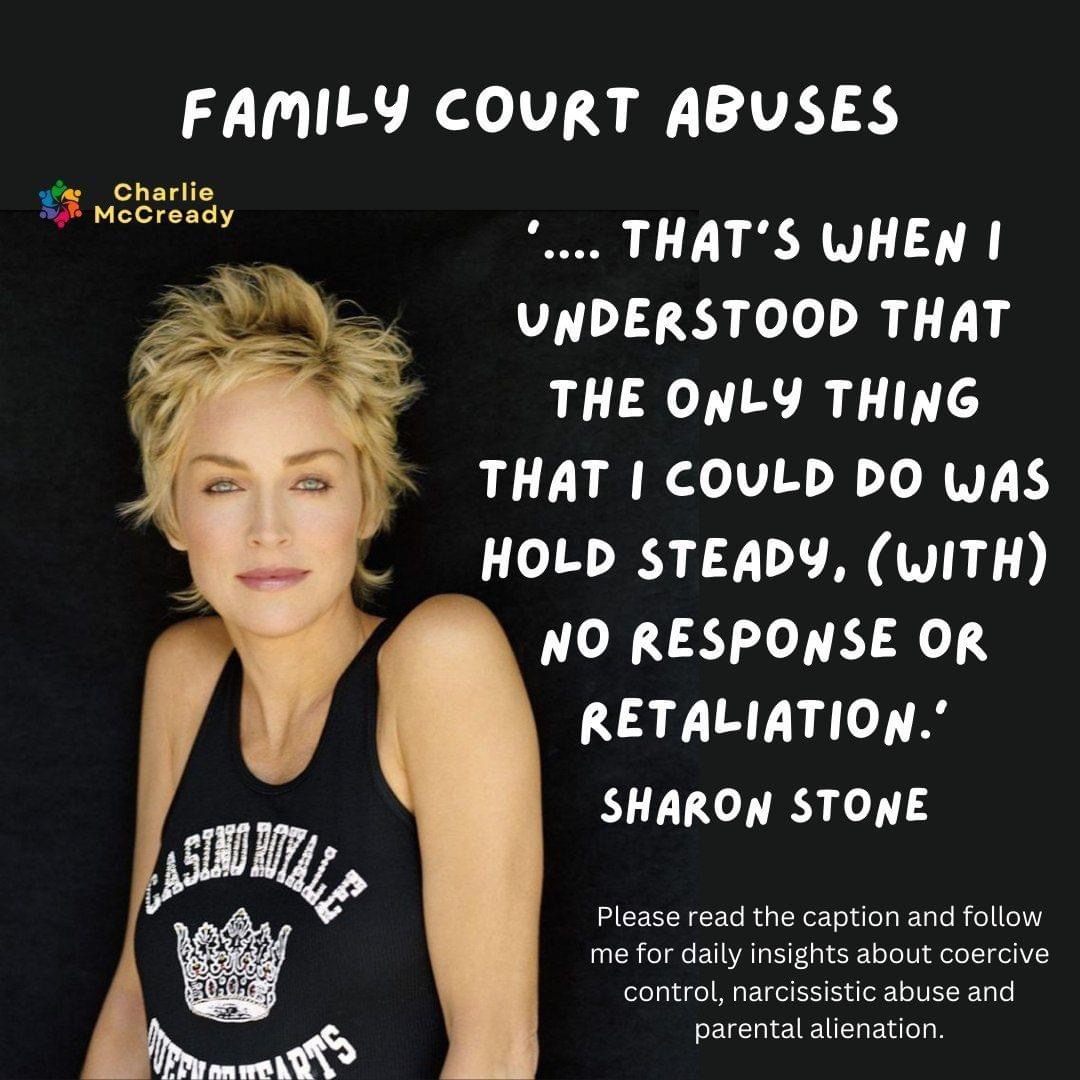
Sharon Stone said during an interview with Bruce Bozzi on his Table for Two podcast that she believes she lost custody of her son because of a ‘kind of abuse by the (family court) system.’ And, in a Saturday Times article, Jan 2024, Sharon Stone talked about how, in 2008, she lost custody of her son, Roan, then 8, whom she shares with Bronstein, after a four-year custody battle following their divorce. She said, ‘… I had envy. Envy of the way they manipulated the court system. And envy is a deeper thing than jealousy. It’s dangerous. It’s in your bones …’ She sees it as the worst period of her life. ‘I was trying to recover from a nine-day brain bleed … and then someone takes your kid … and then they continued by trying to take my reputation ….’ The judge asked her young son, ‘Do you know your mother makes sex movies?’ She says of that horrific experience: ‘And that’s when I understood that the only thing that I could do was hold steady, (with) no response of retaliation.’⁠

I often write about this non-reactive response in posts. It’s difficult because the provocation is immense, the injustice and grief almost unbearable. But the problem is that if we react negatively (in anger or in-kind), the focus is directed to that rather than the root cause of the problem. The alienating parent then sits back and says, ‘See!’ ⁠

I hope it’s true her son has now changed his name from Roan Bronstein to Roan Joseph Bronstein Stone. Thanks to Sharon Stone for sharing her story and spreading awareness about spurious, devastating family court rulings.⁠

#charliemccready #9StepProgram #parentalalienationcoach #parentalalienationawareness #parentalalienationisreal #parentalalienation #parentalalienationischildabuse #highconflictcoparenting #coparenting #coparentingwithanarcissist #highconflictdivorce #divorce #familylaw #FamilyCourt #childabuse #narcissisticfather #narcissisticmother #narcissisticparent #narcissisticabuseawareness #narcissisticabuserecovery #narcissist #narcissists #narcissisticabusesurvivor #narcissisticpersonalitydisorder #narcissisticrelationship #narcissism #narcissismawareness #alienatedchild #alienatedmother #alienatedparent #alienatedfather #alienated

Craig Childress – Parents : How to file a successful board complaint Sunday Chat

I’ve decided on the topic of my Sunday Coffee talk for this coming Sunday.

A Successful Board Complaint: What To Do Next?

I received an email from a parent who indicated that their licensing board complaint against an involved mental health professional was successful. They credited information from me as helping with the successful board complaint.

Unfortunately.

It means that the damage was severe – and the damage was done.

The ‘children’ are adults now. Happens. The pathology remains unresolved – because of the problematic mental health person. Accountability is necessary – don’t leave them for the next parent and family.

We need standards.

However, accountability is not a solution – accountability remains partial until it leads to a solution.

And if you’re successful in your board complaint, that’s the beginning… there’s more you can do… and… there’s more the now-adult ‘child’ can do.

The next step off of a successful board complaint is to roll the licensing board sanctions into a malpractice lawsuit – this will trigger their malpractice insurance carrier… again.

They already have an open case with their malpractice carrier based on your board complaint, they hired an attorney’s representation through their insurance carrier… and they lost. Now they face a malpractice case… and that can mean damages.

The board complaint is strongest on ethical violations of Standards. A malpractice lawsuit is strongest on failure in their duty to protect – AND – a finding from the licensing board of ethical violations.

The goal for the malpractice lawsuit is… settlement… and existing licensing board sanctions… encourage… settlement by the malpractice insurance carrier.

With already existing licensing board sanctions, the malpractice insurance carrier sees a losing malpractice lawsuit. They know what the case is, they already represented the mental health person on the board complaint… that they lost.

The way settlement works is that it must cost less money for them to settle in damages than for them to fight it, lose, and then pay. They’ll look at their numbers-table and settle on a number.

All the attorney people will say it’s hard to “quantify in dollars” the emotional suffering of the parent and child. That’s their concern, not yours. There’s board sanctions, there’s malpractice, they can figure it out.

Your malpractice attorney is hopefully for the settlement, not the litigation. Once the licensing board has sanctioned their license – malpractice is the next roll-over action.

And… and… the now-adult ‘children’ have a strong claim against the ignorant and incompetent mental health professional who failed to protect… them. Even stronger than the targeted parent.

If the now-adult ‘child’ awakens within the statute of limitations… and there’s a successful board complaint… that could mean trouble for the incompetent mental health professional from the now-awakened now-adult ‘child’… who they abused.

Parallel Process: Do you know how there’s those child sex abuse victims of Catholic priests who don’t disclose during childhood, but then establish their foundation and make their allegation in adulthood – as a now-adult ‘child’ of sex abuse by the Catholic priest?

The role of the Catholic priest is played by the incompetent mental health person who participated in the child abuse to meet their own emotional and psychological needs – it’s not sex abuse though – it’s the ripple; psychological child abuse.

There’s spousal abuse as well using the children as the weapon. They failed to protect you, the targeted parent, from spousal abuse as well. There are grounds.

All your pain. All your suffering. Yeah, I know its source in your ex-spouse… BUT… the involved mental health person should have protected you… and they didn’t.

There are even stronger grounds with the now-adult ‘children’ if they choose. It’s a consideration for them to consider. The treatment for child abuse is to help the child abuse victim find their voice.

Child abuse thrives in silence. Speak. Protect. Two parts.

The greatest danger to the ignorant and incompetent professional is not from the parent, it’s from the authentic child-client if-and-when the authentic child ever awakens and understands what happened.

The therapist betrayed them. The mental health professional who should have protected them from child abuse… participated in their abuse… and destroyed their childhood and their lives as a result.

This Sunday I’m going to talk to parents about licensing board complaints.. and what happens when you’re successful and how. And I want to speak to the now-adult ‘children’ who find their authenticity, what can you do?

You’re the victim, you the child now grown. The other people were adults, you were just a child. They should have protected you, they should have seen and understood. They didn’t.

They failed you as a child. They failed you as their client. They failed in their duty to protect you.

In abuse pathology, it’s important to help the victims find their authentic voice. The abuse victim often feels it was their fault, that they did something wrong to ‘deserve’ it. No, you didn’t.

It’s not your fault. You did nothing wrong. Bad people did bad things. We are going to make them stop.

That’s the first sentence we tell an abuse victim upon rescue. I’ve told that sentence to you targeted parents before. You did nothing wrong. Bad people are doing bad things, we are going to make them stop.

I’ll tell that sentence to the child – as a child and as an adult – it’s not your fault, you did nothing wrong. Bad people are doing bad things and we are going to make them stop.

One bad person is a parent – that is deeply unfortunate. But that parent is pathological – they have a problem inside that needs to be fixed – they are damaged.

One parent is damaged.

There is no excuse for the mental health professional. They’re not the damage that needs fixing, they are the fixers of the damage… except they didn’t.

They didn’t see it – they participated in causing the damage to the child. They failed in their duty to protect the child – they betrayed their obligations and sacrificed the child to meet the therapist’s own emotional and psychological needs.

The betrayer – the one who should protect… and doesn’t.

Typically the betrayer role is filled by the mother in sex abuse/incest who sacrifices the child to the father to save her marriage. She knew, she just didn’t ‘want’ to know. In the family courts, the betrayer role is filled by the mental health professionals who should protect… and don’t.

They failed in their duty to protect – failed to protect the targeted parent from brutal and savage spousal psychological abuse using the child as the weapon – failed to protect the child from severe psychological child abuse by a pathological parent that destroyed the child’s childhood… and life.

The board complaint is the first step. Board complaints are free to the consumer. The board won’t re-try the facts of the case, they only care about violations to procedural issues… like violations to ethical Standards – 2.01 Boundaries of Competence (vitae) – 2.04 Bases for Scientific and Professional Judgments (reports) – 9.01 Bases for Assessment (“not based on information and techniques sufficient to substantiate their findings”).

I’ve given you the grounds – the foundations in professional psychology for your complaint.

As you encounter and move through incompetence, document what happens while you’re in the encounter (don’t remain, move on).

Letter to a Stranger (Wrightslaw). When you email someone, you’re not writing to the person, you’re writing to the magistrate who is going to hear the matter of your future complaint. Know your purpose.

Don’t be ham-handed. Be clear. You’re not making argument, you’re generating the evidence you’ll need later – understand the evidence you’ll need later – now – while you’re still here.

At the time of issues – you are not making argument, you are documenting the evidence, arguments will come later.

Don’t be passionate. Be clear. Passion is discounted. Clarity isn’t. Simple is good.

We’ll talk. How about this Sunday at 8 Pacific here on Facebook Live and saved to my YouTube channel, does that work for you?

It works for me too.

Craig Childress, Psy.D.
Clinical Psychologist, CA PSY 18857

Detractors – Charlie Mc Cready

Many detractors hate us being happy, none more so than an alienating parent. They’ve made it their mission to make us miserable by harming the love and relationship we have with our children because they know that will hurt us the most. What kind of person does this? Not a mentally sound or particularly happy one is the answer. Sometimes, this isn’t the case; they didn’t have a miserable childhood or unresolved issues; they’re ‘just’ vengeful, disordered, dark personalities. They will typically often have narcissistic traits and be manipulative, being comfortable lying and creating false narratives, and particularly good at provoking a reaction that then becomes all the focus. ⁠

What we need to focus on is NOT them and their behaviours. That brings us down and makes us angry and upset. It’s not easy, but it is helpful to focus on what you envisage as an amazing outcome, a future you want to create. When we’re focused on problems, we magnify them, and they can dominate our thoughts and actions. It can drive us crazy. Instead, we are better off doing things and being with people who make us happy. It lifts our vibration/mood. That brings us more of the same. Like attracts like. Like gardening, if we water our plants, they grow. But also, if we water the weeds, they grow too. When we see a weed, we can pull it out at the root, and keep going back and weeding some more, if they grow back. The weeds don’t allow the flowers to bloom as they should. We have to grow and rise above the ‘weeds’ in our lives (and you know who I am referring to, I’m sure). Whatever you love will grow. Believe you are stronger than your problems. You are beyond them already. Focus on that. Love what you can, here and now. ⁠

#charliemccready #9StepProgram #parentalalienationawareness #parentalalienationisreal #parentalalienationcoach #parentalalienation #parentalalienationischildabuse #highconflictcoparenting #coparenting #coparentingwithanarcissist #highconflictdivorce #divorce #familylaw #FamilyCourt #childabuse #narcissisiticparent #narcissisticfather

#narcissisticmother #narcissist#narcissists #narcissisticabuserecovery #narcissisticabuseawareness #narcissisticpersonalitydisorder #narcissisticrelationship #narcissisticpersonality #narcissism #narcissismawareness #alienatedchild #alienatedmother #alienatedparent #alienatedfather #alienated

Long term Trauma via Parental Alienation- Charlie McCready

Something ‘doing our head in’ (an English colloquialism) makes us depressed, disheartened, frustrated, and discouraged. Parental alienation and all its associated, complex, often long-term emotional trauma and abuse wound us mentally and can change brain functionality. There’s science behind it. The alienating parent may be operating from a traumatised mind, too, but holding people in constant fear or anxiety gives them more power to control. They also don’t care and don’t do anything about taking responsibility for what they do. This post is not about them, but what their behaviours do to others – namely the target parent, their family and the alienated child.

Most people have heard of PTSD or C-PTSD (complex post-traumatic stress disorder). Even after a relationship or a painful experience has ended and time has passed, memories of it can be triggered, causing a reaction of paralysing anxiety, panic attacks, grief, anger or a sense of helplessness. The experience can almost be re-lived.

So, here’s the science. When we experience trauma, the various parts of the brain are activated and respond in different ways.

The reptilian brain is the oldest part of the brain and regulates our basic survival functions such as breathing, heart rate, and body temperature. When we experience trauma, the reptilian brain may become activated and trigger our ‘fight or flight’ response, which can cause physical sensations like increased heart rate, rapid breathing, and heightened alertness. There’s a ‘no time to think’ response. But the reptilian brain can’t tell if it’s a real threat, imagined or memory-triggered.

The hippocampus is for learning, understanding, and experiencing. Memory requires much neural activity, but under the pressure of emotional/narcissistic abuse or a traumatic experience such as parental alienation, cortisol can be damaged, impacting the neurons. The attention becomes fixated on the emotions and thoughts triggered by the stress, limiting the ability to deal with new information. So, when angry or sad, our mind becomes primarily focused on anger or grief and struggles to let other thoughts in.

The amygdala is the emotional part. Our response to a stressful situation can be based on similar childhood experiences. When we experience trauma, the amygdala may enlarge and become overactive and cause us to feel intense emotions like fear, anxiety, or panic. This can result in a heightened sensitivity to potential threats and a tendency to respond defensively or impulsively. Something said irrationally or ‘without thinking’ is the amygdala’s fault!

The prefrontal cortex is the conscious, logical mind, responsible for about 15% of our decision-making and it is essential for our overall well-being. It doesn’t reach maturity until after the teen years. When we experience stress/trauma, the prefrontal cortex ‘tunes out’, and becomes overpowered by the amygdala and reptilian brain, even shrinking in size, making it harder to think clearly, make decisions, or regulate our emotions. This can impair memory, attention, planning, and problem-solving. It can lead to depression, ‘burn out’, and our minds going ‘blank’ during times of stress.

Exposure to stress in childhood can lead to anxiety/PTSD, depression, immune dysfunctions, and other medical issues. As adults, coping mechanisms can become unhealthy (substance abuse, toxic relationships etc) leading to increased stress. Fortunately, there are things we can do, benefits from exercise which increase neurogenesis (production of new brain cells) and it can lift the mood. Being around loving, supportive people, feeling connected, and relaxing. Learning a new skill, sport or topic of interest can help too. Some swear by EMDR (Eye Movement Desensitisation and Reprocessing), which aims to eradicate trauma responses by eliminating dysfunctional ‘protective’ information stored. Meditation is good too, and EFT (Emotional Freedom Technique). This helps the short-circuiting as a result of PTSD. It’s worth looking into this if you’re interested for you or your children. I did many of these things myself. I hope this helps.

#charliemccready

#parentalalienationcoach

#emotionalfreedomtechnique

#traumahealing

#traumahealingjourney

#emdr

#parentalalienationawareness

#narcissisticabuseawareness

#alienatedparent

Alienating Parent & Trojan Horses /Charlie McCready

An Alienating Parent operates much like a modern-day Trojan horse, a trophy parent stealthily infiltrating and undermining the family unit from within, all while masquerading as a symbol of love and stability.

Echoing the ancient Greeks’ strategy during the Trojan War, wherein they used a wooden horse to gain entry into the city of Troy, the Alienating Parent employs cunning deception to sow discord and destruction. Like the hidden warriors concealed within the wooden horse, the Alienating Parent harbors harmful intentions beneath a veneer of warmth and affection.

Just as the Greeks exploited the Trojan’s trust with their deceptive gift, so too does the Alienating Parent exploit the trust of their family members, particularly the children, by presenting themselves as the epitome of a caring, protective and nurturing figure. Often a heroic one too, a victor – a valiant victim. Yet, behind this facade lies a calculated agenda to manipulate and control, leaving emotional devastation in their wake.

In heeding the timeless wisdom of “beware Greeks bearing gifts,” we adapt this caution to “beware the alienator hiding malevolent intent.” They insidiously corrode the bonds of trust and affection, poisoning the very essence of the family unit through deceit, lies, and covert manipulation.

#charliemccready

#parentalalienationcoach

#parentalalienation

#parentalalienationisreal

#parentalalienationawareness

#coercivecontrol

#emotionalmanipulation

#divorce

#FathersMatter

#fathersrights

#mothersrights

#custodybattle

#custody

#childcustody

#familycourt

Pathology of Lies – Craig Childress PsyD

This is a pathology of lies.

How may times have I said that? Everything – everything – about this pathology is a lie.

Because of that, parents in your position are always trying to prove reality to people, because this pathology lies.

It lies all the time. Not some of the time… ALL the time. Really. All the time. It’s a symptom feature – all – the – time.

How do I know the pathogen is lying? Its lips are moving.

This pathology lies all the time. It’s a blend of persecutory delusion and the Machiavellian manipulation of a Dark personality.

Keep that in mind as we go forward in the world around us. This symptom feature of the pathology will be on full display. This pathology is a pathology of lies – it lies all the time.

All of it. Everything about this pathology is a lie.

You know that’s true. You just didn’t realize it was ALL the time, until you think about it… and yeah, this pathology lies all the time. Everything – everything – about this pathology is a lie.

The first thing to do with diagnosing a delusional disorder is to establish where truth is. We can’t diagnose a false belief unless we know where truth is. First, establish where truth is.

When allegations are this extreme and divergent… only ONE reality is true. Which one? Whichever one is true, the other one is false.

When allegations are this extreme and divergent, one reality is true, one is delusional. We cannot diagnose a delusional pathology without first establishing where truth is.

When serious allegations are made – it will be a serious outcome one way or the other. Either the allegation is true, which has serious implications, or the allegation is false, which has serious implications.

When allegations are this extreme and divergent, only one reality is true and the other is… psychotic… the other is delusional… the other is out of touch with actual reality.

Differences this extreme are not mere differences of opinion. There are two entirely different reality proposals. One is true. One is a lie.

Which one is true, which one is a lie?

This is a pathology of lies. It lies all the time. Not some of the time, ALL the time.

Craig Childress, Psy.D.
Clinical Psychologist, CA PSY 18857

Cognitive Dissonance-Charlie Mc Cready

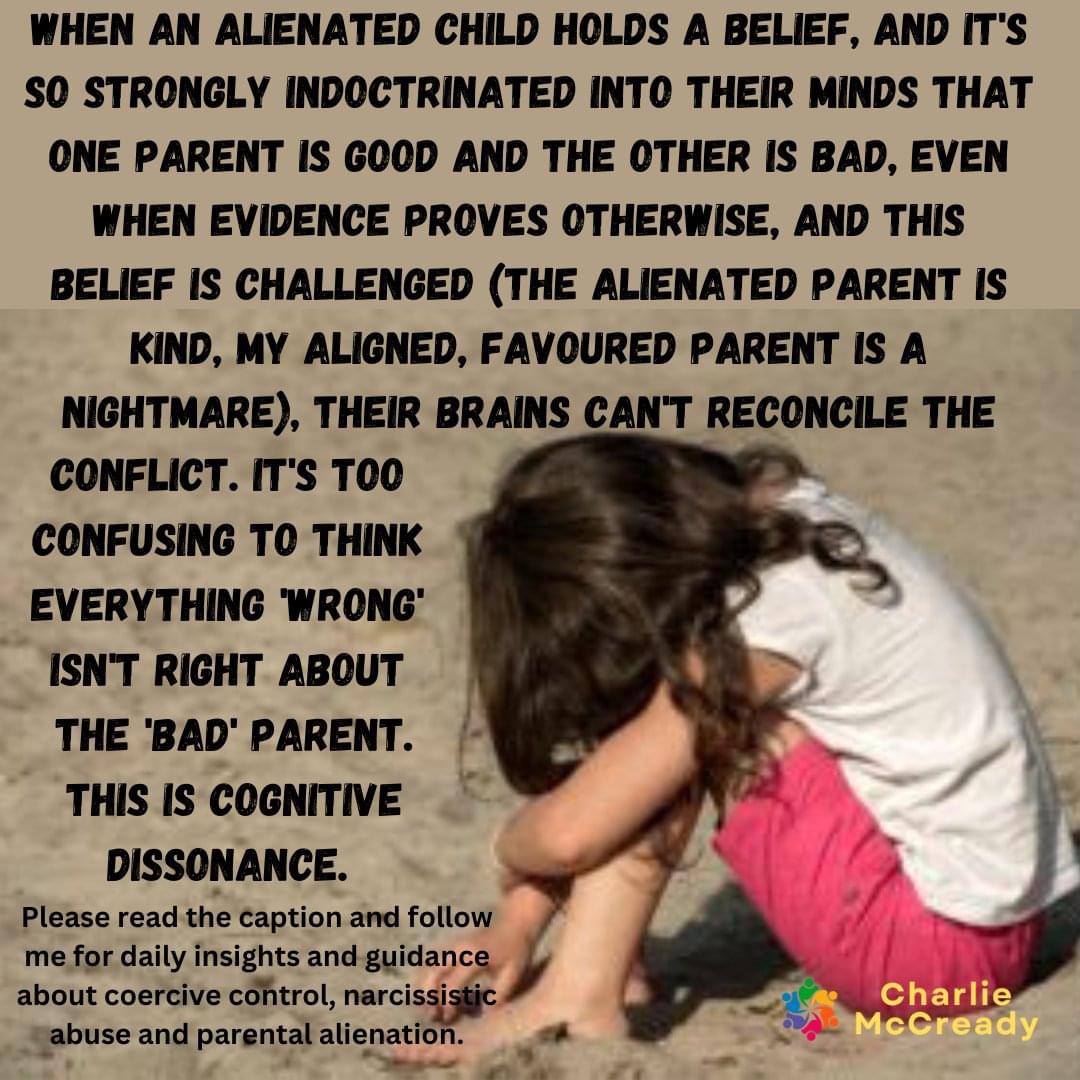
Cognitive confusion contributes to the emotional cut-off and psychological splitting that an alienated child typically adopts to enable them to cope with what is a hugely stressful, confounding and challenging situation. They shut down. There are two conflicting narratives/parents. On the one side, they have the ‘favoured’ parent, whom they align with, believe, defend, protect, and often, deep down fear too. Then there’s the parent they have loved and who now is apparently out of bounds, bad, unloving and whatever else the alienating parent cares to attribute to them. But when the child finds out this isn’t true – their ‘good’ parent has lied to them – it may feel like they’ve got nowhere to turn. They’ve been coerced into rejecting a loving, loved parent. It is an appalling situation for them. The ‘target’ parent might seem out of limits, out of fear of upsetting the ‘favoured’ parent. The child may feel they’ve burned their bridges. The child was ‘asked’ to choose, but in fact, given little choice at all. They feel if they reach out to the ‘target’ parent, they lose the ‘only’ parent they have known to trust …. but who to trust now? It is incredibly isolating for the child. This is the impact of triangulation, which is another alienating behaviour. Divide and rule. Keep everyone apart so they can’t share notes and get to the truth. But cognitive dissonance is something that can be cured, with the truth, with time. Do all you can to keep your door open, be available when they call, keep it light if and when you see them, and try not to react to provocation or rudeness. They have suffered child psychological abuse and coercive control. It is terrible for them to have been put into that situation and not have known it, and it’s also terrible for them to know the truth of it. We have to treat them with great patience and love, as and when they ‘see the light’ one day. They may see it long before they ‘dare’ to come back to us or ever admit this realisation of the truth. They might be afraid and confused for some time and continue denying their alienating parent’s behaviours. This is difficult, I know, but we have to be careful not to rush them.

#charliemccready

#parentalalienationcoach

#parentalalienation

#parentalalienationawareness

#cognitivedissonance

#psychologicalchildabuse

#childpsychologicalabuse

#FamilyCourt

#alienatedchild