Naming pain – Parental Alienation

Most of us had never heard of ‘parental alienation’ until it happened to us. In my case, it was as a step-parent, and I knew something was wrong. Social services wouldn’t listen to me, and I understand their position, but there was zero support until the child told her teacher at school she didn’t want to return home., she was scared. Brave child, finally saying something, and thankfully all is well now (though I became a scapegoat, the abusive parent blameless …..) This was back in 2001. That’s when it started for me – a huge amount of research and many years of personal experience because I was then alienated from my children. It’s complicated, shocking, baffling, painful, heartbreaking, and incredibly isolating. So the day we find out there’s a name for it – parental alienation – is helpful. It exists (though some would like to say it doesn’t). It is something tangible, and these days, there’s a wealth of peer-reviewed research on alienating behaviours too, and sites like mine here. This is the way towards healing, through understanding the pathology, knowing it’s not you, becoming resilient and focusing on the love, not the loss and the present, not the past. Hold fast, and stay strong.

#charliemccready

#parentalalienationcoach

#CoerciveControl

#emotionalabuse

#traumabonding

#custody

#parentalalienation

#ChildCustody

#narcissisticabuseawareness

#parentalalienationawareness

#custodybattle

Alienated Children – Lack of self love

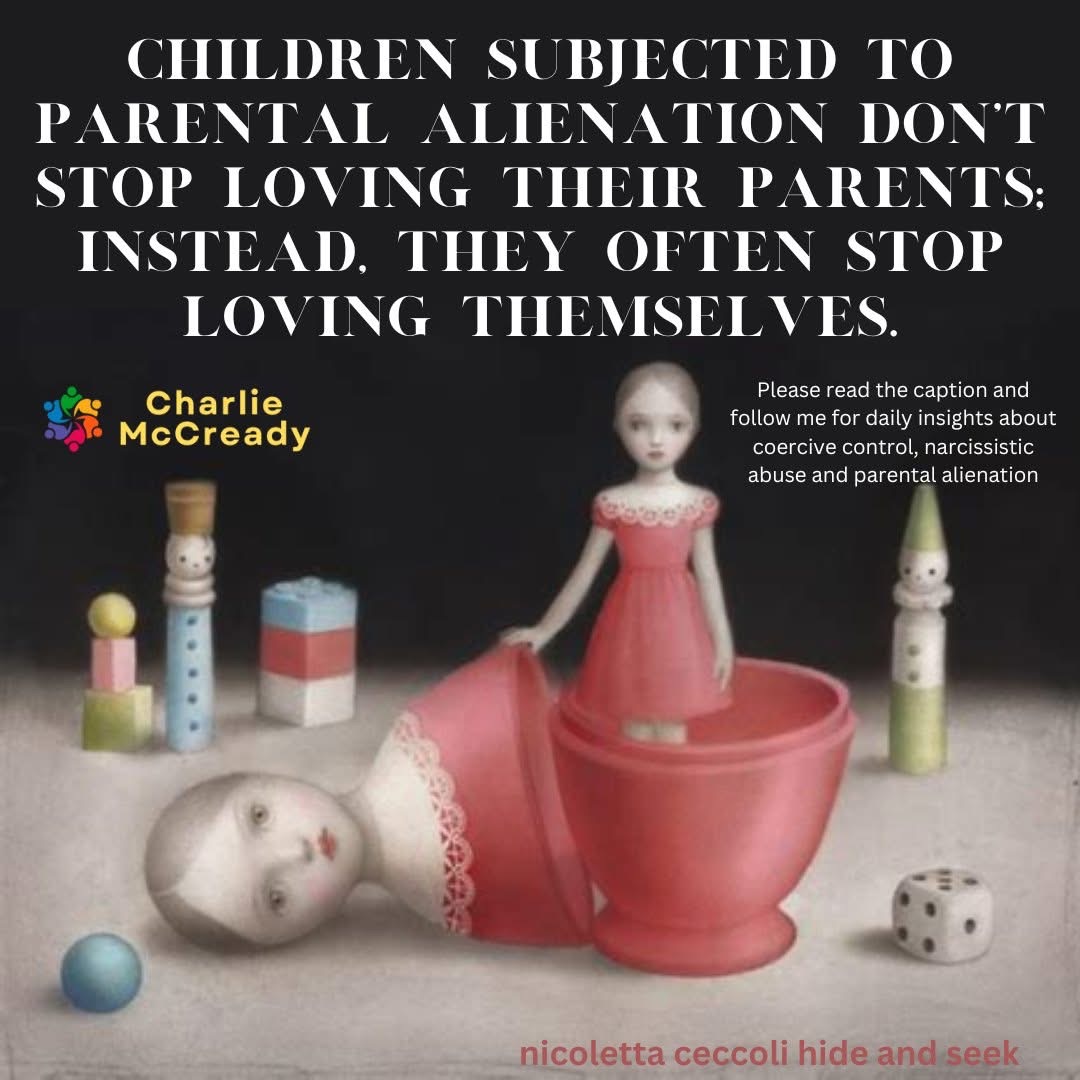
Parental alienation can lead to children distancing themselves emotionally and physically from one parent due to the influence and manipulation of the other parent. The child’s response to this complex situation includes severing contact and adopting a defensive, even hostile stance toward the ‘target’ parent. This strategy serves as a mechanism to navigate the loyalty conflicts and psychological pressures they experience. This inadvertently compels the child to suppress their genuine emotions and authentic self, as they prioritise gaining the approval of the alienating parent to maintain a semblance of peace and stability. The child may internalise the negative narratives about themselves and their alienated parent promoted by the alienator, leading to feelings of inadequacy, guilt, self-blame, and diminished self-worth. ⁠

Children have limited perspectives. Unconsciously, they may believe that any abuse they get from their parents is deserved because it’s their fault. When ignored or their needs and interests are neglected, a child can believe it’s because they’re not good enough. Or that they’re difficult, a nuisance, a problem. If nothing is done to correct these erroneous beliefs, the child will believe they’re true, and the lack of self-worth and the general self-loathing they feel for themselves may be reinforced. It’s not the child that is the problem, but the parenting. This, unfortunately, is how dysfunctional parenting from an unhealed parent can get passed on to the child. ⁠

These internal conflicts and loss of self-love, combined with the desire to maintain attachment to an alienating (abusive) parent, can suppress feelings for the targeted parent. This may not be forever. The love for the alienated parent can endure despite the manipulation and psychological pressures inflicted upon them. Love, as a force, can prevail over the influence of hate and manipulative abuse. ⁠

#charliemccready

#parentalalienationcoach

#emotionalmanipulation

#parentalalienationawareness

#CoerciveControl

#traumabonding

#narcissisticabuseawareness

#ChildCustody

#mothersmatter

#FathersMatter

#custody

#FamilyCourt

#parentalalienation

#traumabond

#childabuse

#narcissisticparent

Charlie McCready / Can’t unsee the truth – Parental Alienation

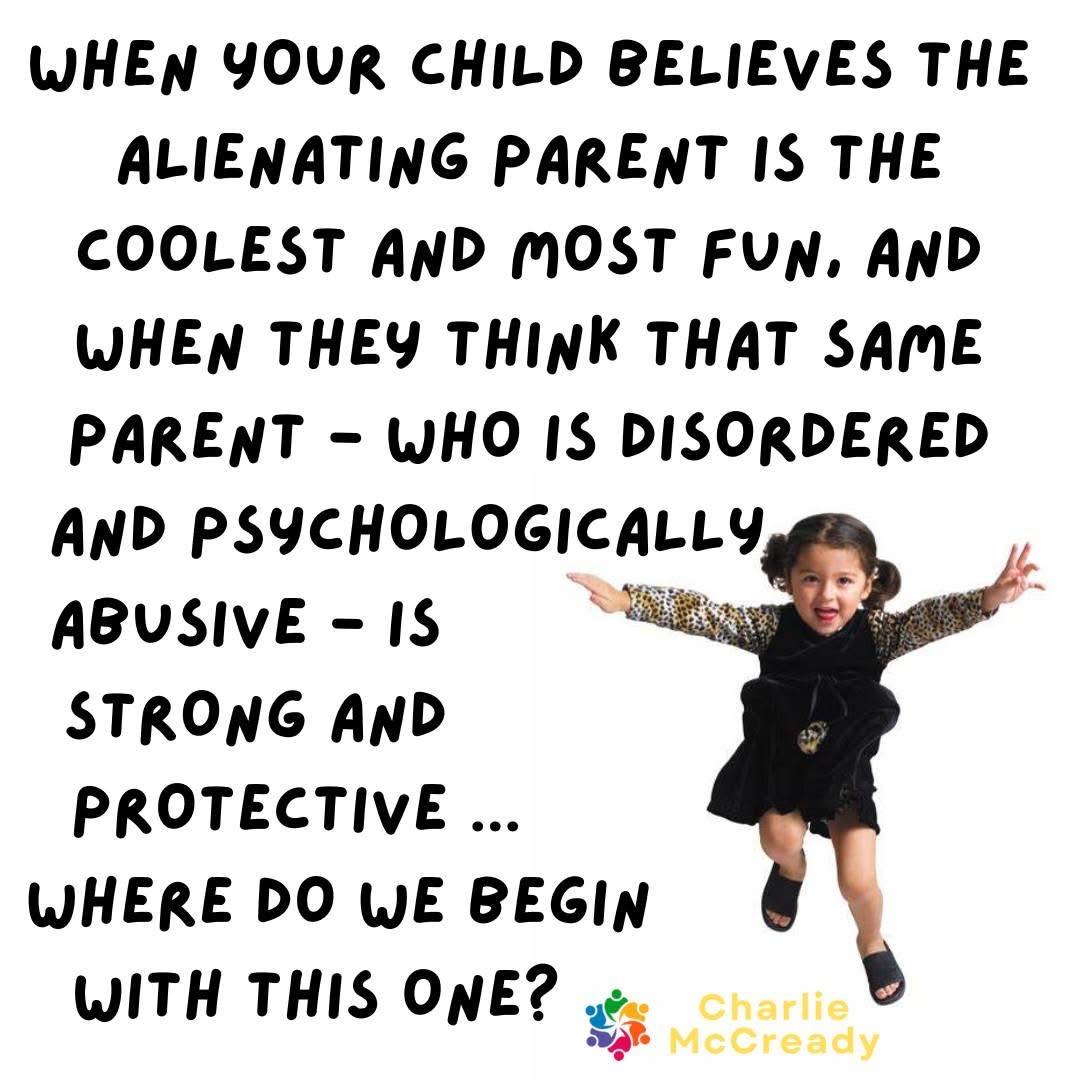
When you can’t unsee the truth, we wonder why others are so blind to it. But we can’t underestimate the coercive control and psychological abuse that’s been inflicted. A child’s perception of the alienating parent as cool, fun and protective is also really painful – and annoying – when our experience of them is quite different. ⁠

Children naturally gravitate towards their parents’ positive traits. The child’s innate yearning for love and care from both parents can lead them, after alienation has done its worst, to idealise the alienating parent. Unfortunately, the child’s cognitive development might not allow them to fully grasp the manipulative and psychologically abusive tactics hidden behind this facade. Plus, as I said recently, the abuser doesn’t abuse every day. ⁠

The deliberate alienation, emotional distance, ceaseless criticism, and limited and disrupted contact between the child and the ‘target’ parent can magnify the contrast between the parents. Additionally, the alienating parent strategically assumes the role of a strong and protective figure, exploiting the child’s natural need for security. By fostering this dependency, the child becomes resistant to questioning the authenticity of their perception.⁠

The child’s unwavering belief in the alienating parent’s favourable attributes clouds their judgment, causing them to overlook or dismiss any signs of the alienator’s abusive conduct. Consequently, the child’s loyalty becomes deeply ingrained, obliging them to shield the alienating parent, even if it entails distancing themselves from the other parent.⁠

It’s important to remember that change is possible. Over time the child can become disentangled from the manipulations, start to question things or see behaviours that jolt them out of the ‘blindness’. They have the potential to ‘wake up’ to the truth. and then they may be in the position as you, not being able to ‘unsee’ what’s been happening. ⁠

#charliemccready

#parentalalienationcoach

#familycourts

#custody

#parentalalienationawareness

#narcissisticabuseawareness

#narcissisticparent

#ChildCustody

#FamilyCourt

#custodybattle

#disneyparents

#emotionalabuse

#parentalalienation

Parental Alienators hide their abuse in shadows/Charlie McCready

Alienating parents and their cohorts work in the shadows. Their abuse is often hidden from sight to all but the target parent. This makes it 100 times worse as the target parent feels nobody hears them or sees what’s happening, not even the therapists and family courts. It makes it incredibly challenging for the target parent to seek help or gain support. It can also be covert and confusing to its victims because there are days when the alienating parent can be affectionate, kind, and caring. This is often why the abused child (and target parent) sticks around, hoping for more good days. But the moments of no-drama can give false hope. ⁠

A few Quentin Tarantino characters come to mind. He writes his villains so well because he shows us the side they show to people they’re not abusing. In Django Unchained, Calvin Candie, played by Leonardo DiCaprio, is a charismatic and charming plantation owner. In one scene, Calvin talks about the French delicacy, “Croque Monsieur.,” amusing and entertaining his guests over a sumptuous dinner. But Calvin is also a cruel and sadistic slave owner who subjects his slaves to brutal treatment. The contrast between his charming demeanour and abusive behaviour highlights his character’s complexity and how he manipulates those around him. ⁠

Just as characters in Tarantino’s films can appear charming while perpetrating cruelty, the alienating parent employs a similar tactic of alternating between kindness and manipulation. This intricate interplay between light and darkness serves to ensnare the child in an emotionally fraught situation. Unfortunately, many Family Court Judges don’t see through the charm, lies, trauma bonds, and indoctrination. They consistently ignore the abusive parent’s coercive control, psychological abuse and dishonesty, often giving that parent placement of the children. The system is broken and failing target parents and alienated children all over the world. We need to do all we can to bring this abuse to light.⁠

#charliemccready

#parentalalienationcoach

#narcissisticabuseawareness

#CoerciveControl

Parental Alienation – Getting out Alive / Charlie McCready

I lived through and overcame what we commonly call “parental alienation.” Mine was (on the scale through mild and moderate) in the severe range. I endured lies, constant criticism, emotional and financial abuse, damaged property, and work suffering under the weight of the stress. For over 10 years of a so-called marriage, I faced a living nightmare. Many of us feel we can tolerate it for the sake of our children. Even if we anticipate that the madness will escalate if we leave, most of us have no idea just how far an alienating parent is prepared to go until it’s actually happening. Nor do many of us realise the weaponising and parentifying of our children may have been going on for some time already, and worse, our children are enmeshed, and don’t know they’re being psychologically manipulated and abused, and that what’s going on is disordered pathogenic parenting from the parent coercively controlling them, turning them against us. It’s heartbreaking to witness the extent of their psychological ‘splitting’ and cognitive dissonance – where they cope by viewing one parent as all good, the victim/hero, an the other as all bad, bearing the full weight of the projection and blame. It’s hard to cope with the lies, false narratives and terrible loss to ourselves, and our children (who do not even realise their loss). ⁠

Alienating a child from a parent is psychological abuse. Alienators—whether mothers, fathers, or other family members—are abusive, destroying the natural attachment bond between a loving parent and their child. To those of you reading this because you or someone you love is enduring this tremendously challenging and needless ordeal: it can be overcome – you can survive. I did, and you can too. Focus on the present, not the past; on love, not loss. Nurturing your own well-being is essential, not only for you but also for your children. Alienated children sometimes carry a terrible burden of doubt, guilt or shame, even grief when they find out what’s actually happened. Seeing you happy, healthy, and thriving, with healthy boundaries, offers them relief and shows them the way back to a loving parent.

Whether you’re in contact with your children or not, you can get through this—and doing so is a gift both to yourself and to them. I’m here to help. My coaching is dedicated to supporting alienated mothers, fathers (sometimes with supportive partners joining us, too). Please do reach out if you’d like to learn more about the coaching I offer.

#charliemccready

#parentalalienationcoach

#highconflictcoparenting

#custody

#narcissisticabuseawareness

#parentalalienationischildabuse

Parental Alienation- Charlie McCready

I fervently believe, especially as I’ve been through the hell known as parental alienation myself, both as a parent and as a step-parent (for over 20 years), it is an urgent mental health issue that needs recognition and attention. This distressing, heartbreaking and totally unnecessary form of spousal and child psychological abuse involves one parent intentionally manipulating a child’s emotions and perceptions, using all sorts of toxic and controlling techniques to weaken or sever their bond with the other parent. In some cases, though thankfully not all, it can have severe and lasting negative effects on the child’s emotional well-being and overall development.⁠

Addressing parental alienation requires collaboration among mental health professionals, legal experts, educators, and society as a whole. By raising awareness about this damaging abuse, advocating for its recognition, and providing resources for parents, children, and professionals, I hope we can work towards preventing and mitigating the adverse effects of parental alienation on the well-being of children and families.

#charliemccready

#parentalalienationcoach

#narcissisticabuseawareness

#parentalalienation

#FamilyCourt

#mothersmatter

#FathersMatter

#CoerciveControl

#traumabonding

#narcissisticparent

#parentalalienationawareness

Isolation- Charlie McCready

The isolation felt when we are alienated from our children is profound and layered with feelings of frustration, shock, deep grief, and anger. It’s not just the pain of this manipulated, enforced separation from our child and the constant worry about the damage being done to that precious relationship; it’s the crushing sense of powerlessness and the disbelief that someone who is meant to love your child would go to such lengths to destroy the bond with you and your child. Adding to this turmoil is the misunderstanding and even judgment from others who can’t grasp the complexity of what we’re going through. They might say, ‘Just give it time,’ ‘There must be two sides to this,’ or even, ‘At least you don’t have to deal with the teenage years!’—all in an attempt to simplify and explain (whether to us or themselves) something that’s anything but simple. Have you experienced this yourself?⁠

Instead of comfort, these comments can intensify our loneliness and despair, making us feel even more alienated. This is why finding support among those who truly understand is vital. Being part of a community that recognises the manipulation and the injustice you’re facing can offer real empathy and validation. I hope that my daily posts, drawn from both personal and professional experience with parental alienation, provide this, as much as is possible in this forum. My aim is to raise awareness, offer solace, and remind you that you are not alone in this.⁠

Remember, parental alienation is not a reflection of your worth or your actions. It’s a form of psychological abuse, a complex pathology, an attachment disorder. Draw strength from knowing there are others who are working to understand, and are advocating for change. Personally and professionally, I have over 20 years of experience. I am reunited with my children and here to offer support with daily posts on social media and also with the coaching I offer. Feel free to reach out to me anytime.⁠

#charliemccready

#parentalalienationcoach

#narcissisticabuseawareness

Craig Childress PsyD – 2nd opinion Consultant -Child Psychological Abuse

I’m a second opinion consultant. That’s what old folks are best at.

We have experience. The young do, the old consult from our accumulated wisdom.

I have a very niche role. I have a client-parent-attorney. My role is to do what I can to ensure the child and family receives an accurate diagnosis and effective treatment plan, and that the Court receives an accurate diagnosis of the family problem for its decision-making surrounding the child.

If you value my opinion regarding the pathology in the family, then I am of value. If my opinion regarding the pathology present in the family is not valued, then I am of no value.

It all comes down to my credibility. Is what I’m saying true or false?

Look it over. Decide. You’ll find that everything I say about the pathology in the family courts is 100% supported, true, and correct.

I know that. I know that it all comes down to credibility. That’s why I’ve grounded in established knowledge, beginning with the DSM-5 diagnostic system of the American Psychological Association and the ethics code for the American Psychological Association.

Forensic psychologists, take a look at what Dr. Childress is asserting. Is it true of false? Judges and court-involved professionals, take a look at what Dr. Childress is asserting. Is it true or false?

Decide. I’ll wait. Dum-dee-dum… it’s true.

So can we now move forward into protecting children from child abuse, and their parents from spousal abuse?

I wrote an email confirming the information I discussed in a consultation session with a parent for documentation purposes to be shared around professionals.

You may find it’s content helpful as well. I always say the same thing – and I’ll continue to say the same thing until we start protecting children from child abuse by a narcissistic-borderline-dark personality parent.

_______________

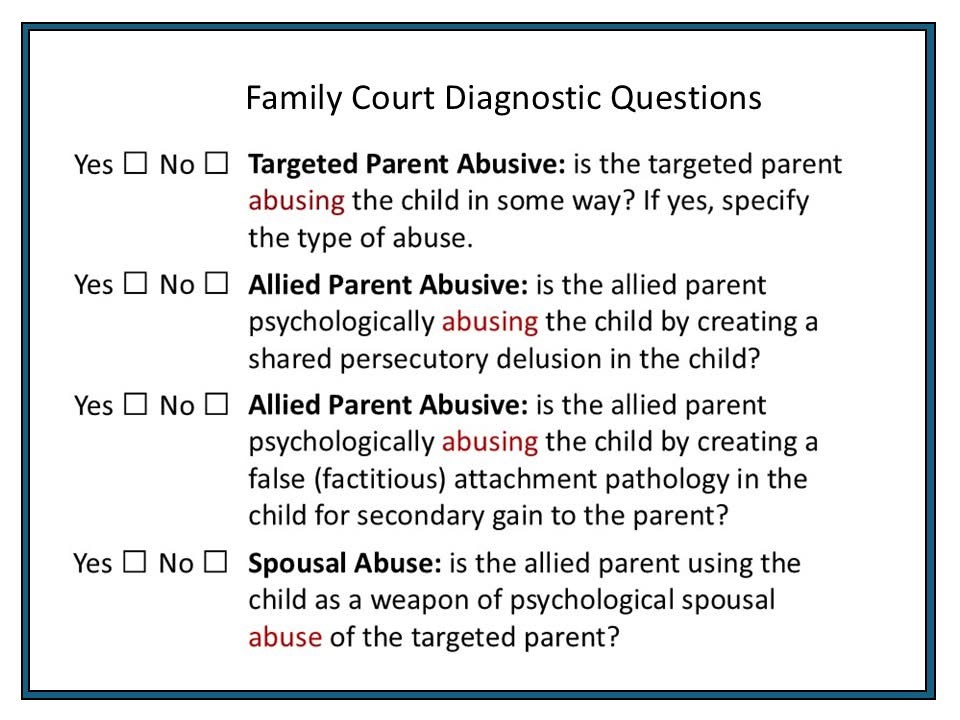
Diagnosis: your family will need an accurate diagnosis of the problem so that an effective treatment plan can be developed. Currently, I am not confident that the pathology (problem) in the family has been accurately diagnosed.

Clinical Concerns (differential diagnosis): the clinical concerns surrounding the family problem include the following differential diagnostic possibilities:

• Child abuse by father (specify the type of abuse)

• A persecutory delusion with the mother induced in the child (DSM-5 297.1 Delusional Disorder; persecutory type)

• A false (factitious) attachment pathology imposed on the child by the mother’s distorted parenting (DSM-5 300.19 Factitious Disorder Imposed on the Child; FDIA)

• Child psychological abuse by the mother who is creating false attachment pathology in the child for secondary gain to the mother (DSM-5 V995.51 Child Psychological Abuse)

• Spousal psychological abuse of the father by the mother using the children as the spousal abuse weapon (DSM-5 V995.82 Spouse or Partner Abuse, Psychological).

I have attached the diagnostic questions that need to be answered. The current family therapist has duty of care and duty to protect obligations relative to the diagnostic concerns involved.

I have the following resources available for the treating therapist and GAL (and Court) regarding the diagnostic assessment of court-involved family conflict surrounding child custody:

• YouTube Diagnosis Series: DSM-5 Diagnoses of Family Court Pathology

• YouTube Diagnosis Series: Diagnosing a Persecutory Delusion

• YouTube Diagnosis Series: Diagnosing a Factitious Disorder Imposed on the Child

• YouTube Diagnosis Series: Diagnosing Child Abuse in the Family Courts

• YouTube Diagnosis Series: Assessing Parenting

I recommend that a proper risk assessment be conducted for the family to the appropriate differential diagnoses for each parent. The current therapist has duty of care and duty to protect obligations, and it would be incumbent upon this therapist to either conduct a proper risk assessment for the dangerous pathologies potentially involved in the family, or to ensure that a proper risk assessment gets conducted.

Dangerous Pathology & Risk Assessments

There are three dangerous pathologies, suicide, homicide and abuse (child, spousal, and elder abuse), Whenever a mental health professional encounters any dangerous pathology (suicide, homicide, abuse) duty to protect obligations are active and the mental health professional must do three things:

1) Risk Assessment: the mental health professional must personally conduct a proper risk assessment for the danger involved, or ensure that a proper risk assessment gets conducted,

2) Protective Action: the mental health professional must take an affirmative protective action to ensure everyone’s safety (this might be increasing the frequency of sessions for a suicidal patient, or a CPS referral for child abuse concerns).

3) Documentation: the mental health professional should then document the findings of the risk assessment (if one was conducted) and the affirmative protective action taken.

I indicated that I am available for professional consultation with all court-involved mental health and legal professionals.

I am attaching the domains of my expertise and vita. Court-involved professionals can also follow me on Bluesky: @drchildress.bsky.social

Craig Childress, Psy.D.

Clinical Psychologist

WA 61538481

OR 3942 – CA 18857