Lesson your pain

“You have some power to lessen your pain! Try using imagery for 15 minutes, two or three times each day.

Put on your favorite calming music.

Lie back on your favorite chair or sofa.

Or if you are at work, sit back and relax in your chair.

Close your eyes.

Imagine your pain or discomfort.

Imagine something that confronts this pain.

Watch it “destroy” the pain.”

from https://www.womenshealth.gov/a-z-topics/autoimmune-diseases

Reaching out

Please try to keep in mind that the friend who reaches out would love to be reached out to.

The friend who does the inviting would love to be invited.

The friend who listens would love to be listened to.

The friend who helps would love to be helped.

The friend who shows up would love to be shown up for.

The friend who initiates things would love if someone would initiate things with them.

The friend who plans would love to have something planned for them.

The friend who compliments would love to be complimented.

The friend who gives would love to be given to.

The friend who makes others a priority would love to be prioritized.

The friend who appreciates would love to be appreciated.

Everyone has a breaking point. Everyone has a limit. Everyone gets exhausted and grows weary of a friendship that isn’t returned, so make sure you are reciprocating.

Be intentional with where you pour and how you pour.

We act like you can’t lose genuine friendship, but absolutely you can. You can lose anything and anyone you don’t nurture.

Everyone in every healthy relationship needs to feel valued.

Make the effort.

Or don’t say I didn’t warn you.

Amy Weatherly 💫

Craig Childress PsyD – Persecutory Delusion

Persecutory Delusion

A delusion is a fixed and false belief maintained despite contrary evidence, it is a type of thought disorder.

A persecutory delusion is a fixed and false belief that the person (or someone to whom the person is close) is being malevolently treated in some way.

The American Psychiatric Association defines a persecutory delusion:

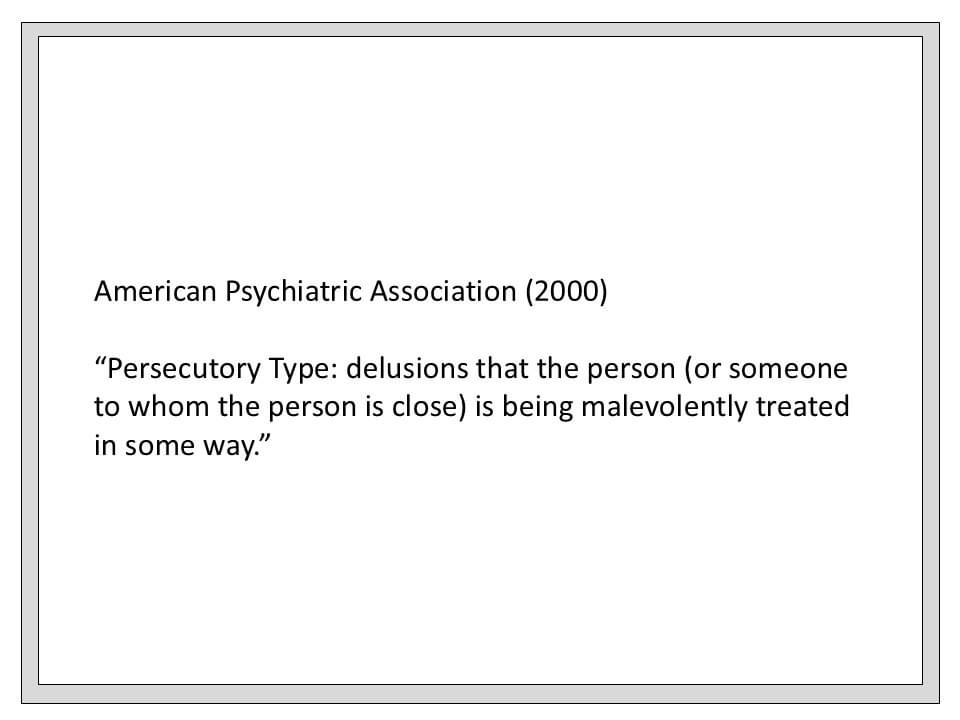
From the APA: “Persecutory Type: delusions that the person (or someone to whom the person is close) is being malevolently treated in some way.” (American Psychiatric Association, 2000)

The American Psychiatric Association describes a shared (induced) delusional disorder,

From the APA: “Usually the primary case in Shared Psychotic Disorder is dominant in the relationship and gradually imposes the delusional system on the more passive and initially healthy second person… Although most commonly seen in relationships of only two people, Shared Psychotic Disorder can occur in larger number of individuals, especially in family situations in which the parent is the primary case and the children, sometimes to varying degrees, adopt the parent’s delusional beliefs.” (American Psychiatric Association, 2000)

Craig Childress, Psy.

Clinical Psychologist,

WA 61538481 – CA 18857