
Tag: education
Narcissist “ love “
Narcissist Total Control and Discard
Blood study shows trauma and grief
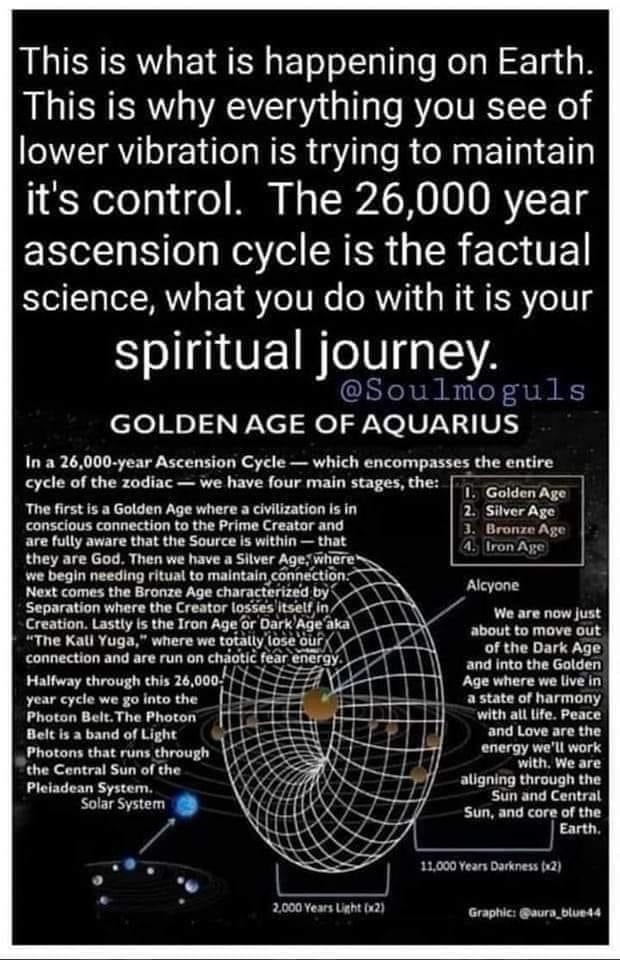
26,000 year cycle
“A Reminder” ~ The Pleiadians,
through Barbara Marciniak
One of the most exciting aspects of being on Earth right now is that there is a reordering or re-equipment taking place in your DNA.
Cosmic rays reach the planet so that a change is transmitted and a reordering occurs within the body.
The scattered data, which contain the history and consciousness of the Living Library, are now coming together.
DNA is evolving.
New helices or strands are being formed as the light-encoded filaments begin to clump together. The scattered data is being gathered into your body by the electromagnetic energies of Prime Creator.
We are here to observe this process in you, to help you and to evolve as well.
As this rebuilding or reordering converges, you will create a more evolved nervous system that will allow much more data to pass into your consciousness.
You will awaken many brain cells that have been dormant and will be using your entire physical body instead of the small percentage that you have been working with.
Every place on the planet is being affected by this shift, this awareness.
Those of you who are Keepers of Light and who wish to completely change this present reality and bring in different options are anchoring the frequency.
If not anchored and understood, it can create chaos. It will create chaos.
This is why you must ground yourselves.
Chaos brings with it a state of reorganization when used properly.
Time is collapsing and energy is becoming higher and higher.
You came here to utilize that energy first. You will create pathways of consciousness by drawing energy into your body that will help others so they don’t have to go through what you go through.
Many people will suddenly start to feel this energy without any preparation.
You are all pulling light, which is data and information, onto the planet, and in doing so, you are producing new pathways to explore consciousness without even saying a word. The new paths of consciousness produce new realities, new options and new ways of living and being.
Jim Palmer – Christian doctrine
As you know, I once was an evangelical megachurch pastor and my pastoral career stretched over many years. Eventually, I could no longer teach Christian doctrine with a good conscience and realized this teaching was not truly changing people’s lives… and so I walked away from the whole enchilada.
Below are 14 things that the misguided religious establishment doesn’t want you to know. Speaking for myself and my personal experience, I was not able to see or admit these things to myself. I truly got into ministry initially because I wanted to make a difference and help people, and I relied upon the belief-system I learned as the proper framework to achieve this. It took a lot of post-religion reflection to see the ways this belief-system was hurting people.
I offer the below list in hopes that you might disentangle yourself from harmful beliefs and attitudes impacting your life.
14 things the misguided religious establishment doesn’t want you to know:
1. Toxic religion is rooted in fear, especially fear about the afterlife. It leverages the false doctrine of hell to win converts and demand holiness. The fear of God’s disapproval, rejection, abandonment and punishment is another hallmark of toxic religion.
2. Clergy have no innate authority. Holding a church leadership position or having a theological degree does not imbue a person with special divine authority or superiority. The terms “anointed”, “called”, or “chosen” or titles such as “pastor”, “priest”, “bishop”, “elder”, “evangelist” or “apostle” do not confer any innate authority on an individual or group.
3. We hold sacred what we are taught to hold sacred, which is why what is sacred to one community is not sacred to another.
4. The stories in our sacred books aren’t history, nor were they meant to be. The authors of these books weren’t historians but writers of historical fiction: they used history (or pseudo history) as a context or pretext for their own ideas. Reading sacred texts as history may yield some nuggets of the past, but the real gold is in seeing these stories as myth and parable, and trying to unpack the possible meanings these parables and myths may hold.
5. Prayer doesn’t work the way you think it does. You can’t bribe God, or change God’s mind through obedience, devotion, or groveling. The underlying theistic premises of prayer are untenable.
6. Anything you claim to know about God, even the notion that there is a God, is a projection of your psyche. What you say about God—who God is, what God cares about, who God rewards, and who God punishes—says nothing about God and everything about you. If you believe in an unconditionally loving God, you probably value unconditional love. If you believe in a God who divides people into chosen and not chosen, believers and infidels, saved and damned, high cast or low caste, etc. you are likely someone who divides people into in–groups and out–groups with you and your group as the quintessential in-group. God may or may not exist, but your idea of God mirrors yourself and your values.
7. Nobody is born Jewish, Muslim, Hindu, Catholic, Protestant, etc. People are born human and are slowly conditioned by narratives of race, religion, gender, nationality, etc. to be less than human.
8. Theology isn’t the free search for truth, but rather a defense of an already held position. Theology is really apologetics, explaining why a belief is true rather than seeking out the truth in and of itself. All theological reasoning is circular, inevitably “proving” the truth of its own presupposition.
9. Becoming more religious cannot save us. Religion is a human invention reflecting the best and worst of humanity; becoming more religious will simply allow us to perpetuate compassion and cruelty in the name of religion. Because religion always carries the danger of fanaticism, becoming more religious may only heighten the risk of us becoming more fanatical.
10. Becoming less religious cannot save us. In fact, being against religion can become it’s own fanaticism. Becoming less religious will simply force us to perpetuate compassion and cruelty in the name of something else. Secular societies that actively suppress religion have proven no more just or compassionate than religious societies that suppress secularism or free thought. This is because neither religion nor the lack of religion solely nullifies our human potential to act out of ego, greed, fear, hostility, and hatred.
11. A healthy religion is one that helps us own and integrate the shadow side of human nature for the good of person and planet, something few clergy are trained to do. Clergy are trained to promote the religion they represent. They are apologists not liberators. If you want to be more just, compassionate, and loving, you must do the personal work within yourself, and free yourself from the conditions that lock you into injustice, cruelty, and hate, and this means you have to free yourself from all your narratives, including those you call “religious.”
12. Religious leaders claims that their particular understanding and interpretation of their sacred books should be universally accepted. Religious leaders often say, “My authority is the Bible.” It would be more accurate for them to say, “My authority is what they taught me at seminary the Bible means.” People start with flawed or false presuppositions about what the Bible is, such as: the Bible was meant to present a coherent theology about God or is a piece of doctrinal exposition; the Bible is the inerrant, infallible and sole message/”Word” of God to the world; the Bible is a blueprint for daily living. Too often religious leaders make God about having “correct theology.” There are a lot of unhappy, broken, hurting, suffering, depressed, lonely people in church with church-approved theology.
13. If your livelihood depends on the success of your church as an organization, it doesn’t take a rocket scientist to see that you will mostly define and reward Christianity as participation in church structures and programs. Christian living is mostly a decentralized reality or way of life, not a centralized or program-dependent phenomenon. Church attendance, tithing, membership, service, and devoted participation, become the hallmarks of Christian maturity.
14. You are capable of guiding your own spiritual path from the inside out and don’t need to be told what to do. You naturally have the ability, capacity, tools and skills to guide and direct your life meaningfully, ethically and effectively. Through the use of your fundamental human faculties such as critical thinking, empathy, reason, conscience and intuition, you can capably lead your life. You have the choice to cultivate a spirituality that doesn’t require you to be inadequate, powerless, weak, and lacking, but one that empowers you toward strength, vitality, wholeness, and the fulfillment of your highest potentialities and possibilities.
Jim Palmer

Defying Societal Norms: Choosing a Child-Free Life for Happiness
Aware that my 40/50 year old single women are not needy, those who have children , are focused on those children , health, finances etc .
The younger generations are choosing to be single and choosing not to have children.
Having children with X was a huge commitment to a life dream , but being
sacrificed by a man whose control is ongoing , and his monitoring,
fraudulent characteristics including financial as well as the effort
to unalive me , which he has enlisted our children , friends , and family .
I have no idea what he has said , due to his limitless attacks
and it’s understood on high ..it’s being remedied..Thy Will Is Done .
The recalibration , and balance is upon us 💯❤️🎊✌️
Discover how defying societal norms by choosing a child-free life leads to women’s happiness and fulfillment. Explore expert insights.
— Read on www.healthy-holistic-living.com/women-choosing-happiness/
Glimmer at Death
When you die, the energy that kept you alive filters into the people you loved.
Did you know that?
It’s like a fire you’ve tended all your life, and the sparks are all scattered into the wind….
That’s why we survive as long as we do,
because the people who loved us keep us going .
~ Kevin Brockmeier ~
Artist Credit : Elena Kraft

Mind Body Soul explained
Nellie Bly
Eighteen-year-old Elizabeth Cochrane was living in Pittsburgh when the local newspaper published an article titled “What Girls are Good For” (having babies and keeping house was the answer, according to the article). The article displeased Elizabeth enough that she wrote an anonymous rebuttal, which in turned so impressed the paper’s editor that he ran an ad, asking the writer to identify herself. When Elizabeth contacted him, he hired her on the spot. It was customary at the time for female reporters to use pen names, so the editor gave her one that he took from a Stephen Foster song. It was the name under which she would become famous—Nellie Bly.
Bly’s passion was investigative reporting, but the paper usually assigned her to more “feminine” subjects—such as theater and fashion. After writing a controversial series of articles exposing the working conditions of female factory workers, and after again being relegated to reporting on society functions and women’s hobbies, at age 21 Bly left for Mexico on a dangerous and unprecedented (for a woman) assignment to report of the conditions of the working-class people there. After her reporting got her in trouble with the local authorities, she fled the country and later published her dispatches into a popular book.
At age 23, having established a reputation as a daring and provocative reporter, Bly was hired by Joseph Pulitzer’s New York World and there she began the undercover project that made her famous. In order to investigate the conditions inside New York’s “Women’s Lunatic Asylum,” Bly took on a fake identity, checked into a women’s boarding house, and faked insanity—so convincingly that she soon found herself committed to the asylum. The report she published of her ten days there was a sensation and led to important reforms in the treatment of the mentally ill.
The following year Bly undertook her most sensational assignment yet: a solo trip around the world inspired by Jules Verne’s Around the World in 80 Days. With only two days’ notice, Bly set out on November 14, 1889, carrying a travel bag with her toiletries and a change of underwear, and her purse tied around her neck. Pulitzer’s competitor, the New York Cosmopolitan, immediately sent out one of its reporters—Elizabeth Bisland—to race Bly, traveling in the opposite direction. As Pulitzer had hoped, the stunt was a publicity bonanza, as readers eagerly followed news on Bly’s journey and the paper sponsoring a contest for readers to guess the exact time of Bly’s return (with the correct guess winning an expense-paid trip to Europe).
Seventy-two days later, Bly made her triumphant return (four and half days ahead of Bisland), having circumnavigated the globe, traveling alone almost the entire time. It was the fastest any human had ever made the journey. Nellie Bly was an international celebrity.
At age 31 Bly married industrialist Robert Seaman, a 73-year-old millionaire, leaving behind her journalism career and her pen name. As Elizabeth Cochrane Seaman she helped run the family business. She patented two inventions during her time as an industrialist, but business was not her really in her skillset and under her leadership the company went bankrupt. When World War I broke out, she returned to journalism, becoming one of the first women reporters to work in an active war zone.
Nellie Bly’s remarkable life ended on January 27, 1922, one hundred two years ago today, when she died of pneumonia in New York at age 57.
The photos below are a publicity shot taken before departing on her round-the-world trip and a photo taken a couple of years later, before her marriage.


 GreatCosmicMothersUnite