

Tag: child Psychological abuse
Behind the mask of rejection- Alienated Child
Malignant Manipulation by alienating parent
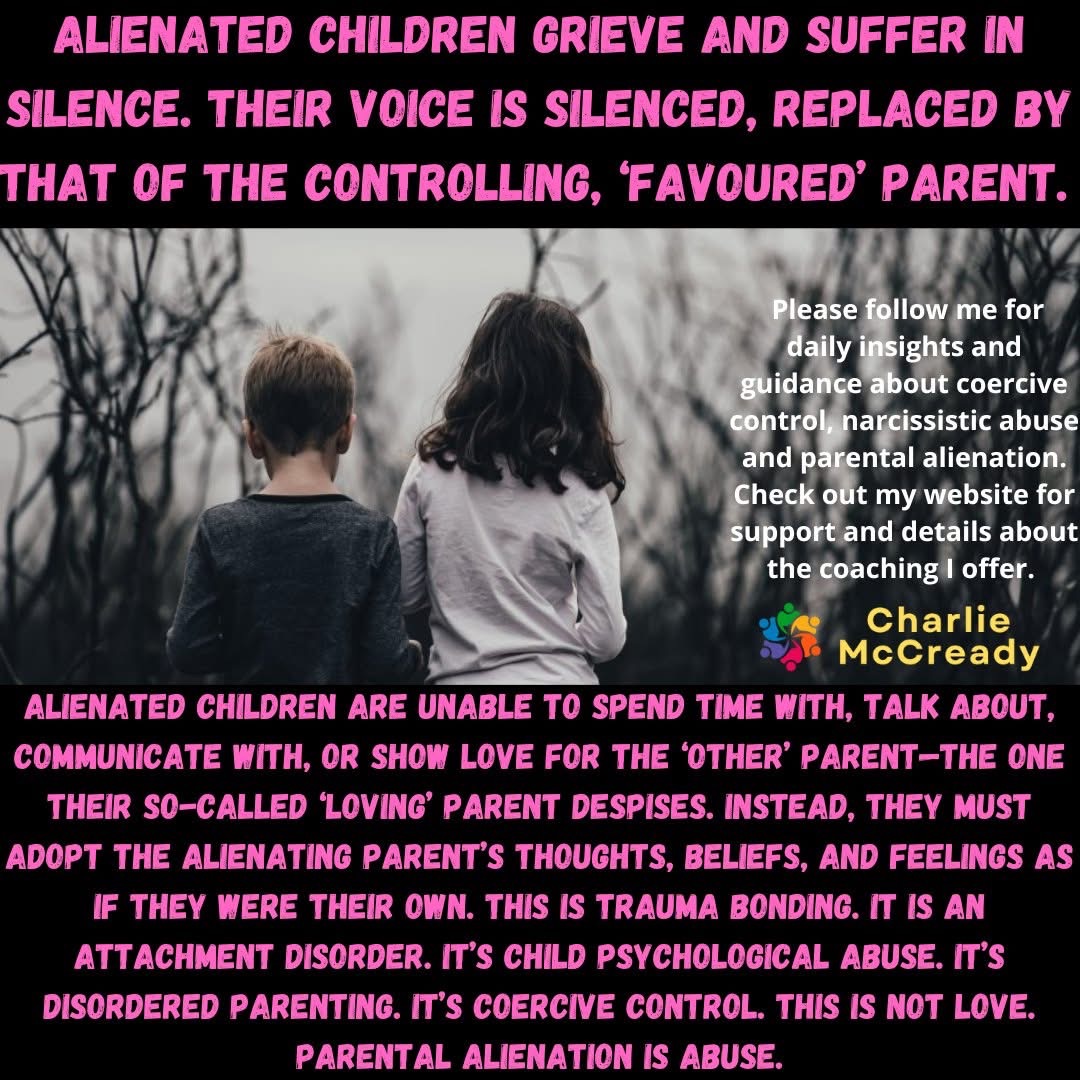
Alienated Children grieve in silence
Many alienated children know, deep down, that they have one parent’s love. Often, it is the parent who loves conditionally—the one often exhibiting toxic, narcissistic, or borderline personality traits—from whom they crave affection, sacrificing their happiness and their relationship with the other parent in the process. Children inherently desire love from both parents. A child does not naturally reject a parent, even an abusive one (which I’ve covered in other posts), and needs to be far better understood.
The targeted parent, like the child, has likely been operating in survival mode within a toxic home environment. If the healthier-minded parent chooses to leave because the home life has become unbearable—recognising that it is harmful for the child too—the fears triggered in the toxic parent can escalate alienating behaviours, which may have already been in play, either overtly or covertly. At this juncture, if not before, the previously loved parent is demonised by the toxic parent, who now positions themselves as the best mother or father in the world.
The child, who may have long craved the love and attention of the toxic parent, may become enamoured with the newfound closeness and the secrets (often lies and delusions) shared by that parent. Yet, they are also scared and confused. They might begin to question whether they misjudged their other (target) parent: Have they truly been abandoned? Did that parent ever love them? This internal conflict often manifests as anger or loyalty to the alienating parent, masking the deeper grief they experience. Their grief may not be overt; instead, it can be expressed through rage, confusion, and compliance, making it difficult for others to see the silent suffering beneath the surface. And they probably are not getting the opportunity (little or none), to believe anything other that what the alienating parent is telling them.
These negative beliefs, reinforced by lies and the alienation tactics of triangulation (obstruction of contact and divide-and-rule), become ingrained. The toxic parent, now playing the roles of victim and hero, often becomes the child’s closest confidant.
In coping with this turmoil, the child may resort to psychological ‘splitting,’ using their anger and hurt feelings as justification for rejecting
the other parent. They adopt the thoughts, beliefs, and behaviours of the toxic parent, believing they have consciously chosen this alignment without external influence. They think it is entirely their decision to turn their back on the other parent. However, what they receive from their aligned parent is not love; it is manipulation. The alienating parent seeks to use the child as a weapon to inflict the maximum emotional pain on the other parent, removing the beloved child from that parent’s life in the most dramatic way possible.
My posts are here not to alarm or upset but to spread awareness about what’s known as ‘parental alienation’ and to provide guidance to those who are going through it, as I did myself. Apart from these daily posts, which I hope help you know you’re not alone, and to better understand it’s an attachment disorder, a pathology, it’s not you; please reach out if I can help with the coaching I offer.
#charliemccready
#parentalalienationcoach
#abuseinthefamily
#pathogenicparent
Pathogenic Parent
You may have read previous posts I’ve written about virtue signalling, which is a symptom of a culture that prioritises appearances over substance, often at the expense of real accountability. In the same way, family courts often strive to maintain an image of fairness and impartiality, but this frequently leads to both parents being treated as equally culpable in high-conflict cases. Tragically, this can result in the targeted parent—the one alienated from their child—being unjustly placed in the same “naughty” camp as the alienating parent. Or worse, they don’t see through the charade and manipulations of the true persecutor.
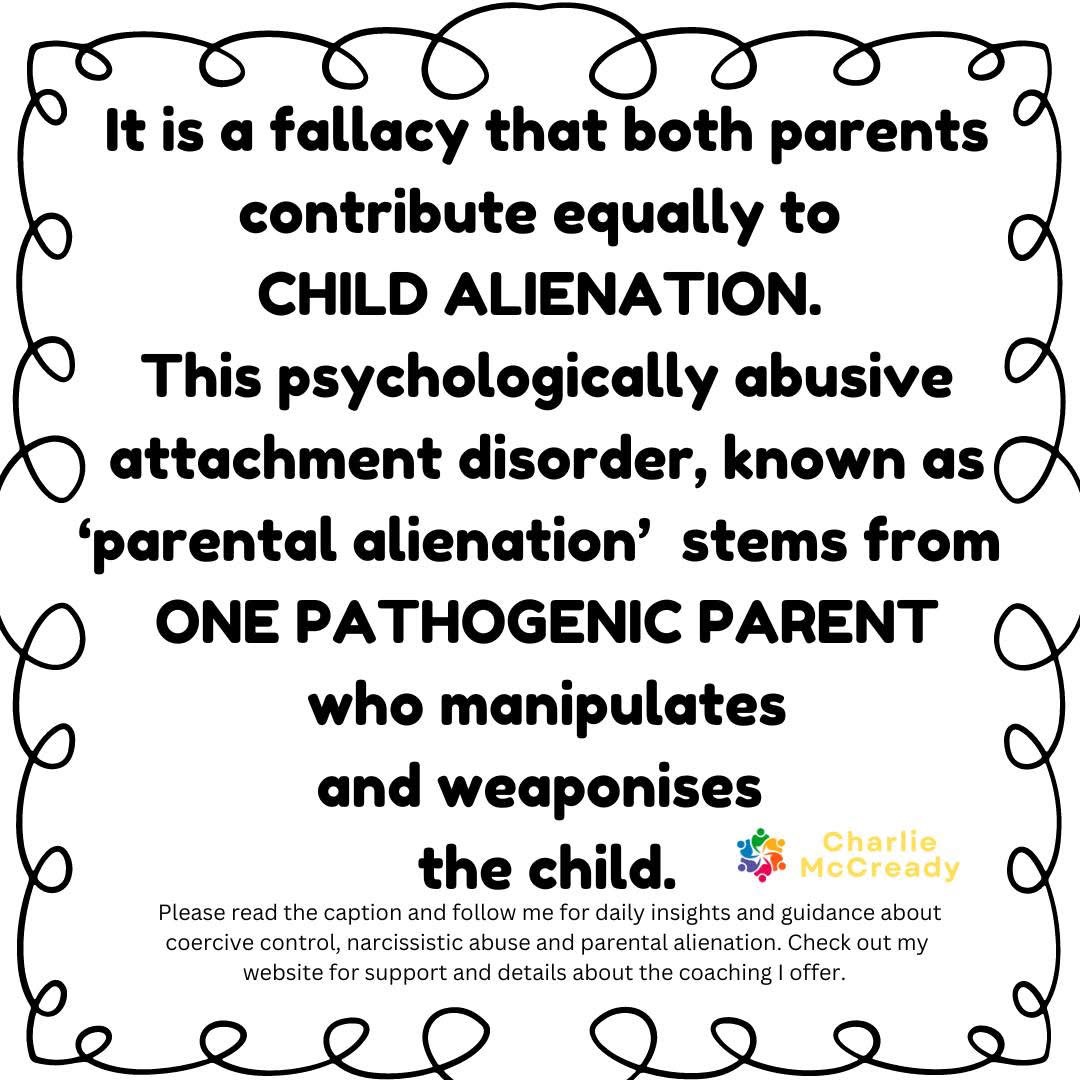
What’s commonly known as ‘parental alienation’ is a psychologically abusive attachment disorder caused by one pathogenic parent who manipulates and weaponises the child against the other parent. Despite this being well-documented in psychiatry, psychology, and social sciences, family courts rarely recognise or act decisively on this knowledge.
Extensive research demonstrates that children fare better with the involvement of two loving, available parents and the wider family on both sides. The American Psychological Association (APA) highlights the significant mental health benefits for children who maintain strong relationships with both parents, even after separation or divorce. A meta-analysis by Bauserman (2002) found that children in shared parenting arrangements experience better emotional, behavioural, and academic outcomes compared to those in sole custody arrangements. Research from Canada’s McGill University reveals that children benefit emotionally, socially, and cognitively when supported by a loving, extended family network.
Furthermore, there is evidence to show that even children who suffer abuse can remain bonded to their abusive parent. This trauma bonding often stems from identification with the aggressor, a psychological survival mechanism in abusive relationships. It is tragic but revealing—children are hardwired to seek love and approval from their caregivers, even in the most harmful circumstances. In cases of parental alienation, this same dynamic is exploited, intensifying the child’s attachment to the alienating parent.
If this is the case, why are the courts not taking decisive action when one parent is clearly sabotaging contact and communication with the other parent?
The courts often listen to the ‘voice of the child,’ influenced by organisations like CAFCASS in the UK or Guardian ad Litem (GAL) representatives in the US, without fully appreciating that this is a child who has been emotionally abused and indoctrinated. Alienating parents engage in coercive control, spreading lies, false narratives, and projections, and using techniques such as triangulation and interference with contact.
These behaviours fall under the umbrella of coercive control. In the UK, coercive control is recognised as a form of domestic abuse under the Serious Crime Act 2015. However, this is not consistently the case in other countries, including the US, where recognition of coercive control varies by state and is not uniformly codified in federal law. In any case, the courts rarely recognise this when it is directed at children, even though it meets the criteria for emotional abuse (at least, under UK safeguarding standards). This failure to understand the dynamics of alienation leaves targeted parents—mothers and fathers alike—with devastating outcomes.
I’m not a fan of the nanny state or ‘big government’, I believe that specialist and experts in the field should have government listen to them, rather than the other way around. Things need to change:
Education and training for family court professionals is critical. Judges, solicitors, CAFCASS/GAL officers, and social workers must understand the tactics of coercive control, false narratives, and manipulation to make decisions that prioritise the child’s best interests. Independent psychological assessments must accompany the “voice of the child” to identify coercive control and emotional abuse. Clear consequences are also needed for parents who violate parenting plans or engage in alienating behaviours, such as therapy mandates or changes in custody arrangements.
Independent Psychological Assessments: The child’s voice should not be considered in isolation but evaluated alongside independent psychological assessments to determine the influence of coercive control and emotional abuse.
Enforcement of Parenting Plans: Clear, enforceable consequences must be in place for parents who violate court-ordered parenting plans or demonstrate alienating behaviours, including mandatory therapy for the alienating parent and the child and fines or changes to custody arrangements when alienation persists.
Mental Health Support for Children: Alienated children need therapeutic support to address the psychological harm caused by indoctrination. This should include trauma-informed therapy aimed at deprogramming the false beliefs instilled by the alienating parent.
Accountability for False Allegations: Alienators who fabricate allegations to restrict the other parent’s access should face legal consequences. False claims of abuse not only harm the targeted parent but also undermine the integrity of genuine abuse cases.
Parental alienation is not simply a family dispute—it is psychological abuse. It leaves lasting scars on the mental health of children and targeted parents. As the courts continue to demonstrate their inability to address this issue effectively, systemic change is urgently needed to protect children from coercive control and to preserve the attachment bond between children and the alienated parent.
The focus must be about identifying and addressing abuse. Parental alienation is an insidious form of psychological harm by one parent (and enablers) against the other parent – which harms the children, too.
#charliemccready
#parentalalienationcoach
#CoerciveControl
Erased from child’s life
Parental Alienation
Alienating Parent projects how dangerous targeted parent is
Parental Alienation: How to trust your child who has lied about you
Building or maintaining a relationship with an alienated child who has made false accusations against you is one of the most challenging aspects of parental alienation. It is deeply painful to hear your child say things that you know are untrue, especially when those accusations damage the trust and bond you once shared. The path forward requires incredible strength, patience, and resilience.
It’s important to remember that these accusations are not coming from your child’s authentic self. Children in situations of parental alienation are often under immense pressure to conform to the alienating parent’s narrative. They may feel coerced, fearful, and/or confused, and as challenging as it is for us/the alienated parent to understand, repeating these falsehoods can be their way of surviving within that dynamic. It is compared to Stockholm syndrome for good reason. Recognising this can help you separate your child from the behaviour, understanding that their words are a reflection of the manipulation they are experiencing rather than an expression of their true thoughts or feelings.
Rebuilding trust starts with showing unconditional love, even when it feels undeserved. It can be helpful to avoid reacting with anger or defensiveness when faced with false accusations. Again, I know this is not easy! (Even as a life coach, I’m guilty of reacting in anger when very provoked/accused of falsehoods and threatened with violence.) Do all you can to respond calmly and kindly, emphasising your love for them and your willingness to listen without judgment. For example, you might say, “I understand that this is how you see things right now, and I’m sorry you feel that way. I love you no matter what.” Such responses demonstrate that you are a safe, steady presence in their life, even when the relationship feels unjustly, painfully fractured.
Trust can feel like a two-way street, but in cases of parental alienation, it’s often one-sided for a time. While you extend trust and love to your child, it’s also essential to protect yourself emotionally. It’s sometimes a good idea to keep a record of interactions and communication, not to use against your child, but to safeguard your own well-being and ensure clarity about what has been said or done. Target parents get gaslighted and manipulated, especially when we’re so emotionally drained. Maintaining realistic expectations is also key; rebuilding the relationship may take months – even years.
Some parents, including myself for a time, face the unbearable reality of no contact or communication with their alienated child. When your child refuses to see you, doesn’t respond to messages, or seems unreachable, it can feel as though they’ve slipped through your fingers. I know how isolating and heart-wrenching it can be. The questions of “How did it come to this?” and “What more could I have done?” can consume you.
In those moments, it’s easy to feel hopeless. They may not show it, they may not acknowledge it, but somewhere deep down, they know you’re there, and you love them. This is what many previously alienated children have said was something like a lifeline.
Social media, for instance, might be one of the few ways they can see you—so present yourself as a person who is calm, loving, and thriving. Avoid posts that reflect your grief or anger, even though those feelings are valid. Over time, your steady presence and resilience may plant seeds of doubt about the alienating narrative and leave the door open for reconnection.
For 1:1 coaching, please DM me for more info, and we can have a chat about how it might help you as I have helped hundreds of others.
#charliemccready
#parentalalienationcoach
#alienatedchild
#narcissisticabuseawareness
#narcissisticparent
#emotionalabuse

Reactive Attachment – Charlie McCready
Reactive Attachment Disorder (RAD) is a serious condition that can develop in alienated children due to disrupted attachment with one of their parents. They are conditioned to see one parent as all-good and the other as all-bad—a psychological defence known as splitting. This black-and-white thinking creates a deep internal conflict, also referred to as cognitive dissonance, especially as the child’s real experiences with the targeted parent don’t always match the negative portrayal they’ve been given.
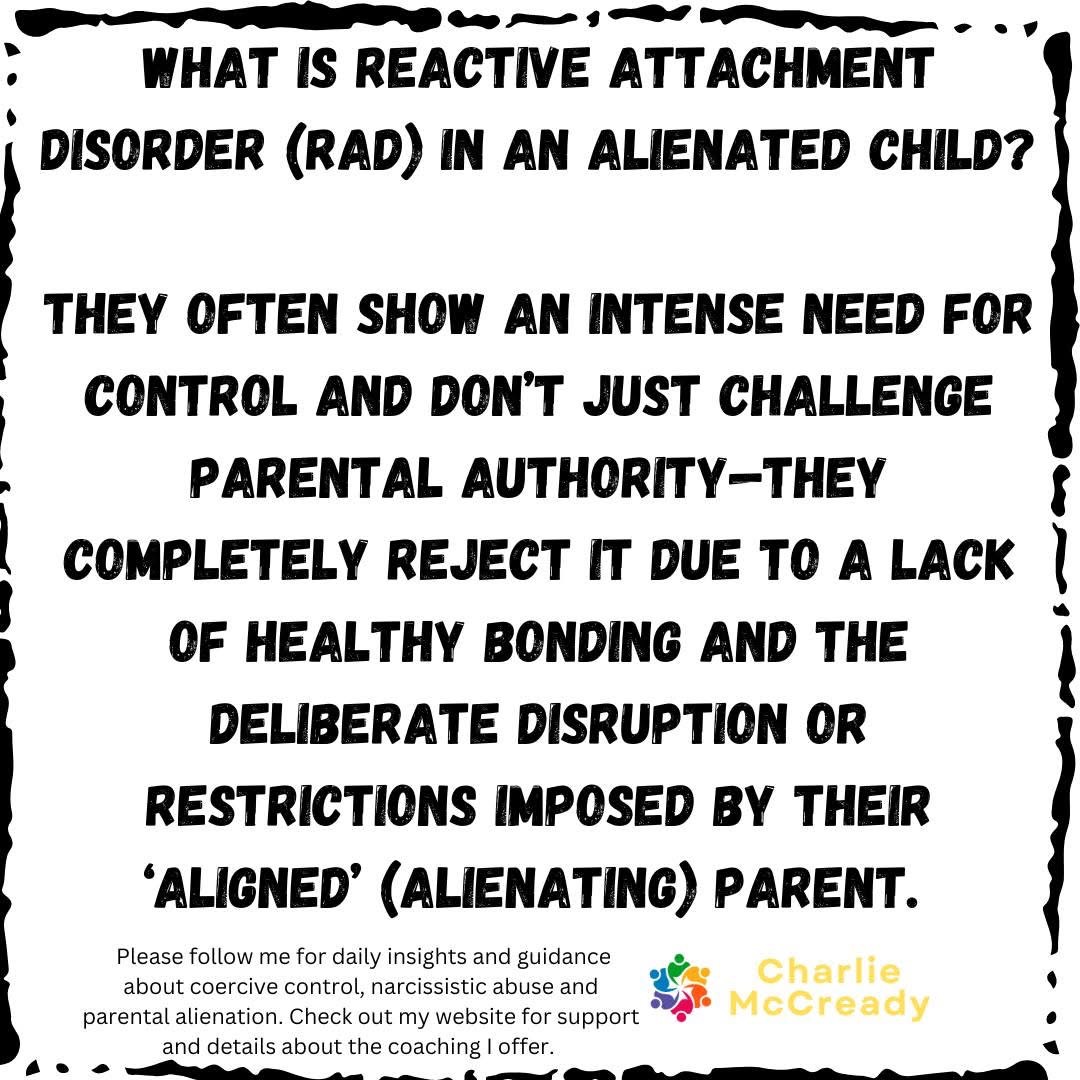
Because they have learned to mistrust or reject the alienated parent—often as a result of manipulation and psychological conditioning—they may show little to no empathy, act emotionally detached, and display an exaggerated sense of independence. Another hallmark of RAD in alienated children is their extreme need for control. Unlike typical children who may test boundaries but still recognise parental authority, those with RAD refuse to accept it altogether. This is not simple defiance; they deny any legitimacy of the alienated parent’s role because the connection was never allowed to fully form or was systematically undermined.
Furthermore, these children may engage in hostile, oppositional, or even aggressive behaviours, seeing the alienated parent not as a caregiver, but as an adversary. They are often highly manipulative, using guilt, threats, or withdrawal of affection to maintain dominance, a behaviour mirroring the alienating parent’s tactics. They might also struggle with trust, display impulsivity, or experience mood swings, which are all signs of emotional dysregulation typical of RAD.
In essence, the alienated child with RAD is trapped in a cycle of relational dysfunction, conditioned to see one parent as unworthy of love and to reject any attempt at reconciliation, while clinging defensively to the alienating parent, even when that relationship is abusive or detrimental.
Over time, many children begin to question their entrenched beliefs. As they mature and gain independence, they may start to recognise the manipulation and emotional inconsistencies in their upbringing leading to a gradual realisation of the truth. Encouragingly, many alienated children eventually start to ‘see the light’ and reach out to the alienated parent. With the right support, patience, and a non-judgemental environment, they can begin to heal, break free from the influence of the alienating parent, and rebuild a genuine relationship.
#charliemccready
#parentalalienationcoach
#coercivecontrol
#pathogenicparent
#abuseinthefamily
#
 GreatCosmicMothersUnite