Alienated child & rejection

An alienated child feels autonomous because their aligned parent’s psychological tactics are often subtle. The alienating parent may use ‘leading questions’ such as ‘Are you sure you want to be with them for such a long time away from home?’ They can use passive-aggressive language such as, ‘It’s a shame they make you feel so angry when they behave as they do, and you’re so good about it.’ It can seem caring and concerned rather than coercive and controlling. The child also develops a strong sense of loyalty and alignment with the alienating parent due to the fear of losing their love, approval, or the stability of the family unit. They can become ‘trauma bonded’ in an emotionally abusive relationship, often due to intermittent reinforcement, manipulation and a cycle of reward and punishment. They may feel autonomous because they’ve internalised the beliefs and narratives of the alienating parent. Often they justify their actions and maintain a positive self-image by convincing themselves that their rejection of the targeted parent is valid. Accepting the reality that the alienating parent acted out of selfish motives and not in the child’s best interests can be extremely distressing and conflicting. It may require them to confront the fact that they were manipulated and used as a pawn in the alienating parent’s agenda. This can be psychologically overwhelming. They can feel incredibly betrayed, sad, guilty, and ashamed, but they can overcome this. They can break free and truly become autonomous when they accept that they were not previously. It is hard to accept, but the key to their liberation and healing.

#charliemccready

#parentalalienationcoach

#parentalalienation

#alienatedparent

#alienatedchild

#childcustody

#FamilyCourt

Warning : Dating or marriage to a narcissist

“Be careful who you date and marry, because the greatest prison in the world is a home without peace.

The person you decide to share your life with will have a profound effect on your happiness, well-being, and overall trajectory. It’s crucial to understand the importance of choosing a partner who contributes to your peace rather than one who drains it.

This is especially true when dealing with narcissists, who are often referred to as toxic energy vampires, who are skilled at playing games and manipulating people.

Narcissists can be incredibly charming and convincing at the beginning of a relationship. They are experts in creating the illusion of a perfect partner, often called “love bombing”.

During this phase, you will be showered with tenderness, compliments, and attention, making you feel extremely special and appreciated. This intense flattery and focus can be intoxicating, leading you to believe you’ve found someone extraordinary.

However, this is a tactic to quickly win your trust and loyalty.

Once they have gained your affection, narcissists often begin to subtly change their behavior.

They can begin to devalue you through criticism, manipulation, and control, all while retaining a facade of charm and concern.

This gradual shift can be confusing and disorienting, leaving you to question your perceptions and feelings.

Narcissists are adept at gaslighting, a manipulative tactic designed to make you doubt your own reality and become increasingly dependent on their approval and validation.

In relationships with narcissists, the ups and downs can be extreme.

They can vary between the period of affection and approval and the period of coldness and criticism.

This cycle creates a rollercoaster of emotions, keeping you off balance and focused on reclaiming their approval. These dynamics are emotionally exhausting and can lead to a significant loss of self-esteem and self-worth over time.

A home with a narcissist is often full of tension and conflict.

Narcissists thrive in control and dominance, often disregarding your needs and feelings. Their inability to empathize with others can lead to a lack of genuine connection and mutual respect. Living in such an environment can seem like a constant battle, draining your energy and disrupting your peace and happiness.

Recognizing the signs of narcissistic behavior early on in a relationship is crucial to protect your well-being.

Look for red flags such as excessive self-centeredness, lack of empathy, need for constant admiration, and tendency to manipulate and control.

Trust your instincts and prioritize your peace and happiness. Establishing and maintaining healthy boundaries is key when dealing with potential narcissists.

In short, be careful who you date and marry because the greatest prison in the world is a home without peace.

Narcissists, or poisonous energy vampires, are adept at playing games and manipulating people to secure their own needs and desires. By understanding their tactics and being cautious, you can protect yourself from entering a relationship that drains your energy and undermines your peace.

Your home should be a haven of love, respect, and peace, not a battleground for domination and control.

Choose wisely and choose your peace over everything else. ”

Taken from the Carousel page

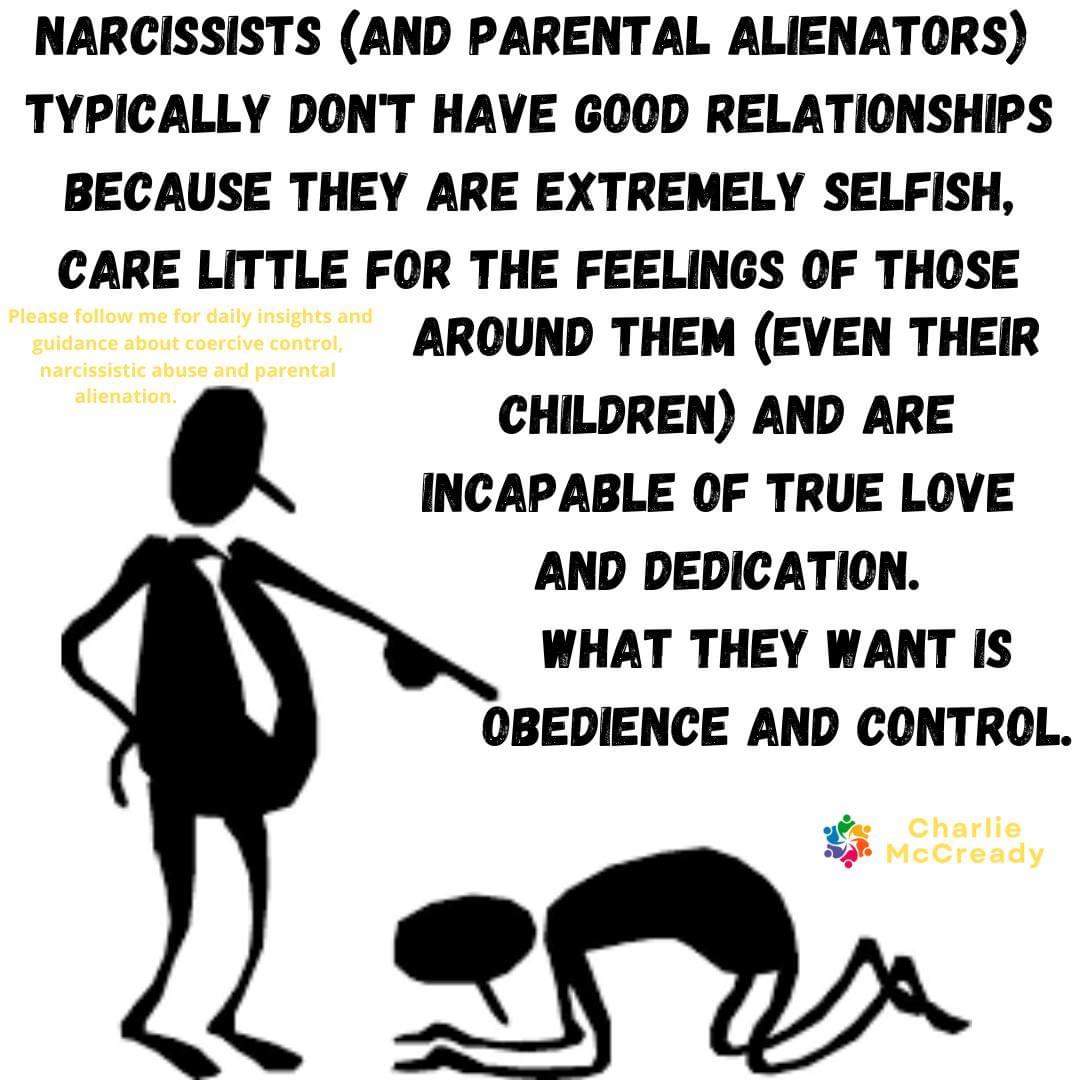
Narcissist & Parental Alienators : facts

Narcissistic alienating parents are characterised by a self-centred, manipulative, and exploitative nature. They prioritise their own needs, desires, and self-image above the well-being of others, including their children. Here are some key points:

Lack of empathy: Narcissistic individuals often struggle with empathy, which is the ability to understand and share the feelings of others. They have difficulty recognising and validating the emotional experiences of their children or anyone else in their lives. Their focus is primarily on themselves and their own needs.

Manipulative and controlling behaviour: Narcissistic parents tend to manipulate and control those around them to maintain a sense of power and superiority. They may use tactics such as gaslighting, guilt-tripping, emotional manipulation, and coercive control to assert dominance and maintain control over their children.

Exploitation of relationships: They view relationships as opportunities for personal gain rather than genuine connections based on mutual care and support. They may exploit their partner’s and their children’s love and loyalty to serve their own agenda, using them as extensions of themselves rather than recognising their autonomy and individual needs. This also goes for other family members and work associates, in fact, anyone in their lives.

Lack of genuine love and care: Narcissistic individuals struggle to experience and express genuine love and care for others. Their primary focus is obtaining admiration, attention, and validation. As a result, their relationships, including those with their children, lack the depth, emotional connection, and authentic care that healthy relationships require.

Superficial charm and manipulation: They often appear charming, charismatic, and even loving in the early stages of a relationship. However, their behaviour tends to be manipulative, self-serving, and inconsistent over time. Their actions are primarily driven by a need for control, admiration, and validation rather than genuine care and concern.

They lose interest when someone no longer ‘serves’ them. When someone calls out their behaviour, they’ll go on the attack to protect their interests/lies. It’s important to recognise that not all alienating parents are narcissistic, and not all narcissistic parents engage in parental alienation. But when these two dynamics intersect, the results can harm and damage the child’s well-being and the parent-child relationship.

#charliemccready

#parentalalienationcoach

#parentalalienation

#narcissisticparent

#FamilyCourt

#custody

#childcustody

#FathersMatter

#mothersmatter

Lies Secrets & Silence

“Women have been driven mad, “gaslighted,” for centuries by the refutation of our experience and our instincts in a culture which validates only male experience. The truth of our bodies and our minds has been mystified to us. We therefore have a primary obligation to each other: not to undermine each others’ sense of reality for the sake of expediency; not to gaslight each other. …

Women have often felt insane when cleaving to the truth of our experience. Our future depends on the sanity of each of us, and we have a profound stake, beyond the personal, in the project of describing our reality as candidly and fully as we can to each other.”

― Adrienne Rich, “On Lies, Secrets, and Silence. Selected Prose 1966-1978”