Purpose in the Pain – Parental Alienation/Charlie McCarthy

In the harrowing and heartbreaking experience of parental alienation, we face a choice that can be as transformative as it is challenging: to emerge from the darkness, either bitter or better. The pain inflicted by the alienation of our children is indescribable (though I do try in my posts as best I can). It is natural to harbour bitterness towards the alienating parent and the unjust circumstances, the handling of it by others who are supposed to help. However, channelling that pain into growth, resilience, and self-discovery can lead to a profound transformation. There’s no denying it’s an arduous journey that demands immense strength, but by embracing the pain and using it as a catalyst for personal growth, we can become stronger, wiser, and more compassionate individuals.

Finding purpose in pain may initially seem inconceivable amidst the devastation of parental alienation. Yet, within the crucible of such suffering lies the potential for profound self-awareness. Some of us discover an unwavering commitment to advocating for the rights of alienated parents and their children. By navigating the intricate layers of emotional violence, manipulation, and grief, target parents can become powerful voices for change, shedding light on the insidious nature of parental alienation and spreading awareness about the urgent need for legislative reforms to protect families from this heinous phenomenon.

Though the journey is arduous, each step towards healing and self-improvement is a testament to the strength of the human spirit. The pain of parental alienation is not without purpose; it can be the fuel that drives our mission to bring about change and awareness about this form of abuse, impacting far too many wonderful, wrongly maligned, poorly supported and alienated/rejected parents. In the face of immense adversity, choosing to emerge better, not bitter, is a declaration of resilience and hope for a future where parent-child relationships can flourish and no one suffers the agony of being alienated from the ones they love.

#charliemccready

#parentalalienationcoach

#fathersrights

#mothersrights

#parentalalienation

#parentalalienationawareness

Disordered Parenting

Poisoning the minds of children against a parent will lead to devastating consequences which the alienating parent will tell everyone has nothing to do with them. It is never their fault, even as they inflict terrible suffering. The innocent children, impressionable and trusting, become unwitting victims of psychological abuse. ⁠

Through a relentless campaign of denigration, the alienating parent plants seeds of doubt, fear and hatred in the child’s mind, distorting their perception of the targeted parent. They may fabricate lies, concoct false narratives, and manipulate events to make the targeted parent appear unworthy, unloving, or dangerous. The child, vulnerable and emotionally dependent on their parents, is coerced into adopting these beliefs, causing them immense confusion, fear, and emotional distress.⁠

The process is insidious; it involves the alienating parent creating an illusion of superiority, making the child believe they alone are the sole source of love, protection, and care. Simultaneously, they portray the targeted parent as the enemy, someone to be feared, rejected, and avoided. The child is placed in an impossible position, forced to choose sides and reject one of their parents. It’s an unimaginable burden on a child. ⁠

This form of psychological abuse is heinous, using children as pawns in a destructive game of manipulation and control. Recognising and addressing parental alienation is of utmost importance to protect the well-being of the children involved. Interventions that focus on early identification, therapeutic support, and the restoration of the parent-child relationship are crucial in mitigating the harm caused by this form of abuse. Legal and mental health professionals must be educated and trained to not only recognise the signs of parental alienation, but to actually act upon them. Too many people write to me about counsellors who do spot alienating behaviours, and psychological evaluations that flag problematic, disordered parenting, but still listen to the voice of the (indoctrinated) child. That is madness. It is in itself abusive. It has to change.⁠

#charliemccready

#parentalalienationcoach

#custody

#parentalalienation

Triangulation is Abuse – Charlie McCarthy

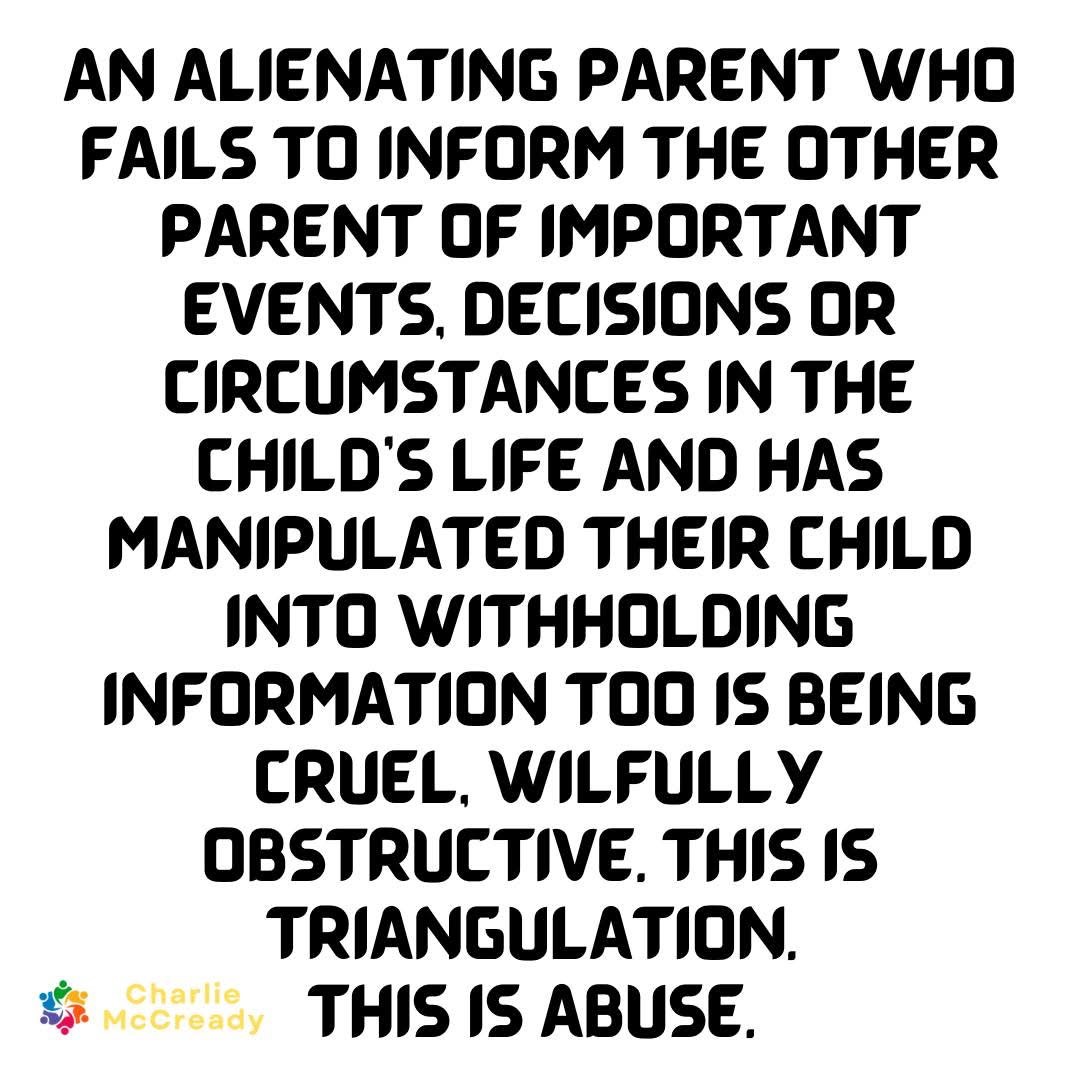
Withholding information is a manipulative and cruel tactic used by an alienating parent to create a sense of distance and indifference between the target parent and the children. I’ll give an example. In court, my ex challenged me to give one of my child’s A’level results to make me look uncaring and uninvolved. Unfortunately, this information had not been shared with me. Sadly. I had, many times, tried to find out. I was financially supportive and wanted to be supportive in other ways too. No information would have been forthcoming from my ex, but my daughter didn’t tell me either. This sometimes continues today due to so many years of aiming to punish me by not including me in their lives. At this point, I’m glad to say it’s more habitual, and we’ve got through the worst of the alienation. But by deliberately withholding significant things such as moving house, school results, buying a dog, travelling, illness, celebrations, mishaps, and any important events, whether this is directly from the children themselves or from the alienating parent, the aim is to make the target parent appear uncaring and disengaged. It is, as I said earlier, also to punish them. It is a form of triangulation. That is to ‘divide and conquer’ and control communication. It causes emotional distress to those involved. We are deprived of the opportunity to maintain a healthy and loving relationship. It perpetuates the cycle of alienation and deepens the emotional trauma experienced by all involved parties, making reconciliation and healing more challenging. But it doesn’t have to last forever. It doesn’t have to be like this. The alienating parent will often be seen in their true colours when the children mature when they start asking questions, and in many other instances.

#charliemccready

#parentalalienationcoach

#childpsychologicalabuse

#coercivecontrol

Alienators are not mentally healthy

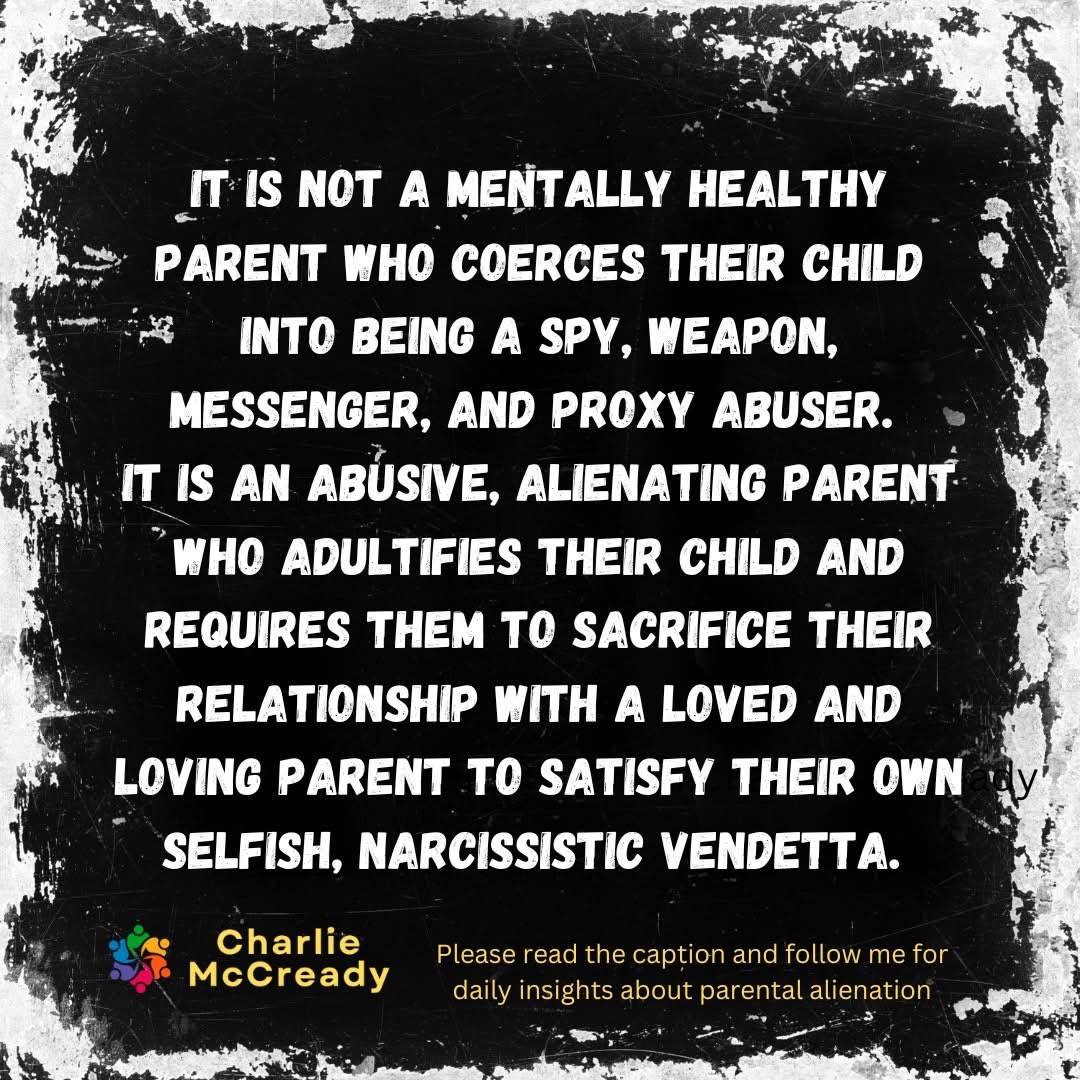
We desperately need legal and mental health professionals and family court judges to understand that ‘parental alienation’ is not mentally healthy parenting. Often it is driven by one parent’s selfish and narcissistic desire for revenge or control over the other parent. The alienating parent forces the child to sever their relationship with the targeted parent, disregarding the child’s well-being and emotional needs in pursuit of their vendetta. Such actions can be emotionally damaging and harmful to the child, as they are used as pawns in the alienating parent’s manipulative tactics.

While there is no magic wand to undo the harm caused, there is always a way forward. Focusing on your own well-being, setting healthy boundaries, and practising calm, non-reactive responses can make a difference—not only for yourself but also for your child. Healing starts with small, intentional steps, and every positive choice you make strengthens the foundation for a healthier future. You have the power to model the stability and love your child needs, even in the face of such adversity.

#charliemcready

#parentalalienationcoach

#parentalalienation

#parentalalienationawareness

Children waking to Pathogenic Parenting – Charlie McCready

As they grow older and gain more life experience, the alienated child may start to question the narrative that has been imposed upon them and realise the manipulation and control tactics employed by one of their parents (typically it’s a parent). They may become aware of the discrepancies between the image of the targeted parent presented by the alienating parent and the reality they observe themselves. This is why it’s so important we do all we can to remain non-reactive, calm, loving … as I cover in many of my posts.

This realisation can be a gradual process, sparked by various factors such as interactions with the targeted parent, exposure to different perspectives, or their own inner reflection. As the child starts to critically analyze the situation, they may begin to see the patterns of emotional manipulation, denigration, and falsehoods employed by the alienating parent. They may recognise the parent’s ulterior motives, such as jealousy, vengeance, or a desire for control.

Becoming aware of the disordered parenting of the alienating parent can be a transformative and emotionally challenging experience for the child. It may evoke a range of emotions, including anger, confusion, and a deep sense of betrayal. However, this awareness can also be a catalyst for personal growth and healing as the child begins to reclaim their own voice and establish their own identity independent of the alienating parent’s influence. It opens the door to the possibility of reconnecting with the targeted parent and developing healthier relationships based on truth, understanding, and mutual respect.

Hold on, my friends. Stay strong. Stay loving. Strive to be happy.

#charliemccready

#parentalalienationcoach

#reactiveabuse

Participation in Child Abuse & Spousal Abuse – Craig Childress PsyD

All psychologists – all mental health professionals – have a duty to protect.

There are three dangerous pathologies – suicide – homicide – abuse (child, spousal, elder). Whenever a psychologist encounters a potentially dangerous pathology (suicide, homicide, abuse), duty to protect obligations are active and the psychologist must take three actions:

1. Conduct a proper risk assessment for the danger involved – suicide, homicide, abuse – or ensure that a proper risk assessment gets conducted (such as referring the suicidal person to the ER for evaluation, notifying the police of a homicidal danger).

2. The psychologist must take an affirmative protective action (such as increasing frequency of therapy for a suicidal client).

3. The psychologist must chart the affirmative protective action taken in the patient’s medical record – if it’s not charted, it never happened.

There are two possible causes of a child rejecting a parent (a child seeking to flee a parent), child abuse by the targeted-rejected parent – OR – child psychological abuse by the allied parent (i.e., inducing a shared persecutory delusion and false/factitious attachment pathology in the child for secondary gain to the allied parent).

In all – all – cases of a child rejecting a parent (a child seeking to flee a parent), duty to protect obligations are active based on the child’s symptom display and a proper risk assessment needs to be conducted to the appropriate differential diagnoses for each parent,

Failure to conduct a proper risk assessment for a dangerous pathology or to ensure that a proper risk assessment is conducted when a risk assessment is warranted by the symptoms and context represents a negligent failure in the psychologist’s duty to protect.

From Wikipedia Duty to Protect: “In medical law and medical ethics, the duty to protect is the responsibility of a mental health

professional to protect patients and others from foreseeable harm.”

Cornell Law School Definition of Negligence: “Negligence is a failure to behave with the level of care that someone of ordinary prudence would have exercised under the same circumstances. The behavior usually consists of actions, but can also consist of omissions when there is some duty to act.”

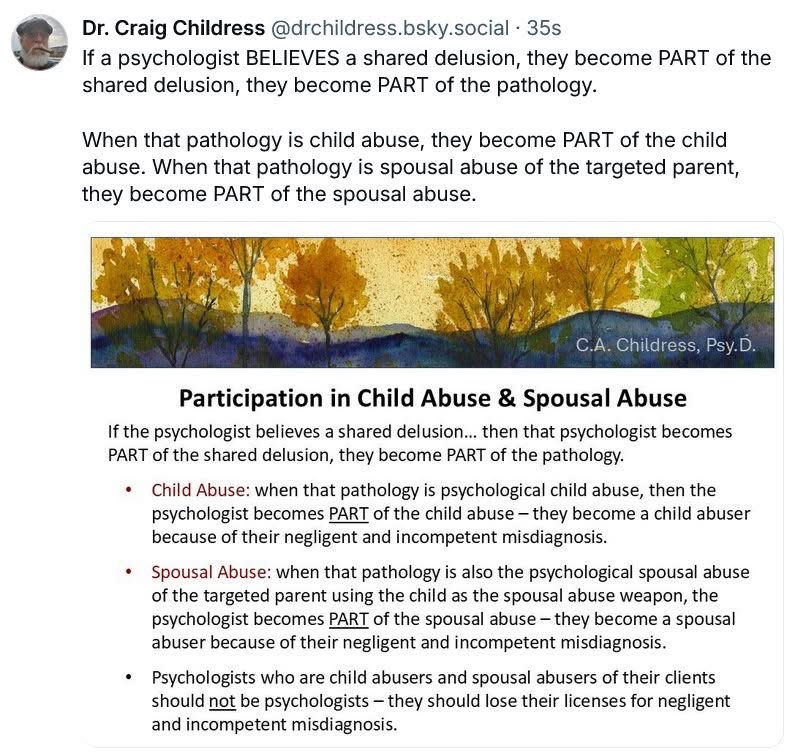
A psychologist who becomes a participating child abuser and spousal abuser because of their negligent misdiagnosis should NOT be a psychologist.

Someone will need to explain to me why an incompetent psychologist who is a participating child abuse and spousal abuser of their clients because of their negligent misdiagnosis should be a psychologist.

From where I sit – participating child abusers should NOT be psychologists – participating spousal abusers should NOT be psychologists.

All psychologists have a duty to protect.

Craig Childress, Psy.D.

Clinical Psychologist

WA 61538481

OR 4392 – CA 18857