Acceptance is Not about Giving Up – Charlie Mc Cready

Acceptance is one of the hardest aspects of dealing with parental alienation. It does not mean that you are giving up, but it does mean that you are getting to grips with what has happened to your relationships with your children.

It’s like a car crash, the wreckage and detritus of a separation or high-conflict divorce. It’s there. It can’t be ignored. Your ex is saying, ‘look what you’ve done!’ Even if they’ve been in the driving seat, they’ll be blaming you. But you are a passenger, you can’t deny it. You need to get to grips with dealing with the wreckage. If your children aren’t ready to leave, if they align with the ‘driver’, the alienating parent, you don’t help them by staying in the wreckage with them. They’re not seeing it like that because, as backseat drivers who have been ‘coached’ by the alienating parent, and maybe this has been a long journey of alienation, they’re scared. They don’t want this drama, they have enough to deal with growing up anyway, and they turn their anger on you, just like they’ve been told to do, to stay ‘safe’ with the aligned/favoured alienating parent. It is a survival tactic.

So, how to accept this? As I say, it’s incredibly difficult. But get yourself out of the wreckage, pick yourself up, and recover yourself and your life. You’re on a different path to the alienating parent. Focus on the things that you have the power to influence or change. If you have contact with your kids, you can adapt your parenting style to better support them through their journey of parental alienation. If you don’t have contact with your kids, that might not be an option, so concentrate on yourself. There are many ways to help with this, and acceptance is one of these. Until you accept the reality of your situation you remain stuck in a limbo that stops you from getting on with your life.

Examples include parents who don’t have normal social and family engagement, preferring to stay at home in case their children reach out to them. How many times have you put your life on hold, and yet they did not contact you? Or they cancelled? Or the alienating parent found somewhere else the child needed to be? Parents stuck in limbo might also not feel good about being happy. Or being in another relationship – even though they’ve not seen their child in years. Give yourself the gift of acceptance. Love your children unconditionally and do everything you can for them within your power. Then accept what you cannot change and ‘let go’ (which is not to quit) of the grief, anger, and sense of injustice. Staring at the wreckage isn’t helping you, or your child. They have to find their way out, just as you did. It starts with acceptance.

#charliemccready #9stepprogram #parentalalienationawareness #parentalalienationisreal #parentalalienation #alienatedmother #alienatedparent #alienatedfather #rejectedparent #rejectedfather #rejectedmother #highconflictcoparenting #coparenting #coparentingwithanarcissist #highconflictdivorce #divorce #FamilyCourt #familylaw #childabuse #narcissisticchildabuse #narcissisticabuseawareness #narcissisticabuserecovery #narcissist #narcissisticabusesurvivor #narcissisticpersonalitydisorder #narcissisticpersonalitydisorder #narcissism #narcissismawareness

Charlie Mc Cready How does a targeted parent get there ?

Good, wonderful, loving, caring mothers and fathers all over the world ask these questions: What the hell is happening? Why did this happen? Did I do something wrong? How and when will this nightmare ever end? What can I do for my child/ren? Why is my ex/partner/spouse doing this when it’s so damaging and hurtful not only to me but our child/ren too? So many questions, and so much guilt, anger, frustration, isolation, shame, confusion … it’s the most traumatic experience, and so little supported and understood by those who are positions to support but often fail to see the alienation. First of all, in any child custody dispute, checks and risk assessments must be carried out. Has the target/alienated parent been cut off from their child/ren because of abuse? No? Then the assessment must check the aligned/favoured parent too. Is it the case that there is psychological abuse going on by a narcissistic parent who has indoctrinated and coercively controlled the child/ren into their shared persecutory delusions about the ‘target’ parent? Is this same parent lying and manipulating by way of a vendetta or need to hurt the other parent in the worst possible way by seeking to destroy the child’s loving attachment bonds with their other loving, caring, healthy-minded parent? Is this all about the parent having their own needs (emotional and psychological) met? Parental alienation has to be understood, detected and urgently, immediately acted upon to end the pain and suffering of so many through misdiagnosis or lack of seeing through the enmeshment, manipulation and lies of the alienating parent.

#charliemccready #9stepprogram #parentalalienationawareness #parentalalienationisreal #parentalalientaion #alienatedmother #alienatedparent #alienatedfather #rejectedparent #rejectedfather #rejectedmother #highconflictcoparenting #coparenting #coparentingwithanarcissist #highconflictdivorce #divorce #FamilyCourt #familylaw #childabuse #narcissisticchildabuse #narcissisticabuseawareness #narcissisticabuserecovery #narcissist #narcissisticabusesurvivor #narcissisticpersonalitydisorder #narcissisticrelationship #narcissism #narcissismawareness

Child Psychological Abuse – Charlie McCready

The alienator will never change, but we can, and we start with ourselves. Knowledge is power. Empower yourselves. Read our posts about coercive control, hostile aggressive parenting, trauma bonds, psychological abuse, mirroring, deflection, how alienated children are weaponised, narcissism and dark personalities, parentification, identification with an aggressor, splitting, Stockholm syndrome/indoctrinating behaviours, attachment disorder, shared persecutory delusions, false allegations, the ‘justice’ system, projection, cognitive dissonance, gaslighting, triangulation and much more. I’m glad to say clients who do my program talk about gaining emotional and mental resilience and peace of mind over a period of just a few weeks (it’s 8 weeks plus 2 follow-up weeks). The 9 Step Program helps my clients understand and deal with their alienated child/ren, the alienating parent, plus how to overcome and survive the many challenges. This program can help transform your experience of alienation and how you live your life. Please send me a message if you are interested to know more, and I can send you testimonials and further details on what the program covers and the benefits you could gain.

#charliemccready #9stepprogram #parentalalienationawareness #parentalalienation #parentalalienationisreal #alienatedmother #alienatedparent #alienatedfather #rejectedparent #rejectedfather #rejectedmother #highconflictcoparenting #coparenting #coparentingwithanarcissist #highconflictdivorce #divorce #FamilyCourt #FamilyLaw #childabuse #narcissisticchildabuse #narcissisticabuseawareness #narcissisticabuserecovery #narcissisticchildabuse #narcissisticabusesurvivor #narcissisticrelationship #narcissisticpersonalitydisorder #narcissism #narcissismawareness

Childress Psy D – King of the Hill

Can we play a game? I want to play a game. It’s a fun game.

It’s called King of the Hill. Ever play it?

I have. Around the age of 12 or so, someone was doing some home building in the neighborhood and brought in truckloads of dirt which they piled into small mounds in a field… and left it there all summer.

The mounds of dirt were perfect for playing King of the Hill, and our neighborhood collective of kids quickly figured that out. It’s a fun game.

Someone starts by standing on top of the hill yelling loudly “I’m King of the Hill” and all the other kids come running to play. Then one-by-one the other kids take their turn at trying to push the King of the Hill off the hill and taking the hill for themselves… for a while… then one-by-one the kids take their turn at pushing that kid off the hill.

You keep going around and around, and eventually the King rises.
Eventually some kid would remain on top of the hill and defeat all the other kids… that’s when the mob-attacks begin.

The rest of the kids would now group-up in twos and threes, how many kids does it take to dethrone the King? At that point, it’s all about the neighborhood honor and bragging rights.

“Do you remember when it took six kids to push Tony off the Hill? He was a mighty King.”

I wanna play King of the Hill. It’s fun. Do you wanna play? I think you’ll like it, it’s a fun game.

I’ll start. “I’m King of the Hill.”

Now one-by-one the other neighborhood kids can try to push me off. It’s so much fun. Have you ever played it? I have. It’s fun.

First, though, we need a hill. You cannot play King of the Hill without a hill. I know the perfect hill. The Expert Hill.

Who’s the world’s Top Number1 Expert regarding the child custody and attachment pathology in the family courts?

Me. I’m the Top Number 1 Expert.

Now… push me off… if you can.

Who’s better than me? Who’s a more Expert expert than I am? Who knows more? Bring your vitae and let’s see.

At first that may seem like a strong statement, and it is, but it’s not as unusual as it seems. We can eliminate nearly everyone else in large groups. Watch.

First we can eliminate all the psychology people who don’t work in the family courts. If they don’t work with the pathology they can’t be the worlds Number 1 Top Expert in it.

So we can eliminate Bessell van der Kolk and Ed Tronick because… they don’t work in the family courts. They know nothing about this attachment pathology that’s here. It’s a dark pathology that’s here.

So immediately we cut the competitors down to just the neighborhood kids who work with the pathology in the family courts.

But we can continue to eliminate the remaining contenders in groups as well. Next.. delusions.

Who has experience in the diagnostic assessment of delusional thought disorders? The pathology in the family courts is a shared (induced) persecutory delusion – acknowledged by Walters & Friedlander who cite to me as the expert in delusional thought disorders.

If you don’t know delusional thought disorders then you don’t know this pathology because that’s what this pathology is – Walters & Friedlander; Family Court Review, 2016.

None of the forensic psychologists have training or experience in the diagnostic assessment of delusional thought disorders – none – zero.

I do. Lots of experience and lots of training.

The ONLY place you get professional-level knowledge of delusional thought disorders is in schizophrenia. No forensic psychologists have experience in schizophrenia.

I do.

For 12 years I worked at UCLA on a major NIMH clinical research project on schizophrenia… where I was trained each year to r=.90 diagnostic reliability to the authors of the Brief Psychiatric Rating Scale, Dr. Ventura and Dr. Lukoff.

The BPRS is “one of the oldest, most widely used scales to measure psychotic symptoms” (Wikipedia: BPRS). Delusions is item 11 Unusual Thought Content.

I was trained by the best, the authors of the BPRS, for 12 years in the diagnostic assessment of delusional thought disorders. Here’s the entry from my vitae:

9/85 – 9/98 Research Associate
UCLA Neuropsychiatric Institute
Principle Investigator: Keith Nuechterlein, Ph.D.

Area: Longitudinal study of initial-onset schizophrenia. Received annual training to research and clinical reliability in the rating of psychotic symptoms using the Brief Psychiatric Rating Scale (BPRS). Managed all aspects of data collection and data processing.

Dr.Childress: 12 years of annual training in the diagnostic assessment of delusional thought disorders to 90% reliability to the authors of the BPRS, “one of the oldest, most widely used scales to measure psychotic symptoms” (Wikipedia: BPRS)..

Forensic psychologists: zero training – zero experience.

The forensic psychologist tumble down the hill en masse.

I’m King of the Hill. I am the world’s Number 1 Top Expert regarding the attachment pathology in the family courts.

We’ve eliminated everyone else.

No one in the family courts has experience in the diagnostic assessment of delusional thought disorders, I do, and the pathology is a persecutory delusion.

But wait… there’s even more, another layer of expertise that divides me from them.

This is an attachment pathology. A child rejecting a parent is an attachment pathology. Expertise in attachment pathology is found within the Early Childhood Mental Health specialization, children ages zero-to-five… the attachment years.

I have Early Childhood Mental Health specialization. Look at my vitae.

So let’s see who remains. No one.

The Gardnerian PAS “experts”? They still believe in the tooth fairy. The PAS “experts” are a fringe group of professionals who reject the diagnostic guidance of the American Psychiatric Association and who reject the ethical guidance of the American Psychological Association.

I assert that the use of the construct of “parental alienation” in a professional capacity is substantially beneath professional standards of practice in clinical psychology and is a violation of Standard 2.04 of the APA ethics code, Bases for Scientific and Professional Judgments.

I assert that the Gardnerian PAS “experts” are unethical – violations to Standards 2.01 and 2.04 of the APA ethics code.

I assert that the Gardnerian PAS “experts” are ignorant. They don’t apply the knowledge (2.04) because they don’t know the knowledge (2.01). The ONLY way they’re “experts” in anything is in their imaginations – they need to make things up.

Google ignorance: lack of knowledge or information

I assert that the reason the PAS “experts” don’t apply the established scientific and professional knowledge of the discipline is because they don’t know the established scientific and professional knowledge of the discipline.

I’ll also assert that they’ve misdiagnosed the pathology this entire time because they’re lazy, ignorant (lack of knowledge or information), and unethical. If you misdiagnose the pathology for 40 years, you’re not an expert, you’re incompetent.

The diagnosis of a shared delusion was in the DSM-IV the entire time, a Shared Psychotic Disorder. They had the diagnosis IN the DSM the entire time, they simply misdiagnosed it for 40 years because they were fixated on making up “new” pathology rather than apply knowledge… because they don’t know the knowledge.

They are ignorant. They are incompetent. They are unethical.

And they are atrocious diagnosticians.

Who’s that leave?

This is fun. Isn’t this fun? I think it’s fun.

We can eliminate whole groups of people from the competition so the remaining field is small, just the neighborhood kids, like Billy Bernet up on PAS Ln, and Susie Deutsch from over on Forensic Psychology St.

Let’s play King of the Hill.

I’m wondering, do you think it would be helpful to your efforts to protect your children if Dr. Childress was the acknowledged Number 1 Top Expert regarding the attachment pathology in the family courts?

Do you think you might find that helpful in your efforts to protect your children?

I think so.

I am the Worlds Top Number 1 Expert on the pathology in the family courts. That’s reality. That’s not boast, that reality. My expertise is supported by my vitae.

If you want to push me off the hill… bring your vitae.

I have 12 years at UCLA on a schizophrenia research project being trained annually in the diagnostic assessment of delusional thought disorders.

I have Early Childhood Mental Health specialization which is spot-on the attachment system and attachment pathology.

I’ve worked in the family courts with his specific pathology for the past decade and I’ve written the book, Foundations, that describes the pathology in detail at three separate levels of analysis.

I am the world’s Number 1 Top Expert regarding the attachment pathology in the family courts – if not me… who?

Bring your vitae. Push me off the hill. Until someone pushes me off the hill, it’s my hill, I’m King of the Hill. Wanna play? It’s a fun game.

Who else? Name someone.

1) Who is in the family courts working with the pathology that’s here.

2) With training and experience in the diagnostic assessment of delusional thought disorders.

3) With Early Childhood Mental Health education, training, and clinical experience in the attachment system and attachment pathology.

Tronick or Bessel? They don’t work in the family courts. If they come to the family courts, I’ll happily concede the hill to them – but until they come here, they don’t know what’s here. It’s dark.T

Who? The outside folks are gone. The forensic psychologists are gone. The PAS “experts” are gone. Who’s left?

Do you parents think that you might find it helpful to have the world’s Number 1 Top Expert regarding the attachment pathology in the family courts be Dr. Childress?

I think so.

So let’s play King of the Hill. It’s a fun game. Have you ever played King of the Hill? I have. It’s fun.

One kid climbs the hill and yells, “I’m King of the Hill” and the other kids come running. It’s a rough-n-tumble sort of play that boys like to do. It’s fun.

Let’s play.

Craig Childress, Psy.D.
Clinical Psychologist, CA PSY 18857

Testify-Craig Childress, Psy D

I’m testifying today. That’s always stressful.

I don’t like it but I think I’ve gotten pretty good at it. I’ve had a lot of experience now, I’ve been testifying in courts in a variety of jurisdictions for years now. I’ve even testified once in Sweden and once in South Africa – remotely. I don’t travel.

I’ve been through a lot of cross-examinations.

I can watch where the pathogen is as it snakes around me trying to find a vulnerabilty to strike. Cross-examination keeps me apprised on the current movement of the pathogen. It’s an interesting critter, once you see its movements… you see it move.

It doesn’t know what to do with me. The opposing counsel wants to attack on the “parental alienation” line – but can’t. The pathogen wants to attack on the forensic custody line – but can’t – I’m a clinical psychologist. Some opposing counsels try the slander line, I don’t think that works with the judges – judges know the games of the courtroom.

For me, testifying is easy. I turn off my thinking mind and remain only my information mind. I listen to the question. I answer the question, then I stop and wait for the next question.

It’s like a test in graduate school. I apply the knowledge of clinical psychology to the question I’m asked. That’s it.

I don’t have an opinion. I do, I like the color blue. So what? My opinion is not relevant. I apply the established scientific and professional knowledge from clinical psychology to the information I review as the bases for my professional judgments.

As I am required to do by Standard 2.04 of the APA ethics code. I remain contained within my role. I’m a clinical psychologist – treatment not custody – diagnosis guides treatment.

There is an attorney in the matter who believes that the application of the established knowledge of clinical psychology to a set of information will assist the Court in its decision-making. So this attorney qualifies me and introduces my testimony to the judge for consideration.

I’m not an advocate. The legal system has advocates, they’re called attorneys. I’m evidence. I understand my role. I’m the applied knowledge of clinical psychology to a set of information. That’s it.

I listen to the question. I answer the question, then I stop and wait for the next question. I apply knowledge, I don’t create it.

I then face cross-examination by opposing counsel. This allows for a full presentation of the information for the Court – the information that supports one side, and the information that supports the other. I understand this and I understand its value to the Court.

Oftentimes, there’s little professional-level information to support one side, and a lot to support the other, which can be frustrating to opposing counsel – they have a job to do and its hard when the evidence is against you.

I don’t fight with opposing counsel, they have a job to do. It’s the judge’s call to decide – I know where I am and I understand my role.

I’m evidence. I listen to the question. I answer the question, then I wait for the next question. I allow the attorney to present the evidence of applied professional information from clinical psychology to the Court.

Opposing counsel has a job to do. Their role is to discredit my testimony that damages their side as much as they can. I understand that.

I don’t think the slander approach works for them. It might have early on, but I’m becoming an increasingly known entity in the courts – I’m on the Internet with a Consulting Website – I pop up on Google searches, judges can google me the same as any one else can, and I’ve been saying exactly the same thing for a decade.

I’m not a surprise, although I am a surpisal (Friston), an unexpected bit of information. I’m an open book. Apply knowledge. Comply with the APA ethics code.

The knowledge to apply is attachment – family systems – personality disorders – complex trauma – child development – self psychology – the DSM-5 diagnostic system.

When the opposing counsels adopt an effort to slander, I correct the record for the judge, but I don’t fight with attorneys. My credibility is fair – so let’s settle it.

Look at my vitae. Look at my writings. Look at what I say. Am I credible or not? Let’s decide and settle that question so we can move on, because it’s relevant to every case I testify in. Am I credible, is what I’m saying the application of established knowledge?

Yes.

Judges understand the various legal games played by attorneys in the courtroom, and if there’s some issue that arises during cross-examination relevant to the substantive arguments being made, then the attorney who brought me into the matter can correct the record on re-direct.

I let the attorneys do what they do. They seem to enjoy it. Oh my goodness, do they like to argue. Are you here for the 5-minute argument, or do you want the full hour?

My role is easy. I listen to the question. I answer the question, then I wait for the next question. That’s easy.

But it’s stressful because every answer I give must be precise in its word-choice and sentence structure. If I make a mistake on this test of knowledge, my license is at risk. This pathogen is immensely dangerous and retaliatory.

There are a lot of people who want to hurt me because I’m helping you to protect the child.

I need to be precise and accurate in every word choice I select… for hours-and-hours of questioning about anything and everything psychological.

That’s okay. I’m senior staff. Have you ever presented a case at a case-staffing meeting of six psychologists, four interns, and two post-docs? I’m senior staff. No worries.

I know where I am. I understand my role and obligations. I must be precise and accurate because… that’s the information the Court needs. The Court needs accurate information fully understood. Accurate information is my testimony, fully understood is the cross-examination.

The best questions are when the judges ask me a question. The questions from the Court are always on target to the issue and are perceptive. The judge is seeking a specific piece of professional-level information that will help in the decision. I answer as fully and accurately as I can.

I don’t make the decision. That’s the judge’s call. I’m information, I’m evidence. I allow the attorneys to present the evidence. That’s my role, I’m the information, the extraction of the information is through the attorneys.

What is it that you want to know?

What many opposing counsels don’t yet understand is that I don’t have a opinion – I do, I like the color blue – that’s not relevant. I apply knowledge to information. You provide the information, I provide the knowledge.

My value is my knowledge, not my opinion – I like the color blue. I have extensive knowledge of clinical psychology because I’m an old clinical psychologist – it’s the old part. I’m not from the family courts, I’m from everywhere else – attachment – family systems – complex trauma and child abuse, everywhere but here, and also here.

I apply knowledge, I don’t create it.

Bowlby creates knowledge through his research, Tronick creates the knowledge through his research, van der Kolk creates knowledge through his research, Minuchin creates knowledge through his clinical research with families – I apply the knowledge they discover – the established scientific and professional of the discipline.

I’m evidence, the application of knowledge in clinical psychology to a set of information to assist the Court in its decision-making surrounding the child. I have no opinion on custody.

In the absence of child abuse, parents have the right to parent according to their cultural values, their personal values, and their religious values. In the absence of child abuse, each parent should have as much time with the child as possible.

In the absence of child abuse, to restrict either parent’s time and involvement with the child will damage the child’s attachment bond to that parent, thereby harming the child and harming that parent.

Is there child abuse?

That’s my only concern as a clinical psychologist – and the answer is yes – the ONLY cause of severe attachment pathology is child abuse by one parent or the other… the only question is, which parent?

In all cases of court-involved child custody conflict involving severe attachment pathology displayed by the child, a proper risk assessment for possible child abuse needs to be conducted to the appropriate differential diagnosis for each parent.

The current crop of court-involved “forensic” psychologists are failing the Court, they are failing the child, and they are failing the parents.

Forensic psychology is a failed experiment in service deliver to a vulnerable population. Clinical psychology – treatment not custody – needs to return to court-involved child custody conflict – but they won’t come to the family courts because it’s too professionally dangerous for them here.

That’s my role. I’m the first to return. I’m a trauma psychologist out of foster care, look at my vitae. This is my pathology, child abuse, attachment pathology, and complex trauma. I am a court-involved clinical psychologist. I’m the first to return.

Notice a difference?

Where I come from, I’m not unique, I’m common. I’ll name Keith Nuechterlein and Jim Swanson right off the top. Keith knows everything there is to know about schizophrenia – everything – and he then reads (writes in) journals to remain current. Jim knows everything there is to know about ADHD and he then reads (writes in) journals to remain current.

That’s the standard for competence where I come from – clinical psychology. That was the standard for competence I was trained to at Children’s Hospital Los Angeles working on the treatment teams with their physicians. If you’re a doctor at a Children’s Hospital, you’re the. best, because that’s the expected standard.

There may be lots of others who are just as good, but none better. If someone knows more than you about the pathology – learn what they know.

We’re doctors. It’s our job to know the pathology we diagnose and treat.

Testimony is like taking a test. Ask me anything about psychology. Go ahead. I know a lot because I need to know a lot, the kids I worked with needed me to know a lot, so I do.

Go ahead, ask me a question.

Notice that on Facebook that I can always answer your questions with ease from the knowledge in my brain. I don’t have to refer to a book… because I’ve already read the books. It’s the old part of being an old clinical psychologist.

I know a lot, pretty much everything there is to know about the pathology. Do you know what that’s called where I come from? Competence, basic competence.

The value of my testimony is my knowledge, not my opinion. The downside is that the shelf-life on the acquired knowledge is brief. I suggest you use it while I’m here. Or go to the source – Bowlby – Minuchin – Beck – van der Kolk – Tronick – Kohut – DSM-5.

Attachment – family systems – personality disorders – child development – analytic self psychology – delusional thought disorders and FDIA.

Apply knowledge to solve pathology.

2.04 Bases for Scientific and Professional Judgments
Psychologists’ work is based upon established scientific and professional knowledge of the discipline.

The American Psychiatric Association provides the definition of a persecutory delusion:

From the APA: “Persecutory Type: delusions that the person (or someone to whom the person is close) is being malevolently treated in some way.” (American Psychiatric Association, 2000).

I hate testimony. The stress is high so my adrenaline is high for hours. Once I finish hours of testimony, I need a day to recover my inner-chemistry, it’s exhausting – easy but exhausting.

Like taking the SAT or GRE tests, or the licensing board exam. We study months and months for the licensing exam, recapturing everything we ever learned about every aspect of psychology, the licensing exam can ask any question from anything you’ve ever learned about psychology.

Testimony is like that.

I’m used to it. I have testified a lot. With experience comes a degree of familiarity and comfort. But I can never relax on the stand, not yet. Not until we bring the fighting surrounding these children to an end.

All doctors should be using the same scientifically established knowledge to reach the same conclusions and recommendations. That’s true with cancer, it’s true with diabetes, it’s true with attachment pathology.

I’m a court-involved clinical psychologist. Notice a difference? They’ll be returning once its safe for them to return. I’m just the first to return to the family courts – I’m establishing the path of safety for clinical psychologists to follow.

Walk where I walk, step where I step to avoid the landmines for clinical psychologists in the family courts.

Treatment not custody. Diagnosis guides treatment.

Apply knowledge to solve pathology – abide by the APA ethics code Standards 2.01, 2.03, 2.04, 9.01, and 3.04. When child abuse or spousal abuse are considered diagnoses, all mental health professionals have duty to protect obligations that must be appropriately discharged.

Diagnose the pathology and tell the Court. When the pathology is Child Psychological Abuse, diagnose it (V995.51) and inform the Court of your diagnosis.

We have duty to protect obligations. They are failing.

We need change. We need to do things differently. Randomly different? No. We need stability as we change, we need to remain grounded and change at the same time. We need to return to the application of established scientific and professional knowledge as the bases for our professional judgments, and clinical psychology needs to return to court-involved custody conflict.

The change involves applying actual knowledge – for a change.

We need Standards. Let’s start with the ethical Standards of the American Psychological Association which are currently mandatory – required – of all psychologists.

Standard 2.01 Boundaries of Competence

Standard 2.03 Maintaining Competence

Standard 2.04 Bases for Scientific and Professional Judgments

Standard 9.01 Bases for Assessment

Standard 3.04 Avoiding Harm

All mental health professionals have a legally obligating duty to protect the child from child abuse and to protect the parent from spousal emotional and psychological abuse by the other parent using the child as the weapon.

DSM-5 V995.51 Child Psychological Abuse

DSM-5 V995.82 Spouse or Partner Abuse, Psychological

I always say the same thing. I apply established knowledge, I don’t create it. I don’t have an opinion – I have obligations – I’m a doctor, we have obligations.

If you don’t want the obligations – don’t be a doctor. If you’re in the family courts – know where you are – know what the pathology is.

In all cases of child abuse, we protect the child.

Is there child abuse? When there is severe attachment pathology (a child rejecting a parent), the answer is yes. The only question is, which parent?

Craig Childress, Psy.D.
Clinical Psychologist, CA PSY 18857

Kim Saeed – The grooming of Narcissistic children

I don’t know who needs to see this, but if you share young children with a narcissist, fighting to maintain the family unit can actually backfire on you. While you’re fighting to keep your family intact, or even staying because you think it’s best for your children, the narcissist is grooming, conditioning, and poisoning your children against you.

So then, by the time you actually leave, there’s a very high likelihood that your children (who may be grown at this point), will side with the narcissist, despite the protective measures you tried to put in place.

* I have known this for decades , unfortunately . Our adult children are bonded to their Dad , and have voiced his ugliest , darkest thoughts , and certainly do not treat or talk to be with anything but contempt . He’s had help along the way , in this evilness , but they have faded away .

Still in total denial of being anything but a saint, a survivor , the good guy ….a light is coming to highlight his behavior .

Pathology- Pathogen – Childress Psy D

This is such an interesting pathology. I wish we were talking about all the interesting stuff.

One day maybe we can.

Did you know the pathology has defenses? It wants to be the pathology. No other pathology has defenses. ADHD doesn’t WANT to be ADHD, autism isn’t trying to be autism. This pathology wants to be this pathology and it will defend its existence from efforts to try to eliminate it.

It wants to survive. A pathology wants to survive… and replicate itself in other minds.

That’s weird.

This pathology has a motivation, a will to maintain its existence – it wants to survive and it will defend itself trying to survive. No other pathology has motivation, and no other pathology has a will to survive.

We have this thing within us that’s not us, yet that makes us do stuff. It’s a set of damaged information structures in the attachment networks of our brain, a coherent set of damaged structures that create a characteristic pattern of pathology.

That’s why I call it a pathogen. It’s a coherent set of damaged information structures in our attachment networks, damaged by trauma, that produces a characteristic pattern of symptoms – it’s pathogenic, it creates pathology.

This is absolutely a public health issue. There is a pathogen in our brain networks, in our attachment networks, the love-and-bonding system of the brain, that’s creating severe pathology in us… to meet its own needs, not ours.

It seeks to replicate itself. It wants to replicate the trauma that gave it birth, it wants to replicate itself in other brains – child brains, child attachment networks.

Frankly, I find that a bit terrifying. A lot terrifying actually. It has a motivation to survive and will fight against efforts to heal it, and it wants to replicate the damage in other minds, especially in the mind of the child’s attachment networks.

Yikes.

Did you know it groups? It becomes a larger organism-thing spread between multiple brains. It has two ways of bonding into other brains. Did you know that? Yeah, pretty weird for a pathogen to spread among brains.

The first way it unites with other brains that contain the pathogen is by simple resonance. This type of bonding is weak but pervasive. I think of this type of bonding like the hydrogen bonds that occur in water molecules. They make water liquidy and sort of hold together, but they’re easily broken between molecules allowing us to enter water, not like the bonds in a rock.

Brains that contain the pathogen resonate and they join together in their resonance. It’s simple and pervasive.

At a low level of intensity, this resonance mind-bond is like the mind-bond that occurs at a baseball game. Everyone cheers and boos at roughly the same time. But if there’s an earthquake during the game, the group-mind is broken and individual minds easily reemerge.

At a higher level of intensity, the resonance mind-bond becomes the Nazi rally at Nuremberg with all the flags and pageantry. It’s not a deep personal bonding among the participants, it’s a superficial but intense bond of resonance among the pathogen damage in the attachment networks, the love-and-bonding system, of all the brains present.

The first type of collective mind-bond is simple resonance with variable intensity.

The second type of mind-bond that the pathogen makes is deeper and stronger. It’s more like the covalent bond in chemistry where two atoms share the same electrons, they complete each other’s electron needs.

This covalent bond of the pathogen creates an ally, a specific person who bonds closely to the pathogenic source.

The primary pathogenic source creates the trauma reenactment narrative, and the covalent ally bonds to the narrative in the coveted role of the “virtuous protector” to also work out their pathogen in replication.

The ally bond is deeper and stronger. It’s to an individual and process. One ‘tell’ on the covalent mind-bond of the ally is the presentation of the “virtuous-protector” role.

Lots of people are virtuous. I’m kind of a virtuous guy, mostly, kind of, usually I hope. Lots of people are protectors in a given situation. I’m a protector person a lot, usually, I try.

But it’s different with the ally, you’ll notice the difference. They – present – and the presentation is important, they want to be socially seen in the role of the virtuous-protector.

It’s the presentation of the role that’s important to them, the virtuous-protector role in their own co-narrative of trauma resolution.

He’s an example, the ally says “I just want what’s best for the child.” Of course you do. We all do. No normal-range person says that because for every normal-range person that’s a given.

But for the ally, they want to “present” as being especially virtuous in their protector role. The ally thinks it’s special to value the child – and that other people don’t. It’s the presentation that’s the tell.

When you see it, that’s a covalent mind-bond of an ally pathogenic structure working itself out in collaboration with the primary source.

Now that’s weird.

I never had this with ADHD or autism or any other pathology. ADHD people don’t join other ADHD people to co-create their ADHD. It’s because it’s an attachment pathology, damage to the love-and-bonding motivational system of the brain. It’s a motivational pathology of love-and-bonding, a social bonding thing damaged by trauma.

The damaged set of information structures have access to the motivational networks. It wants to replicate itself in reenactment trying to heal, but it doesn’t understand the purpose – just the motivation – replicate the trauma.

And it wants to survive. It defends itself, it wants to exist. Even if that harms the host organism of us. Now that is really weird to understand. There’s a coherent set of damaged information structures in our attachment system that seeks to survive… even it harms us… sometimes even if it kills us.

Yikes. I wish we were talking more about this pathogen. It is extremely interesting. It has motivation. It has defenses. It seeks to survive even if that harms the host organism. It replicates itself, especially in the minds of children. It bonds among minds in various ways and intensities.

This is such an interesting pathology if it weren’t also so devastating in its danger and damage. This is the most dangerous pathogen on the planet… and it’s in the family courts unrecognized and untreated. Yikes.

Book et al. describe the Dark Triad and Dark Tetrad as the core of evil. Research has identified evil in us – and it’s in the family courts. Yikes cowabunga, that’s bad.

There’s this thing within us that’s not us, a pathogen created by trauma, a coherent set of damaged information structures in our attachment networks that create a characteristic pattern of pathology in us.

It’s not us, but it’s in us, and it makes us do things, bad things… but it shapes our thinking to think that the bad things are good things – it tells us that we need to “protect” ourselves from the danger.

What danger?

What dangers are available? It will choose from among the available options.

Jews and Blacks are typically available. Germans if you’re French and the French if your a German in the 20th century, ‘not so much anymore. Catholics if youre Protestant. Protestants if you’re Catholic. Holy cow, religion is always a convenient source of “others” for a holy war jihad. Liberals seem popular recently by alleging a “woke” agenda no one defines, whatever I disagree with is “woke” which is obviously bad.

Everything I disagree with is bad, and everyone who believes what I disagree with is the enemy to be afraid of, killed and destroyed. Finding the enemy, finding the target for fear and projection, is easy once the motivation to do so is there.

Such an interesting and dangerous pathogen that is not us but in us, and it makes us do things, bad things. It’s damage in our love-and-bonding system, our attachment system.

We can’t see it in us because it is us that’s looking to see it. We can’t see what is us. I wish we were talking more about how intriguing this pathogen is.

Craig Childress, Psy.D.
Clinical Psychologist, CA PSY 18857
Disorganized Attachment – Craig Childress Psy D

We should talk about disorganized attachment, because that’s what’s here.

In terms of the attachment pathology in the family courts, it’s a disorganized attachment… the child displays no organized strategy develop a secure attachment bond to the parent.

All the chaos that surrounds the families in the family courts is the result of a disorganized attachment. It’s pretty obvious once you start using the word “disorganized” to describe the child’s emotions and behavior… the child has no organized strategy to form a secure attachment to the parent.

It’s going to get complex as we start to examine the attachment pathology – because – it’s a false attachment pathology. It’s not real, so the child is not showing a standard attachment pathology that’s authentic.

The disorganized attachment is with the allied narcissistic-borderline-dark personality parent. They create a disorganized attachment bond to the targeted parent through pathogenic parenting of psychological control (Barber) and manipulation of the child.

When we analyze the attachment behaviors of the child, the child displays a secure attachment bond to the targeted parent (the child is venturing away in exploratory behavior), and the child has an insecure attachment to the allied parent (the child is remaining in close proximity for protection).

But then the child also displays a disorganized attachment toward the targeted parent – the child seemingly has a secure-disorganized attachment. No, that’s just bizarre. This is not normal, this is not realistic, this is an artificially created attached pathology.

What is a disorganized attachment. What kind of parenting causes a disorganized attachment?

Frightened and frightening parenting.

Let’s start with the big-wigs, Aaron Beck and Karlen Lyons-Ruth. In the pantheon of grand-high kahunas, there’s Bowlby, Ainsworth, Stern, Tronick, and Lyons-Ruth all together in a bunch.

Aaron Beck, the grand-high kahuna of Cognitive-Behavioral Therapy (CBT; Beck is the C part of CBT), orients us to where we are.

From Beck et al: “Various studies have found that patients with BPD [borderline personality disorder] are characterized by disorganized attachment representations (Fonagy et al., 1996; Patrick et al, 1994). Such attachment representations appear to be typical for persons with unresolved childhood traumas, especially when parental figures were involved, with direct, frightening behavior by the parent. Disorganized attachment is considered to result from an unresolvable situation for the child when “the parent is at the same time the source of fright as well as the potential haven of safety” (van IJzendoorn, Schuengel, & Bakermans-Kranburg, 1999, p. 226). (Beck et al, 2004, 191)

Key takeaway: disorganized attachment is caused by frightened and frightening parental behavior as the result of unresolved parental trauma.

Now let’s turn to Lyons-Ruth for the next step into the causes of disorganized attachment.

From Lyons-Ruth, Bronfman, & Parsons: “The issues of whether and how mother-infant interactive processes are related to disorganization of infant attachment patterns gains additional importance from recent findings that early disorganized or controlling attachment strategies are related to oppositional or hostile-aggressive behaviors up to age 7 (Lyons-Ruth, Alpern, & Repacholi, 1993; Lyons- Ruth, Easterbrooks, & Cibelli, 1997; Shaw, Keenan, Owens, Winslow, Hood, & Garcia, 1995; see Lyons-Ruth, 1996, for review). Additional work has related disorganized or controlling attachment patterns during preschool to concurrent oppositional or externalizing behavior (Greenberg, Speltz, DeKlyen & Endriga, 1993; Moss et al., 1996, 1998; Solomon, George, & DeJong, 1995; Speltz, Greenberg, & DeKlyen, 1990). Others have described the coercive cycles observed between oppositional preschoolers and their mothers by the time of clinic referral (Campbell, 1991; Patterson, 1982).” (p. 67-68)

Key takeaway: disorganized attachment develops within “coercive cycles” leading to angry, oppositional, and defiant behavior displays by the child.

Why? Turning again to Lyons-Ruth…

From Lyons-Ruth, Bronfman, & Parsons: “The major theory-based hypothesis that has been advanced regarding mother-child interactive processes among infants with disorganized attachment strategies is Main and Hesse’s (1990) formulation regarding frightened and frightening parenting. According to Main and Hesse, “the traumatized adult’s continuing state of fear together with its interactional/ behavioral concomitants (frightened and or frightening behavior) is the mechanism linking unresolved trauma to the infant’s display of disorganized/disoriented behaviors” (p. 163).

Key takeaway: The pathogenic parenting behaviors (creating a pathology in the child) originate in the unresolved trauma of the parent.

Are there patterns to the types of parenting that then creates types of disorganized attachment?

From Lyons-Ruth, Bronfman, & Parsons: “In the first pattern, infants displaying disorganized forms of avoidance are more likely to have mothers who exhibit negative-intrusive and role-confused behavior. In the second pattern, infants who display disorganized forms of proximity seeking, forms that may include resistant behavior, are more likely to have mothers who display elevated rates of affective communication errors. In the third pattern, infants who display disorganized forms of mixed avoidance and resistance are more likely to have mothers who exhibit disoriented behavior at high levels. Finally, infants who show disorganized behaviors alone, without associated avoidance, resistance, or proximity-seeking (e.g., dazed wandering, putting head down on the floor) are more likely to have withdrawing mothers.”

Types of parenting: frightened and frightening, negative-intrusive, role-confused, affective miscommunication errors, disoriented behaviors, withdrawn – depending on the child display.

In the family courts, the child’s attachment display makes no sense – because – it’s not real, it’s an artificially created attachment pathology. We’ve reached the phase past family systems and shared delusions, past narcissistic-borderline-dark personalities, past complex trauma and child abuse… we’ve reached the attachment system.

I can make the diagnosis based on the child’s attachment display alone – it’s not authentic to real attachment pathology. It’s a disorganized attachment displayed by a child… toward a normal-range parent.

That’s not possible – because – it’s not the targeted parent who’s causing the child’s attachment pathology, it’s the allied parent. The disorganized attachment is with the allied parent who is imposing their attachment pathology onto the child – a Factitious Disorder – a false (factitious) attachment pathology – Imposed on Another – imposed on the child for secondary gain to the pathological parent.

We’ll talk more in the days ahead about the attachment system and attachment pathology – this is a false (factitious) attachment pathology. The child’s disorganized attachment to the targeted parent is being artificially created.

There are lots and lots of ways to tell… if… you know what you’re doing. If you’re ignorant like a rock, then everything looks “complex”. It’s not complex, it’s simple, and they’re immensely ignorant mental health people.

Craig Childress, Psy.D.
Clinical Psychologist, CA PSY 18857

I am the Alienator – Abuser

I am the alienator. My obsession is your destruction.

I live to win. I live for revenge. There are no depths to which I will not sink to achieve my goal.

I will destroy you using ‘my’ children. I will bulldoze anyone who gets in my way. I will twist every living being around my little finger.

I am the actor. It’s so easy, they are so naive. I am the best manipulator, the best liar you will ever know. The words of my children are my words. They can’t read between the lines. I am all good, I play a superb game.

I will make your life a living hell, using my children as my spies, goading you until you explode. I will use your reaction against you. I am so clever, I know you so well.

I instil fear into my children and feed their words. They don’t dare to go against me, or I withdraw my love, I ignore them, I punish them. They are my soldiers, my pawns.

I don’t care, your demise is my obsession. I will make my children hate you, I will erase you from my children’s life. I will take your money . You do not exist, and I feel elated at my power and control.

This helps to fill the void in my life, the emptiness that I will never admit to. The pain you make me feel will become your pain.

I fear my children growing up, I fear their inquisitiveness, I fear their independence. I kid myself they will love me and fight my battle forever. The cracks are showing.

Deep down inside my fear is growing, crippling me, making me more hateful, more thirsty for revenge and control. My spiral of destruction is taking me with it, down to the depths of hell as I watch you climb out, 2 steps forward, 1 step back.

I am the alienator. My obsession is your destruction.

Disordered Parenting – Child Psychological Abuse

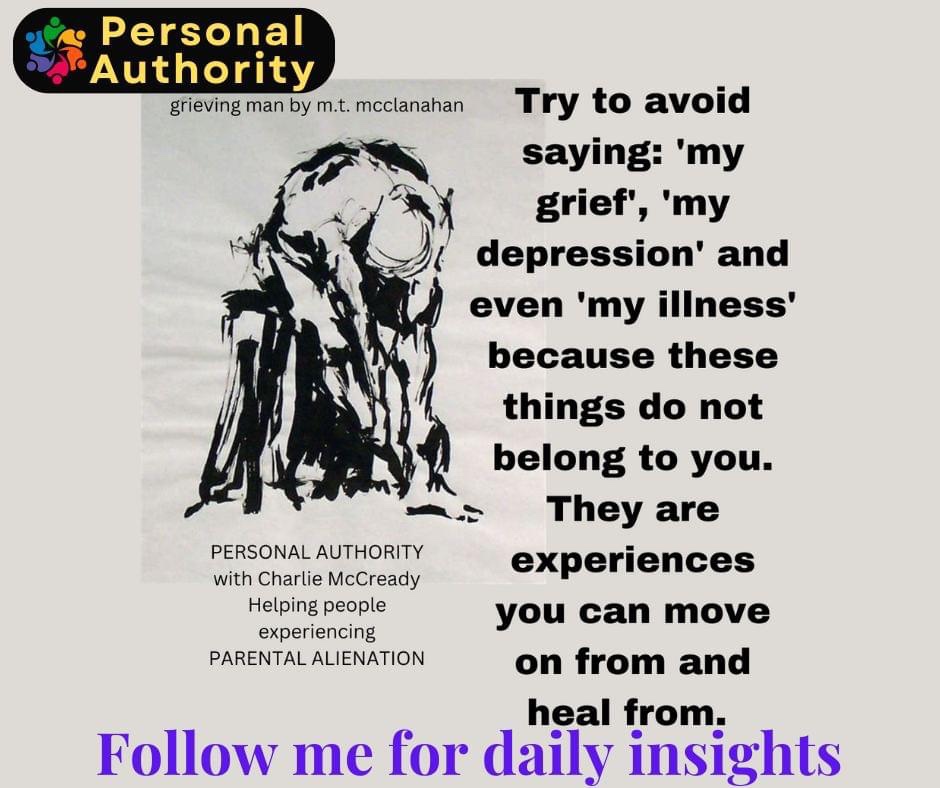
It might seem like a trivial technicality, but it’s important as far as our thoughts and beliefs get ‘ingrained’ and become a part of us when they’re really separate. The experience of parental alienation, as traumatic, unfair, maddening, and agonising as it is, is not you. Nor is it your fault. It happened as a result of a separation/high-conflict divorce from someone who is typically narcissistic/borderline and unable to deal with it. Or the alienation might have started sometime before, but it still stems from disordered parenting. ***

Not you. Try to detach from the experience as being ‘yours’ by changing the ‘my’ to ‘the alienation’ It’s a subtle but important shift.

charliemccready #9StepProgram #parentalalienationawareness #parentalalienationisreal #parentalalienation #alienatedparent #alienatedmother #alienatedfather #rejectedparent #rejectedfather #rejectedmother #highconflictcoparenting #coparenting #coparentingwithanarcissist #highconflictdivorce #divorce #FamilyCourt #familylaw #childabuse #narcissisticchildabuse #narcissisticabuseawareness #narcissisticabuserecovery #narcissist #narcissisticabusesurvivor #narcissisticpersonalitydisorder #narcissism