Soul knows it’s truth and it’s worth

Love isn’t all about physical attraction or romance. it’s all about finding your soul in another person’s body… it’s not physical desire you’re feeling inside,.. it’s a craving for tender human touch, genuine affection, mutual intimacy, belonging, and a meaningful, deep, unbreakable connection. Your heart wants more than fleeting passion, it craves mental stimulation, non-sexual warmth and hug, honest, deep and open conversation, and unfiltered vulnerability. You’re truly seeking a profound bond where masculine and feminine energies harmonize effortlessly. It’s not just about sharing a bed with someone, it’s about someone who touches the depths of your soul, ignites your inner fire, and sees you for who you really are. The soul knows its truth and its worth, and it will never settle for anything less than the richness, depth, and fullness it deserves. (My Love for you is not merely physical attraction or infatuation, in fact, I loved you in times past before I even saw you. I think I know you from an unknown time. My soul was yearning for yours for so long and when we met, we fell in love and we both belonged to each other. 🤍❤️‍🔥🖤

Men – Woman / Relationships

Romantic relationships are more central to men’s well-being than women’s, according to recent research.

Popular culture suggests women prioritize romantic relationships more than men, though recent evidence paints a different picture. Studies often depict women as emotionally dependent on their partners, while men are stereotypically viewed as independent and emotionally reserved. These assumptions have influenced not only cultural narratives but also academic research.

Iris V. Wahring and colleagues challenge this narrative by providing a comprehensive analysis of how romantic relationships impact men and women differently, drawing on interdisciplinary research across psychology, sociology, and evolutionary biology.

The researchers argue that men, on average, rely more on their romantic partners for emotional support and intimacy than women do. They suggest that this discrepancy stems from gendered socialization patterns: men are less likely to cultivate strong, emotionally supportive friendships or family ties outside of romantic relationships, while women are encouraged to develop broader networks of intimacy and care. These differences make romantic relationships disproportionately significant for men in fulfilling emotional and psychological needs.

The authors outline four key findings to support their argument. First, men expect greater benefits from relationships and are more motivated to form romantic partnerships. Compared to women, men perceive romantic relationships as offering a more substantial improvement in their well-being, partly because they tend to have fewer alternatives for fulfilling emotional and intimacy needs.

For example, research indicates that single men are more likely than single women to actively search for a partner, and men are more likely to idealize romantic connections, believing in concepts such as “love at first sight” and confessing love earlier in a relationship. Men also report falling in love more often and more quickly than women, reinforcing their stronger drive to initiate romantic involvement.

Second, men derive more mental and physical health benefits from romantic involvement compared to women. Romantic relationships provide men with a source of emotional support, which translates to higher life satisfaction, improved mental health, and better physical health outcomes. The paper cites evidence showing that single men experience higher rates of depression, stress, and loneliness compared to single women, and men who lack a partner are at greater risk of adverse health outcomes, including reduced life expectancy.

Conversely, married or partnered men tend to experience lower rates of hypertension, inflammation, and other health issues compared to single men. Women’s broader social networks and alternative sources of support mean that they are less dependent on their romantic partners for these health benefits, resulting in a weaker overall association between relationship status and health for women.

Third, men are less likely to initiate breakups than women, partly due to their stronger dependence on the emotional support provided by romantic partners. The authors highlight that approximately 70% of divorces are initiated by women, and women are more likely to end non-marital relationships as well. Men’s greater reluctance to end relationships is explained by their perception that the costs of leaving, primarily the loss of emotional and intimacy support, outweigh the potential benefits. Additionally, men are less likely to view breakups as opportunities for growth or self-discovery, further decreasing their likelihood of initiating separation.

Fourth, men experience greater emotional and psychological distress following the dissolution of a romantic relationship. After a breakup, men are more likely to report feelings of loneliness, sadness, and reduced life satisfaction compared to women. They also experience more severe physical health consequences, including an increased risk of suicide and mortality after losing a partner through separation or death. The authors argue that these negative outcomes are tied to men’s dependency on romantic partners as their primary source of emotional support. Women, by contrast, are more likely to turn to friends and family for support during and after a breakup, which helps them cope more effectively and recover more quickly.

These findings are grounded in broader societal and cultural norms that discourage men from seeking or expressing emotional vulnerability outside of romantic relationships. From an early age, men are socialized to prioritize independence and emotional restraint, which limits their ability to form deep, supportive connections with friends and family. As a result, romantic partners often become the sole providers of emotional intimacy and care in men’s lives. This dynamic explains why men tend to strive harder for relationships, benefit more from being in them, and struggle more deeply when they end.

Wahring and colleagues highlight the importance of rethinking cultural narratives around gender and relationships, particularly in recognizing men’s emotional vulnerabilities and their reliance on romantic relationships for well-being.

Mane Kara-Yakoubian

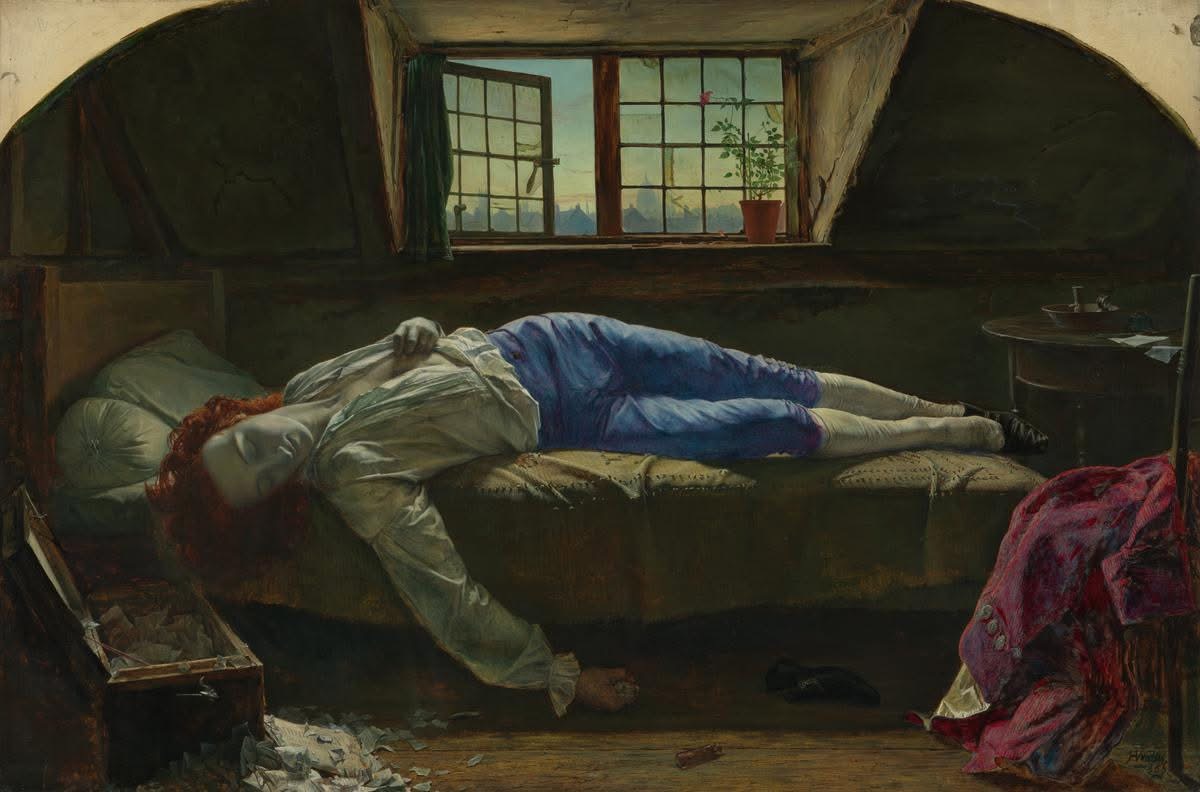
Art- Chatterton, 1856, Henry Wallis. Visual description-The painting depicts the impoverished late 18th-century poet Thomas Chatterton, who poisoned himself in despair at the age of seventeen, and was considered a Romantic hero for many young and struggling artists at the time. The poet is lying on a bed, his eyes closed and his long red hair falling away underneath an open window.
Highest Intimacy

The highest intimacy we can find is neither touch or orgasm, it is comprehension.

There is nothing more intimate than to be understood as well as understanding one another and having our intellectual and imaginative faculties completely aligned and met. The most beautiful thing about a person is never in the what we can see, feel or otherwise sense with our bodies. But it is what we can sense with our minds and hearts.

To be so completely understood in the depth of our being like no other can offer. That is true intimacy. That is the basis for tremendous growth. We have to be able to dive deep together in consciousness for our intimacy to reach incredible heights.

Otherwise we will plateau in our partnerships and not keep rising. This is when one or both partners outsources their thoughts and feelings to a third party in order to have unmet needs met and this is when intimacy fails.

Seek not so much someone who entices the eye, but seek someone who entices the mind.

Who ignites your search for intellectual riches and go in search of someone who shows not only deep compassion, but also deep comprehension.

There is no greater intimacy than that of two people who can unravel mysteries together that nobody else could even comprehend with either of them.

This is when the spiritual heart feels fulfilled. She may be stunning and yes that is lovely,

but her beautiful mind is something I treasure more than a set of gorgeous eyes and a perfect body. A mind able and willing to travel beyond the frontiers of human consciousness as we expand past the firmament, now that is a whole other level of sexy.~

~ Ulf Haukenes

2Souls

When two souls call to each other, the universe listens and brings them together. Not always at the right time or in the expected way, but always with a purpose. Some connections feel like home from the very first moment.

Even if the world pulls them apart, their bond lingers in a song, in a whisper, in a quiet thought at midnight. Because when souls truly recognize each other, no distance or circumstance can ever erase what was meant to be.

~ Grow up

intimateheartconnections 🤍

Happy Woman

If you want your woman to be truly happy in your presence—whether you’re with her or away—there are some simple yet powerful things you must do.

Observe her throughout the day. Pay attention to her actions, her energy, and her behavior. Is she constantly in her masculine role—making decisions, solving problems, handling responsibilities, and always being in control? If she is, she may not truly be happy. She is simply surviving alongside you. She is not thriving in her feminine essence.

A woman who is happy in her relationship moves with softness, grace, and flow. She is not constantly on edge, not always calculating the next step, not always carrying the weight of the world on her shoulders. If she is in a state of constant stress and pressure, she cannot fully relax into her feminine nature. And if she cannot relax, no matter how much you try to hold her, she will not truly feel your touch.

Your touch is not just about physical contact; it is about how safe, cherished, and adored she feels with you. If she is emotionally burdened, your touch will feel distant, empty, or even irritating. But if she feels held, seen, and supported, even the slightest touch from you will melt her.

After marriage, a woman’s energy tells you everything. If she is glowing, laughing effortlessly, and moving through life with a sense of ease, she feels safe in your presence. She trusts you—not just to love her, but to carry the weight of life alongside her.

If she has to handle everything alone, if she is always the one making the decisions, if she is never allowed to just be soft, she will slowly disconnect from her femininity. She may still love you, but she will not feel deeply desired, and over time, the relationship will lose its warmth.

A woman in her natural feminine essence is not meant to be rigid, controlling, or always in her logical mind. She is meant to trust, to flow, to feel safe enough to surrender into her emotions, her love, and her softness. This does not mean she is weak—it means she is aligned with her true nature.

And as a man, you play a role in this. You create the environment where she can either thrive or shut down. If you lead with strength, direction, and emotional presence, she will naturally soften in your presence. If you are passive, disconnected, or inconsistent, she will harden to protect herself.

Ask yourself: Does she feel safe with me? Does she trust me enough to let go? Do I make her feel like a woman, or have I left her to handle life as if she were alone?

Your woman’s energy is a direct reflection of how you show up as a man. If she is radiant, at peace, and emotionally open, she is not just living with you—she is deeply happy with you.

Love her in a way that allows her to rest in her femininity, and you will never have to question whether she is happy by your side.

– Abhikesh

The Runner

“Running Away from Relationships : The Silent Struggle

Running away from a relationship often stems from a mix of fear, pain, and unresolved emotions. It’s not just about avoiding someone; it’s about evading vulnerability, confrontation, or deeper truths about oneself.

Fear plays a significant role—fear of commitment, fear of rejection, or fear of losing independence. Sometimes, people run because the intensity of emotions feels overwhelming, or they’re haunted by past scars they haven’t healed from. They may also feel unworthy of love, projecting insecurities onto the relationship.

However, fleeing doesn’t resolve the underlying issues. Instead, it creates a cycle of loneliness and regret. Building healthy relationships requires courage—courage to communicate, face discomfort, and embrace imperfections, both in oneself and others.

Running might seem like the easiest option, but true growth lies in staying, understanding, and healing together. Every relationship offers a mirror to our soul; perhaps what we’re running from is not the relationship, but ourselves.”

Man’s Unhealed Trauma

A man with unhealed childhood trauma becomes the “nice guy” who is either defensive or shut down in his relationships with women. You see, this is why most women appear drained, exhausted, and empty.

Dear man,

The truth is, your unhealed pain can silently shape the dynamics of your relationships. While you might strive to be the perfect partner, your defenses can build walls that make it difficult for those you love to truly reach you. When you shut down, you unintentionally shut out the very love and connection that could heal both you and her.

Understand that when you avoid facing your inner wounds, you allow them to dictate how you interact with others. This isn’t because you don’t care; it’s because your emotional armor is still intact, and it’s preventing you from truly being present. Women can sense this absence, and it often leaves them feeling isolated, even when you’re physically there.

It’s important to realize that this isn’t about blaming you. You may have been taught to suppress your feelings, to “man up” and put on a brave face. But holding it all in doesn’t make you stronger—it makes you fragile. Your unresolved trauma can manifest as defensiveness, as a reluctance to trust or open up fully. Over time, this behavior starts to drain the people around you, especially the woman who longs for your vulnerability and presence.

Her exhaustion isn’t just physical; it’s emotional. She’s carrying the weight of trying to reach you, to understand you, while you silently suffer inside. Every time you withdraw, she’s left to wonder if she’s doing something wrong. This cycle can lead to confusion and emotional depletion on both sides.

What you don’t realize is that your pain doesn’t have to define your relationships. You don’t have to stay in the role of the nice guy who retreats into himself when the pressure mounts. Healing requires courage—the courage to face the past, to confront the emotions you’ve been avoiding. It means allowing yourself to feel, to express, and to be real with the one you love.

She wants to see the real you, the raw, unguarded version of you. The man who is willing to heal, to be vulnerable, and to embrace the power of emotional intimacy. When you do this, you not only give her the love she deserves but also create space for your own healing. It’s a beautiful cycle of mutual support and understanding that can transform both of you.

The journey to healing isn’t easy, but it’s one that’s worth taking. Start small—acknowledge your feelings, take responsibility for your triggers, and seek the support you need. Surround yourself with people who encourage your growth, and most importantly, allow yourself the grace to heal at your own pace.

As you heal, you’ll find that your relationships become more fulfilling. No longer will you have to hide behind a facade of being the “nice guy.” Instead, you’ll be the man who is strong because he is whole, a man who gives love freely because he has learned to give it to himself first.

Dear man, this is your time to stop running from the very thing that holds the power to set you free. Let go of the past, open your heart, and let the healing begin. It won’t happen overnight, but with each step forward, you’ll become more of the man you were always meant to be.

Embrace the vulnerability, and watch how it transforms not just your relationships but your entire life. You have the strength to heal, and in doing so, you can bring healing to the woman you love.

Attracting Toxic Partners

People who attract toxic partners often do so due to a combination of psychological, emotional, and social factors. Here are some reasons why this may happen:

1. Unresolved Past Trauma

Patterns from childhood: People who grew up in unhealthy or dysfunctional families may unconsciously seek partners who replicate those dynamics, as they feel familiar, even if toxic.

2. Low self-worth: Past trauma can lead to self-esteem issues, making someone more tolerant of poor treatment.

3. Codependency

Some individuals feel the need to “fix” or “rescue” others, which can attract toxic people who exploit this tendency.

4. Poor Boundaries

People with difficulty setting boundaries may allow toxic behavior because they fear conflict, rejection, or abandonment.

5. Unrealistic Optimism

A belief that they can change a toxic partner’s behavior or help them become better may lead to staying in unhealthy relationships.

6. Lack of Experience or Awareness

Some may not recognize red flags in the early stages of a relationship, especially if they haven’t encountered healthier relationship models.

7. Fear of Being Alone

Fear of loneliness can push people to settle for toxic partners rather than being single.

8. Cultural or Societal Conditioning

Some cultures or social norms glorify suffering or sacrifice in relationships, making toxic dynamics seem acceptable or normal.

9. Manipulation by Toxic Partners

Toxic individuals are often charming and manipulative in the beginning, making it difficult to see their true nature until later.

Breaking the Cycle:

Self-awareness: Understanding personal patterns and triggers.

Therapy or counseling: Addressing underlying trauma or emotional issues.

Education: Learning about healthy relationships and red flags.

Support systems: Relying on friends or support groups for guidance and perspective.

Self-worth: Building confidence and practicing self-love to set higher standards for relationships.

• Recognizing these factors is the first step toward breaking the cycle of attracting toxic partners and fostering healthier connections.

Separation

I digressed in forward motion for a lot of reasons ; but I was clear and still am that relationships must be reciprocal, healing has begun for Beloved and he sees and knows me .

Abandonment was huge for me for decades but that’s just showing up as discernment and with the exception of landlords who reveal themselves as less than honestly , compassionate or humanely motivated .

I don’t allow disrespect or endangerment in a home situation and haven’t lived with anyone for several decades . I don’t have anyone to separate from and I’m good with that !

The Final Separation between partners after a long relationship is difficult, not just emotionally but also physiologically.

Throughout the relationship, even one with problems, both individuals activate neural networks that produce chemical neurotransmitters and peptides, giving their experiences a certain emotional tone and reinforcing their personalities.

The two become so accustomed to the relationship that, even when they decide to end it, they cannot immediately destroy the neural connections and chemical attachments between them.

After the breakup, memories of their experiences remind the body that it is now deprived of its usual chemical stimulation.

The pain of ending a relationship can be caused by the interruption of a neurological habit.

Considering the chemistry of emotional dependence, it’s no surprise that so many couples break up, reunite, and then repeat the cycle.

We may separate from others, but we remain chemically dependent on the emotional states generated by the relationship, at least for a period of time.

When we feel a certain attraction toward a partner, we are convinced that they are the right one for us.

However, most of the time, the person we are drawn to reflects the unresolved emotional wounds we carry.

Often, when we feel a strong attraction to someone, it’s not just hormones at play- we are intuitively drawn to partners because we subconsciously believe they will help us resolve our emotional issues, even ones we are unaware of.

The more abandoned we feel, the more we are attracted to people who tend to abandon those who care about them.

#Illuminatekokoro #story #art #literature #perspectives