
What it is
https://en.wikipedia.org/wiki/Open_Dialogue
imhcn.org/bibliography/recent-innovations-and-good-practices/open-dialogue/

This starts my 22nd year of teaching middle school. Yesterday was quite possibly one of the most impactful days I have ever had.
I tried a new activity called “The Baggage Activity”. I asked the kids what it meant to have baggage and they mostly said it was hurtful stuff you carry around on your shoulders.
I asked them to write down on a piece of paper what was bothering them, what was heavy on their heart, what was hurting them, etc. No names were to be on a paper. They wadded the paper up, and threw it across the room.
They picked up a piece of paper and took turns reading out loud what their classmate wrote. After a student read a paper, I asked who wrote that, and if they cared to share.
I’m here to tell you, I have never been so moved to tears as what these kids opened up and about and shared with the class.
Things like suicide, parents in prison, drugs in their family, being left by their parents, death, cancer, losing pets (one said their gerbil died cause it was fat, we giggled😁) and on and on.
The kids who read the papers would cry because what they were reading was tough. The person who shared (if they chose to tell us it was them) would cry sometimes too. It was an emotionally draining day, but I firmly believe my kids will judge a little less, love a little more, and forgive a little faster.
This bag hangs by my door to remind them that we all have baggage. We will leave it at the door. As they left I told them, they are not alone, they are loved, and we have each other’s back.
I am honored to be their teacher.
Credit: Karen Wunderlich Loewe


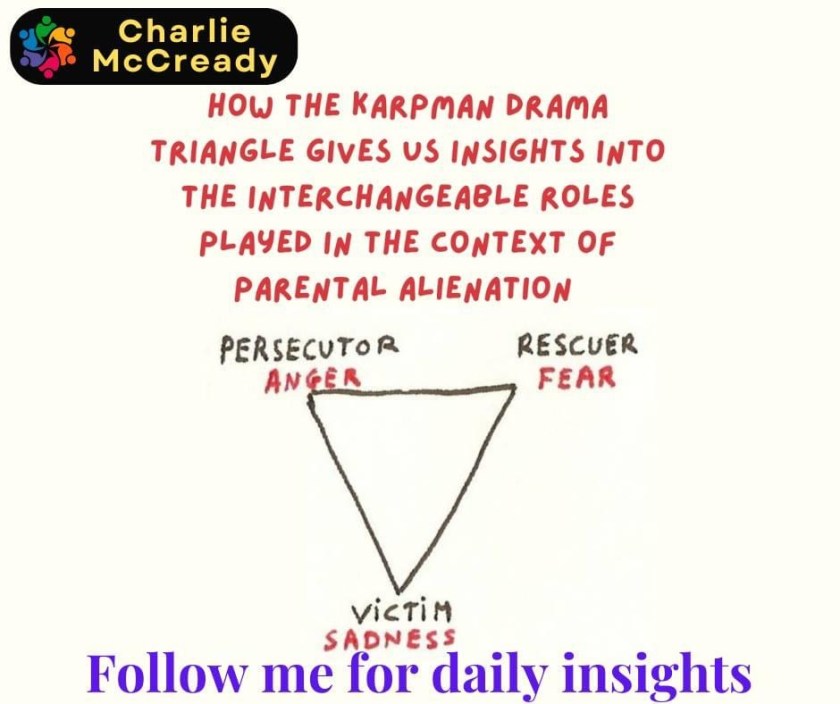
The Karpman Drama Triangle provides insights into social dynamics and conflict and identifies three distinct roles: victim, rescuer, and persecutor. These roles are interchangeable, not the actual circumstances of someone’s life but rather unconscious roles people play or manipulate others to play.
When in the victim role, people view themselves as powerless and oppressed, and they seek a rescuer. They might typically say, ‘Poor me’ and not take responsibility for their circumstances. If the person they think might save them fails to do that, they may now consider them a persecutor. In the frame of parental alienation, the alienating parent might have thought you could somehow save them and then blame you for not doing so if the relationship ended in divorce. The children may become their rescuers, which is when they become parentified (as well as weaponised).
Rescuers are keen to help and care for others, often neglecting their own needs. They want others to feel better. They say: ‘I want to help you!’ This is a codependent role; some look for a victim to help validate themselves and feel good about themselves. But this role leaves them feeling overworked, tired, caught up in martyr-complex, sometimes harbouring resentment. They may hope they will be rewarded and taken care of themselves later. They fear abandonment.
Persecutors assume a controlling, authoritarian role, exerting power over others, typically the victim or scapegoat. It’s never their fault. They get angry, issue threats, and oppress through domineering and bullying tactics. They shout and cause conflict but don’t solve the problems themselves. These warring people believe the world is hard and they need to be tough to survive it. They take no responsibility for the harm they may cause others – it’s their fault! What they fear most is being seen as weak, feeling helpless, or being a victim. The persecutor is the alienating parent.
The drama triangle is interesting in terms of identifying unhealthy family dynamics. People can switch roles and perpetuate the drama. Until they take responsibility for the part they’ve played. Unfortunately, alienating parents will refuse accountability or work towards co-parenting. But ‘target’ parents can empower themselves and refuse to be victimised – the pathology is the problem, not them. They can initiate self-care and be their own saviour. Children, as rescuers, can reclaim their autonomy and authenticity and see the difference between helping and enabling. Rescuers can empower rather than enable.
#charliemccready #9stepprogram #parentalalienation #parentalawareness #parentalalienationisreal #alienatedparent #alienatedchild #alienatedfather #alienatedmother #rejectedparent #rejectedmother #rejectedfather #highconflictcoparenting #coparenting #coparentingwithanarcissist #highconflictdivorce #divorce #FamilyCourt #familylaw #childabuse #psychologicalchildabuse #narcissism #narcissisticpersonalitydisorder #narcissisticabusesurvivor #narcissists #narcissisticabuserecovery #narcissisticabuseawareness #narcissisticpersonalitydisorder #narcissisticparent #narcissismawareness
I highly recommend this
EAGLE COUNTY, Colo. — Carrie Rodgers gestures toward the silver medallion sitting atop her fridge, then waves it off. It’s nothing really, she shrugs. …
— Read on www.edsurge.com/news/2023-09-06-when-affordable-housing-is-scarce-so-are-educators
Amazon.com: The Devil’s Secret: How Emotional Illness is Passed Through The Generations eBook : Homan, Mark: Kindle Store
— Read on www.amazon.com/dp/B0CDKFMQD2/ref=tsm_1_fb_lk
The 1st thing I heard this morning was this bull s***
He’s extremely distorted in his opinion but I’m sure others agreed
“Schools train people to be ignorant, with style. They give you the equipment that you need to be a functional ignoramus. American schools do not equip you to deal with things like logic; they don’t give you the criteria by which to judge between good and bad in any medium or format, and they prepare you to be a usable victim for the military-industrial complex that needs manpower.”
~Frank Zappa

 GreatCosmicMothersUnite