
Tag: hz
The Sound Theory
Cathedrals
440 HZ -1932
Resonance
Matter as Music: Sympathetic Vibratory Physics and the Scalar Architecture of Reality
“In the beginning was the Tone…”
In the realm of Sympathetic Vibratory Physics, we are invited to look beneath the veil of appearance—not to dismantle the world into parts, but to hear its song. This framework does not merely study matter; it listens to its music. It suggests that the universe is not a machine, but a resonant organism, where energy, form, and consciousness all arise from fundamental vibratory relationships.
Here, matter unfolds like music.
Each element in the periodic table is not just a configuration of protons, neutrons, and electrons—it is a standing wave, a unique chord struck in the great scalar octave of creation. These chords are not arbitrary. They are expressions of deeper harmonic laws, much like the tones of a well-tuned instrument. What we perceive as “substance” is, in this view, the visible imprint of an invisible harmony—a crystallized resonance.
⸻
The Scalar Octave: The Hidden Ladder of Form
In contrast to the more familiar transverse waves (like light or sound), scalar waves are longitudinal, non-Hertzian, and more akin to internal ripples in the etheric field—vibrations that do not travel through space, but alter the structure of space itself. These scalar fields are fundamental carriers of formative information. They act as geometric wombs, shaping how vibration coalesces into energy, and how energy descends into matter.
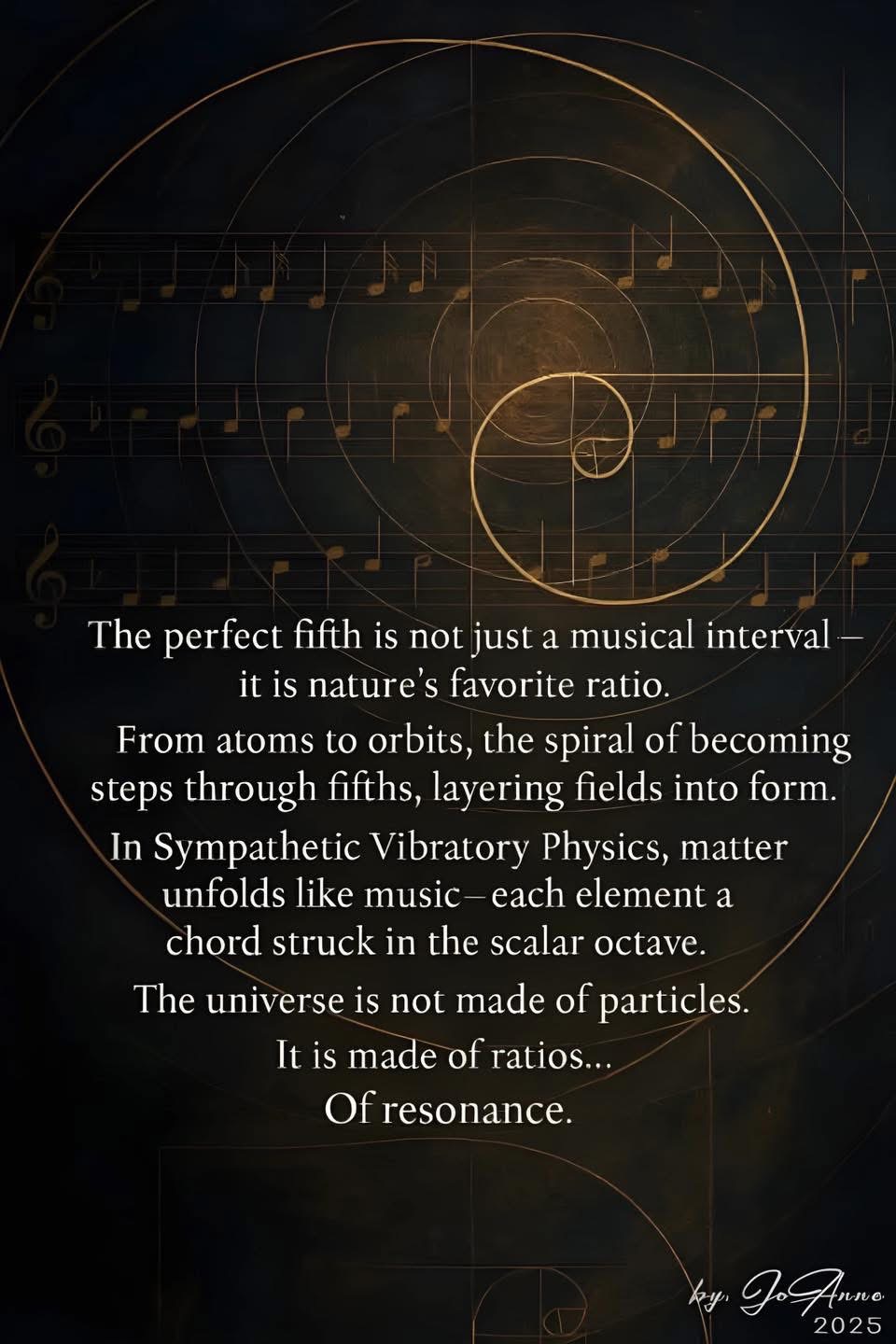
The scalar octave is not merely metaphor. It is a real hierarchy of vibratory domains—nested frequency ranges wherein energy steps down through successive thresholds of coherence. This process mirrors the musical scale: as notes rise or fall in pitch, they repeat patterns at higher or lower orders. Similarly, matter manifests in octaves of vibration—hydrogen resonates in the first octave, helium in the second, and so on. These are not accidental frequencies but expressions of an underlying harmonic lattice.
⸻
Elements as Chords: The Music of the Periodic Table
Each element is a chordal entity—a bundle of vibratory frequencies stabilized in geometric proportion. Just as musical chords arise from precise relationships between tones (ratios like 3:2 or 5:4), atomic structures form through harmonic resonance in the field of potential.
• Hydrogen is the fundamental, the root note of matter.
• Carbon, the tetrahedral architect of life, is a four-note harmony—a stable structure of balance and creativity.
• Oxygen—life’s breath—is a chord that energizes and catalyzes.
• Gold is the high harmonic, a metal of solar resonance, often seen as the physical analog of spiritual incorruptibility.
These elemental chords can interact, combine, or transmute—just as musical notes form complex overtones when played together. The alchemist’s dream of transmutation is not impossible in this worldview—it is simply a question of retuning the vibratory field. Transmutation is harmonic engineering.
⸻
Form, Sound, and the Living Geometry of Resonance
When vibration is coherent, it gives rise to form. This is the basis of cymatics—where sound organizes particles into complex geometric patterns. Extend this principle into the scalar realm, and you begin to see how atoms, molecules, cells, and even galaxies may be expressions of standing waves within higher-dimensional harmonic fields.
This resonance is sympathetic—it spreads by tuning, not force. When one frequency finds its match, it calls it into vibration, like strings across space. This is the hidden dynamic behind gravity, magnetism, and even consciousness itself. The universe is not a closed mechanism but a field of interrelated tones, where all things influence each other through harmonic correspondence.
In this light, sacred geometry is not decorative—it is descriptive. It maps the resonance patterns that give rise to form: the flower of life, the golden ratio, the Platonic solids—these are not symbols imposed upon matter, but frequencies frozen into shape.
⸻
The Role of Consciousness: The Cosmic Tuner
Perhaps most profound in sympathetic vibratory physics is the implication that consciousness itself is vibratory—not an emergent property of the brain, but a primary resonance in the fabric of reality. Mind tunes matter. Thought, intention, and emotion become scalar acts—affecting reality not by mechanical force, but through sympathetic entrainment.
This positions the human being not as a passive observer of a dead cosmos, but as a co-resonator within the cosmic symphony. When we meditate, sing, pray, or visualize, we are tuning the strings. We are playing chords in the scalar octave—activating harmonics that ripple outward into the morphogenetic field.
⸻
Toward a Harmonic Science of Reality
Sympathetic Vibratory Physics is not a fringe theory—it is a paradigm in waiting, bridging the mystical and the mathematical, the ancient and the futuristic. It unifies music and matter, form and field, sacred geometry and scalar science. It points toward a universe where coherence is power, where form is resonance made visible, and where the key to transformation lies not in force, but in tuning.
Matter is not mute. It sings.
And every element is a note played by the cosmos—
A chord in the eternal score of becoming… xx
Lost language of Frequency
Weaponized Disease
Indeed the chemical ware far $$$$$
that aligns with pharmaceutical/chemical ,
and medical companies/corporations!
 GreatCosmicMothersUnite