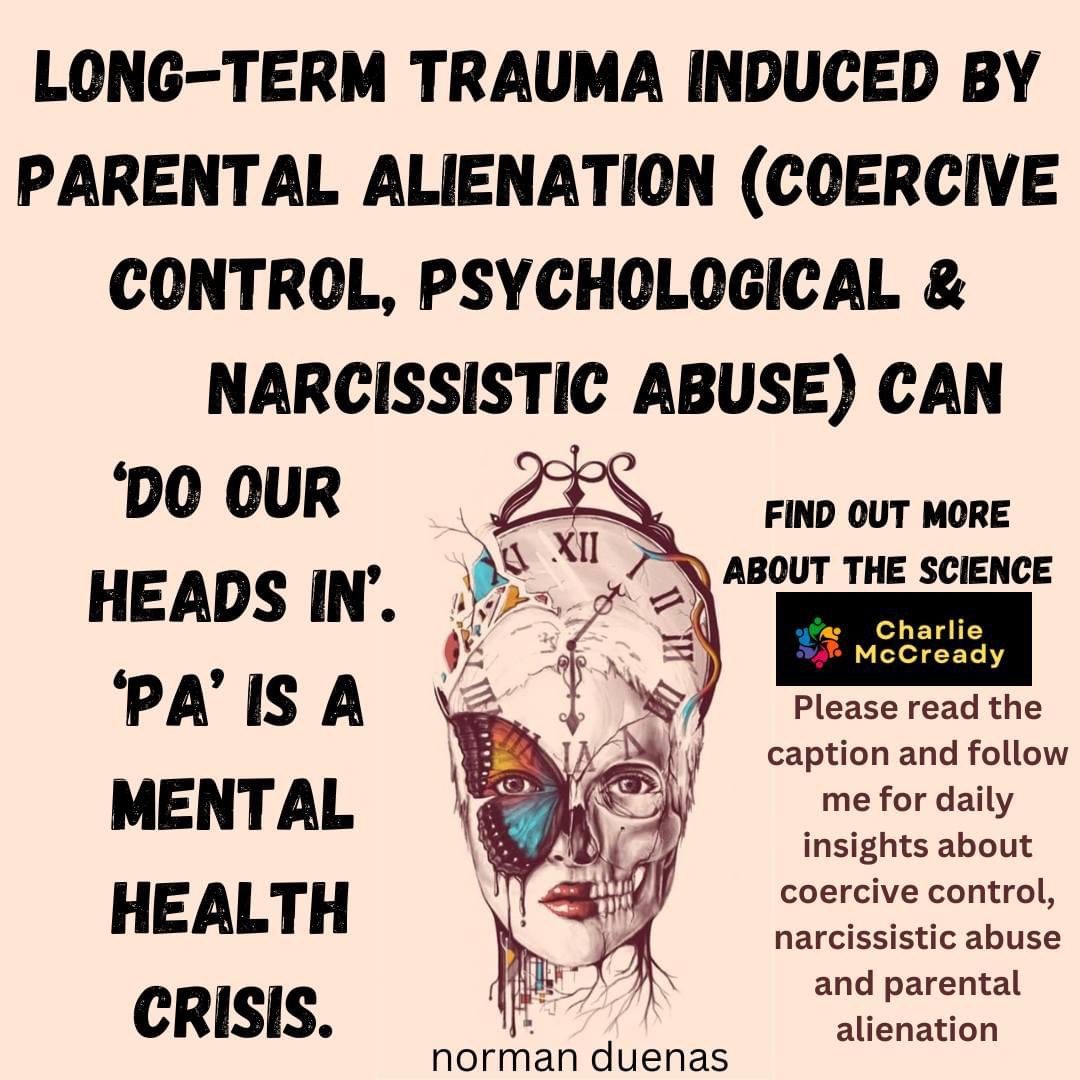
Something ‘doing our head in’ (an English colloquialism) makes us depressed, disheartened, frustrated, and discouraged. Parental alienation and all its associated, complex, often long-term emotional trauma and abuse wound us mentally and can change brain functionality. There’s science behind it. The alienating parent may be operating from a traumatised mind, too, but holding people in constant fear or anxiety gives them more power to control. They also don’t care and don’t do anything about taking responsibility for what they do. This post is not about them, but what their behaviours do to others – namely the target parent, their family and the alienated child.
Most people have heard of PTSD or C-PTSD (complex post-traumatic stress disorder). Even after a relationship or a painful experience has ended and time has passed, memories of it can be triggered, causing a reaction of paralysing anxiety, panic attacks, grief, anger or a sense of helplessness. The experience can almost be re-lived.
So, here’s the science. When we experience trauma, the various parts of the brain are activated and respond in different ways.
The reptilian brain is the oldest part of the brain and regulates our basic survival functions such as breathing, heart rate, and body temperature. When we experience trauma, the reptilian brain may become activated and trigger our ‘fight or flight’ response, which can cause physical sensations like increased heart rate, rapid breathing, and heightened alertness. There’s a ‘no time to think’ response. But the reptilian brain can’t tell if it’s a real threat, imagined or memory-triggered.
The hippocampus is for learning, understanding, and experiencing. Memory requires much neural activity, but under the pressure of emotional/narcissistic abuse or a traumatic experience such as parental alienation, cortisol can be damaged, impacting the neurons. The attention becomes fixated on the emotions and thoughts triggered by the stress, limiting the ability to deal with new information. So, when angry or sad, our mind becomes primarily focused on anger or grief and struggles to let other thoughts in.
The amygdala is the emotional part. Our response to a stressful situation can be based on similar childhood experiences. When we experience trauma, the amygdala may enlarge and become overactive and cause us to feel intense emotions like fear, anxiety, or panic. This can result in a heightened sensitivity to potential threats and a tendency to respond defensively or impulsively. Something said irrationally or ‘without thinking’ is the amygdala’s fault!
The prefrontal cortex is the conscious, logical mind, responsible for about 15% of our decision-making and it is essential for our overall well-being. It doesn’t reach maturity until after the teen years. When we experience stress/trauma, the prefrontal cortex ‘tunes out’, and becomes overpowered by the amygdala and reptilian brain, even shrinking in size, making it harder to think clearly, make decisions, or regulate our emotions. This can impair memory, attention, planning, and problem-solving. It can lead to depression, ‘burn out’, and our minds going ‘blank’ during times of stress.
Exposure to stress in childhood can lead to anxiety/PTSD, depression, immune dysfunctions, and other medical issues. As adults, coping mechanisms can become unhealthy (substance abuse, toxic relationships etc) leading to increased stress. Fortunately, there are things we can do, benefits from exercise which increase neurogenesis (production of new brain cells) and it can lift the mood. Being around loving, supportive people, feeling connected, and relaxing. Learning a new skill, sport or topic of interest can help too. Some swear by EMDR (Eye Movement Desensitisation and Reprocessing), which aims to eradicate trauma responses by eliminating dysfunctional ‘protective’ information stored. Meditation is good too, and EFT (Emotional Freedom Technique). This helps the short-circuiting as a result of PTSD. It’s worth looking into this if you’re interested for you or your children. I did many of these things myself. I hope this helps.
#charliemccready
#parentalalienationcoach
#emotionalfreedomtechnique
#traumahealing
#traumahealingjourney
#emdr
#parentalalienationawareness
#narcissisticabuseawareness
#alienatedparent








 GreatCosmicMothersUnite