

To diagnose a delusion… you MUST identify what actual reality is.
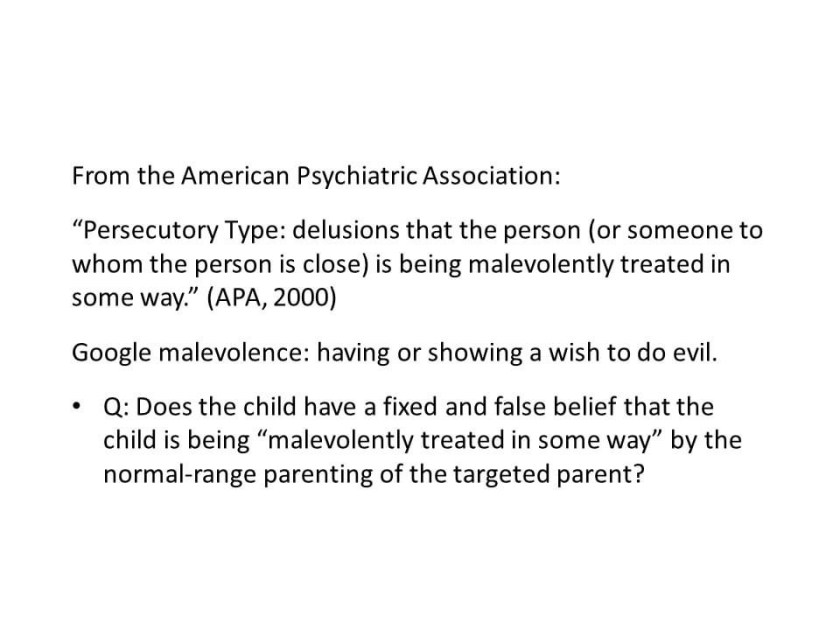
A delusion is a fixed and – false – belief. To diagnose a delusional disorder REQUIRES establishing that one reality is true, and one reality is false.
When two realities are too discrepant, both realities cannot be true. One reality is true. One reality is false.
Trump vs Cohen. One of them is telling the truth, and the other one is lying. There is no middle ground of some sort of “misperception” – nope – one is telling the truth and one is lying.
You’re job as the diagnostician of delusional disorders is to identify actual reality from the lies. Can you do it with Trump and Cohen? Which one do you think it telling the truth and which one do you think is lying?
It’s one way or the other, there is no grey in the middle. One reality is true. One reality is a lie.
In the family courts – one reality is correct – the other reality is a lie. Either the child is being authentically abused by the targeted parent, or the child is being psychologically abused by the allied parent.
There is no grey “misperception” – one reality is true – one reality is a lie told to deceive.
If you are going to be a court-involved clinical psychologist, it is your obligation to make the diagnosis of truth and lie – of reality and delusion. That’s your job.
Because that’s required to make a diagnosis of a potential delusional thought disorder, and the pathology of concern is a potential delusional thought disorder.
So should one person decide what’s truth and what’s a lie?
Get a second opinion. Get a third opinion. Get all your second-opinions right at the start – put your combined heads together and decide – which is the truth and which is the lie.
We can make an accurate diagnosis when there’s the motivation to make an accurate diagnosis. They’re not motivated to make an accurate diagnosis.
I wonder why that is?
Craig Childress, Psy.D.
Clinical Psychologist, CA PSY 18857

 GreatCosmicMothersUnite