
Tag: abuse narcissistic behavior
Empaths & Narcissist -Early childhood trauma
I’ve read narcissist have deep and profound trauma and lack Christ Consciousness connection 
Alienator are predators
Alienators are predators disguised as good parents. Only a predator would seek to destroy the bond between a loving parent their child.
Re-education for parents and professionals on the danger parental alienation creates should be mandatory.

Kim Saeed – Not everyone has Narcissistic traits
Psychology (and mental health), as defined by the APA and the DSM, is one of the most outdated disciplines as it currently stands.
Not everyone has narcissistic traits. This idea is largely based on outdated Freudian theories. The DSM is not inclusive of the work of other important pioneers in Psychology, such as Abraham Maslow.
Maslow’s theory of self-actualization emphasized the positive aspects of human nature. He believed that individuals have an inherent drive to reach their fullest potential and become the best version of themselves. Self-actualization involves pursuing personal growth, creativity, and a sense of fulfillment. This innate drive has nothing to do with any level of narcissism. This positive outlook resonates with many people because it offers a hopeful and empowering perspective on human behavior.
On the other hand, Freud’s psychoanalytic theory focused on negative aspects of human behavior, such as unconscious desires, conflicts, pen*s envy, and defense mechanisms. While Freud’s work has been influential in understanding the unconscious mind, it can be seen as more pessimistic and deterministic compared to Maslow’s emphasis on self-actualization.
Freud’s findings were seen as applicable to all individuals, regardless of their backgrounds or life experiences. This is precisely the reason the DSM has been widely criticized.
Narcissism is not an all-encompassing trait, applicable to every individual on the planet. Various theories, such as psychodynamic, social, and cognitive perspectives, have highlighted that narcissism is influenced by a complex interplay of genetic, environmental, and individual factors. Therefore, it is erroneous to assume that narcissistic tendencies are universally present in all individuals.
The notion that we all have narcissistic traits is a large-scale attempt to normalize a lack of empathy/self-centeredness and to shame everyone into believing that every thought and behavior they engage in has a narcissistic motive behind it, much in the way that religion says we’re all sinners just because we breathe.
If you look at a basic list of what are considered narcissistic traits, not everyone possesses them: grandiosity, lack of empathy, exploitation of others, arrogance, manipulative tendencies, sense of entitlement, etc. To say we all have these traits is simply not true.
What’s happened is that folks are taking the basic, universal human emotions and feelings that are essential aspects of human psychology and tying them to narcissism, i.e., narcissistic traits. This is wrong.
The field of mainstream Psychology is all too pleased to keep this false notion alive. While the psychodynamic approach made some valuable contributions, it also has many uncorrected flaws. Ultimately, there are many other approaches and frameworks that don’t pathologize trauma responses in the way that the DSM and mainstream Psychology do. Be mindful not to rely too heavily on this system to the exclusion of others that might be more applicable and validating to your situation.
Always thinking of you,
Kim 🕊️
Communication skills of a Narcissist
When the Narcissist hears you talk
In retrospect , I’m sure he heard his voice , his needs , and those words of his confidant , his Mother .
Intimacy and trust never developed , though I tried , he was not interested or drained from communicating with others .. of course I’m blamed for this too.. I wasn’t worthy of his time.
Around age 3 he began to interact with our 1st child, and was thrilled when I gave birth to number 2, his ” brother ” his friend and parent in adult life ..
The projection of a Narcissist
Yes, projection was a huge part of his need for me ..someone to dump all his lower energy and opinion of himself.
Mirroring his characteristics , I also sought help and psychiatry termed me bipolar , discounting the Xanax prescribed for IBS addicting me unknowingly , I alone was responsible , he’s had a free pass for decades .
Narcissistic personality disorder (NPD) includes core behaviours such as capriciousness, lack of empathy for others, excessive self-admiration, a need for validation from others, grandiosity, fantasies about success, beauty or love, entitlement, superiority, exploitative behaviours, arrogance and self-centeredness. A person with NPD will compare and judge, they’re sensitive to criticism, highly reactive and resistant to perceived slights. It’s estimated that about 0.5 – max 6% of adults have NPD and more men than women. We’re all a little bit narcissistic in some ways – we can be proud of our achievements, and of a new coat we bought, but for the vast majority of us it’s not a personality disorder. It only became recognised as an illness in the century, but narcissism is a concept going back thousands of years. It goes back to ancient Greek mythology. Narcissus, a proud and handsome man, on seeing his reflection in the water for the first time, fell in love with his image and couldn’t stop staring at it until the day he died.
It was only in 1980 that NPD was officially recognized in the Diagnostic and Statistical Manual of Mental Disorder (DSM). Parental alienation isn’t yet recognised, and there’s the argument over its existence even though those of us who’ve suffered it know it’s real. But it involves narcissism and one parent insisting and coercing their child into believing they are the one and only parent who is good and loving. Narcissistic people get really upset if they’re not in total control and with everything going their way. They’re terrible at collaboration, mediation or meeting halfway. Co-parenting is almost impossible for them. They’re right, everyone else is wrong.
A child growing up with a narcissistic alienating parent is probably not getting their needs met because the attention is on the victim/victor parent and their needs. The child becomes a reflection of the parent, serving the parent, and becomes pathologically enmeshed because the parent exerts ‘power over’ and coercive control. It can lead the child into depression, anger, substance abuse, and relationship difficulties. It is child abuse. But they can and do break out of this. It doesn’t have to be a life sentence. The narcissistic parent won’t change, but the child can. They figure out their parent isn’t well. They may remain protective of that parent, or they may become angry with them, but at last, they will find out it wasn’t their fault, it wasn’t a normal childhood or parent/child relationship, it was toxic, disordered and disturbed like the narcissistic alienating parent, and the ‘target’ alienated parent wasn’t what they were led to believe either. And when they figure this out, especially with a bit of distance, they can get psychologically-X5xrxpxUu9QskLdU-hukgeLv2823tdYXkL-goe93J1LwTKz_sV1LRRdsj9rkd0HBFcJxQY3IGRW-QUegRcI0KTxlk&__tn__=-UK-R)

Refusing to Co parents
A parent who refuses to Co-parent is a parent who is seeking control and what’s not in the best interest of their child.
For kids this control can be disguised as love and safety when in fact it’s alienating a parent from their child.
To get your copy of Alienated “When Parents won’t parent” click link in comment👇🏼

Not everyone is Narcissistic- Kim Saeed
Psychology (and mental health), as defined by the APA and the DSM, is one of the most outdated disciplines as it currently stands.
Not everyone has narcissistic traits. This idea is largely based on outdated Freudian theories. The DSM is not inclusive of the work of other important pioneers in Psychology, such as Abraham Maslow.
Maslow’s theory of self-actualization emphasized the positive aspects of human nature. He believed that individuals have an inherent drive to reach their fullest potential and become the best version of themselves. Self-actualization involves pursuing personal growth, creativity, and a sense of fulfillment. This innate drive has nothing to do with any level of narcissism. This positive outlook resonates with many people because it offers a hopeful and empowering perspective on human behavior.
On the other hand, Freud’s psychoanalytic theory focused on negative aspects of human behavior, such as unconscious desires, conflicts, pen*s envy, and defense mechanisms. While Freud’s work has been influential in understanding the unconscious mind, it can be seen as more pessimistic and deterministic compared to Maslow’s emphasis on self-actualization.
Freud’s findings were seen as applicable to all individuals, regardless of their backgrounds or life experiences. This is precisely the reason the DSM has been widely criticized.
Narcissism is not an all-encompassing trait, applicable to every individual on the planet. Various theories, such as psychodynamic, social, and cognitive perspectives, have highlighted that narcissism is influenced by a complex interplay of genetic, environmental, and individual factors. Therefore, it is erroneous to assume that narcissistic tendencies are universally present in all individuals.
The notion that we all have narcissistic traits is a large-scale attempt to normalize a lack of empathy/self-centeredness and to shame everyone into believing that every thought and behavior they engage in has a narcissistic motive behind it, much in the way that religion says we’re all sinners just because we breathe.
If you look at a basic list of what are considered narcissistic traits, not everyone possesses them: grandiosity, lack of empathy, exploitation of others, arrogance, manipulative tendencies, sense of entitlement, etc. To say we all have these traits is simply not true.
What’s happened is that folks are taking the basic, universal human emotions and feelings that are essential aspects of human psychology and tying them to narcissism, i.e., narcissistic traits. This is wrong.
The field of mainstream Psychology is all too pleased to keep this false notion alive. While the psychodynamic approach made some valuable contributions, it also has many uncorrected flaws. Ultimately, there are many other approaches and frameworks that don’t pathologize trauma responses in the way that the DSM and mainstream Psychology do. Be mindful not to rely too heavily on this system to the exclusion of others that might be more applicable and validating to your situation.
Always thinking of you,
Kim 🕊️
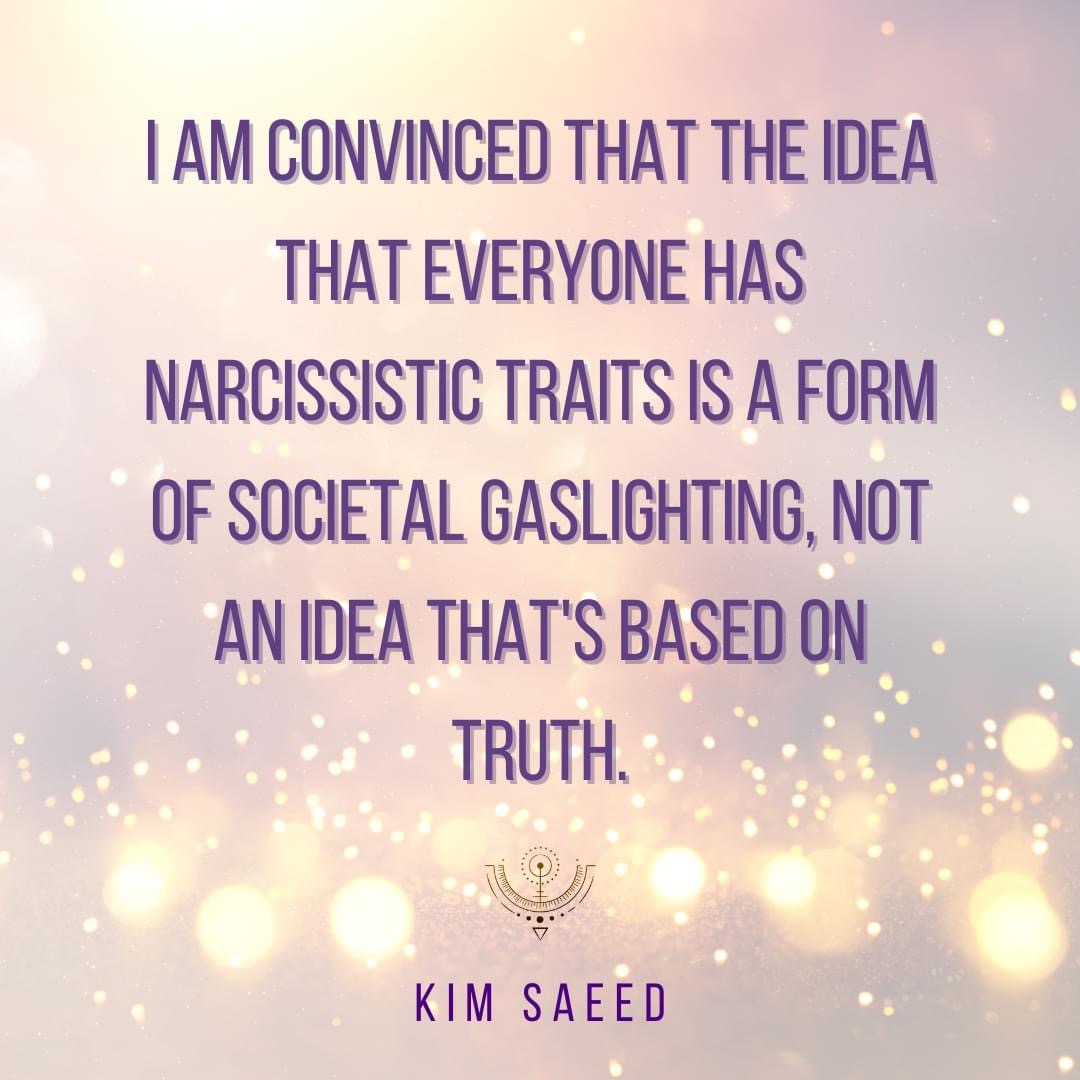
Not everyone is Narcissistic
 GreatCosmicMothersUnite