

Wanna see something?
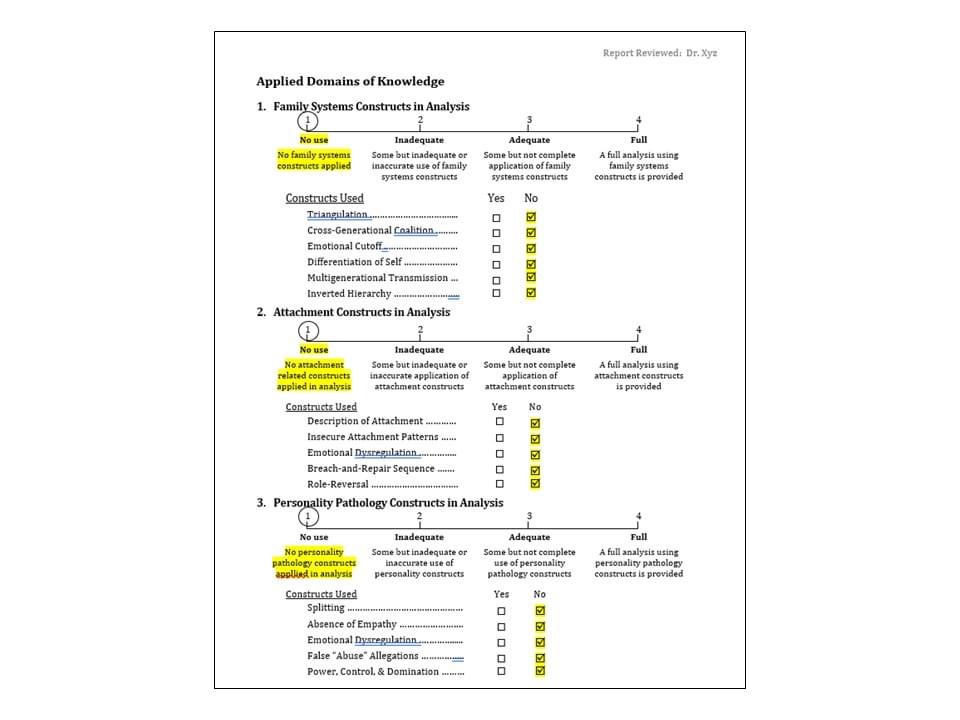
When I conduct a line-by-line review of a forensic custody evaluation, I generate a Checklist of Applied Knowledge at the end of my review.
The Checklist of Applied Knowledge provides a structured way to document compliance with Standard 2.04 and the application of the “established scientific and professional knowledge of the discipline” as the bases for their professional judgments.
It’s a 4-page checklist with a one-page written Summary. Here’s the written Summary for a recent review:
______________________________
Checklist of Applied Knowledge for Dr. Xyz
A Checklist of Applied Knowledge was used to evaluate Dr. XYZ’s application of the established scientific and professional knowledge of the discipline as the bases for her professional judgments. Based on a review of Dr. XYZ’s report, no domain of established professional knowledge was evident in application as the bases for her professional judgments.
Applied Knowledge:
• Family Systems: Despite Dr. XYZ being tasked with assessing a family conflict, no family systems constructs were evident in her reporting or analysis.
• Attachment: Despite Dr. XYZ assessing severe attachment pathology being displayed by the children toward their father, no application of attachment constructs was evident in her reporting or analysis of the family conflict.
• Trauma Pathology: Despite Dr. XYZ assessing issues of possible child abuse, as well as issues of possible spousal abuse, no constructs from complex trauma or child abuse were evident in her reporting or analysis of the family conflict.
• Personality Pathology: Despite indicators in the reported data of possible personality pathology in a parent (possible narcissistic-borderline-dark personality pathology), no constructs from personality pathology were evident in her reporting or analysis of the family conflict.
• Child Development: Despite assessing childhood pathology across multiple child developmental levels, no constructs from child development were evident in her reporting or analysis.
• Self Psychology: Despite assessing the psychological development of children within the parent-child relationship, no constructs from self psychology were applied regarding the psychological development of children in the parent-child psychological relationship.
• DSM-5 Diagnostic System: No diagnostic constructs from the DSM-5 were applied, despite multiple relevant differential diagnoses including:
1) a possible shared shared/induced persecutory delusion (DSM-5 297.1)
2) a possible factitious attachment pathology being imposed on the child for secondary gain to the parent (DSM-5 300.19),
3) possible psychological child abuse (DSM-5 V995.51)
4) possible spousal psychological abuse of the father by the mother using the children’s induced pathology as the spousal abuse weapon (DSM-5 V995.82)
.
Diagnostic Formulation
No diagnosis was provided by Dr. XYZ. No discussion of any diagnostic issues was provided. No theoretical orientation was evident in case formulation, and no organized case formulation was offered.
Treatment Plan Formulation
No treatment plan formulation was offered.
_____________
Hello, I’m Dr. Childress. It’s a pleasure to meet you. I’ve been asked by an attorney in this matter to review your report.
Craig Childress, Psy.D.
Clinical Psychologist, CA PSY 18857

 GreatCosmicMothersUnite