

All psychologists – all mental health professionals – have a duty to protect.
There are three dangerous pathologies – suicide – homicide – abuse (child, spousal, elder). Whenever a psychologist encounters a potentially dangerous pathology (suicide, homicide, abuse), duty to protect obligations are active and the psychologist must take three actions:
1. Conduct a proper risk assessment for the danger involved – suicide, homicide, abuse – or ensure that a proper risk assessment gets conducted (such as referring the suicidal person to the ER for evaluation, notifying the police of a homicidal danger).
2. The psychologist must take an affirmative protective action (such as increasing frequency of therapy for a suicidal client).
3. The psychologist must chart the affirmative protective action taken in the patient’s medical record – if it’s not charted, it never happened.
There are two possible causes of a child rejecting a parent (a child seeking to flee a parent), child abuse by the targeted-rejected parent – OR – child psychological abuse by the allied parent (i.e., inducing a shared persecutory delusion and false/factitious attachment pathology in the child for secondary gain to the allied parent).
In all – all – cases of a child rejecting a parent (a child seeking to flee a parent), duty to protect obligations are active based on the child’s symptom display and a proper risk assessment needs to be conducted to the appropriate differential diagnoses for each parent,
Failure to conduct a proper risk assessment for a dangerous pathology or to ensure that a proper risk assessment is conducted when a risk assessment is warranted by the symptoms and context represents a negligent failure in the psychologist’s duty to protect.
From Wikipedia Duty to Protect: “In medical law and medical ethics, the duty to protect is the responsibility of a mental health
professional to protect patients and others from foreseeable harm.”
Cornell Law School Definition of Negligence: “Negligence is a failure to behave with the level of care that someone of ordinary prudence would have exercised under the same circumstances. The behavior usually consists of actions, but can also consist of omissions when there is some duty to act.”
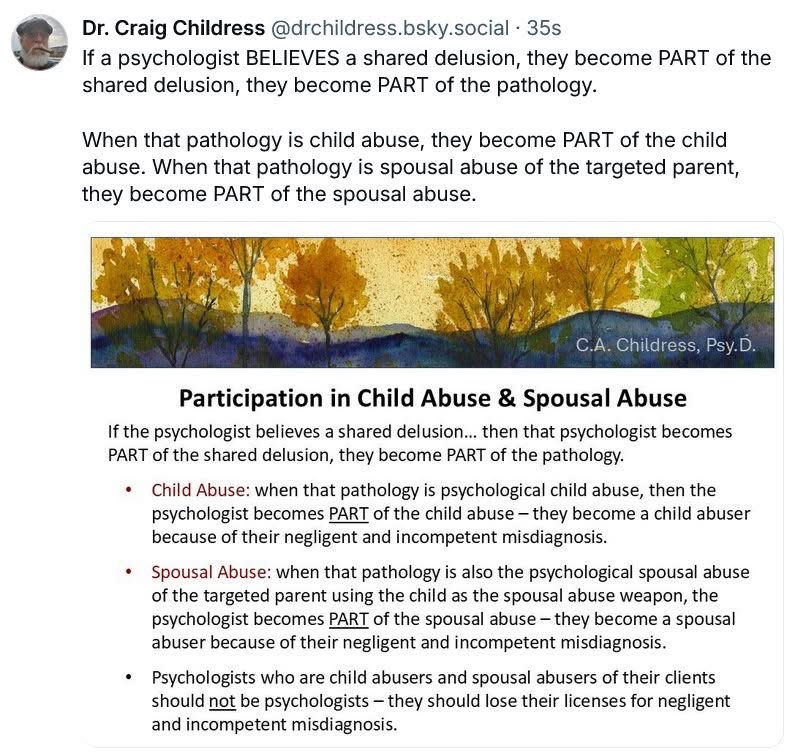
A psychologist who becomes a participating child abuser and spousal abuser because of their negligent misdiagnosis should NOT be a psychologist.
Someone will need to explain to me why an incompetent psychologist who is a participating child abuse and spousal abuser of their clients because of their negligent misdiagnosis should be a psychologist.
From where I sit – participating child abusers should NOT be psychologists – participating spousal abusers should NOT be psychologists.
All psychologists have a duty to protect.
Craig Childress, Psy.D.
Clinical Psychologist
WA 61538481
OR 4392 – CA 18857

 GreatCosmicMothersUnite