

When abandoned or disappointed by other people they may show what on the surface looks like depression, but which on further examination emerges as anger and resentment, loaded with revengeful wishes, rather than real sadness for the loss of a person whom they appreciated.” (Kernberg, O.F. (1975). Borderline Conditions and Pathological Narcissism)
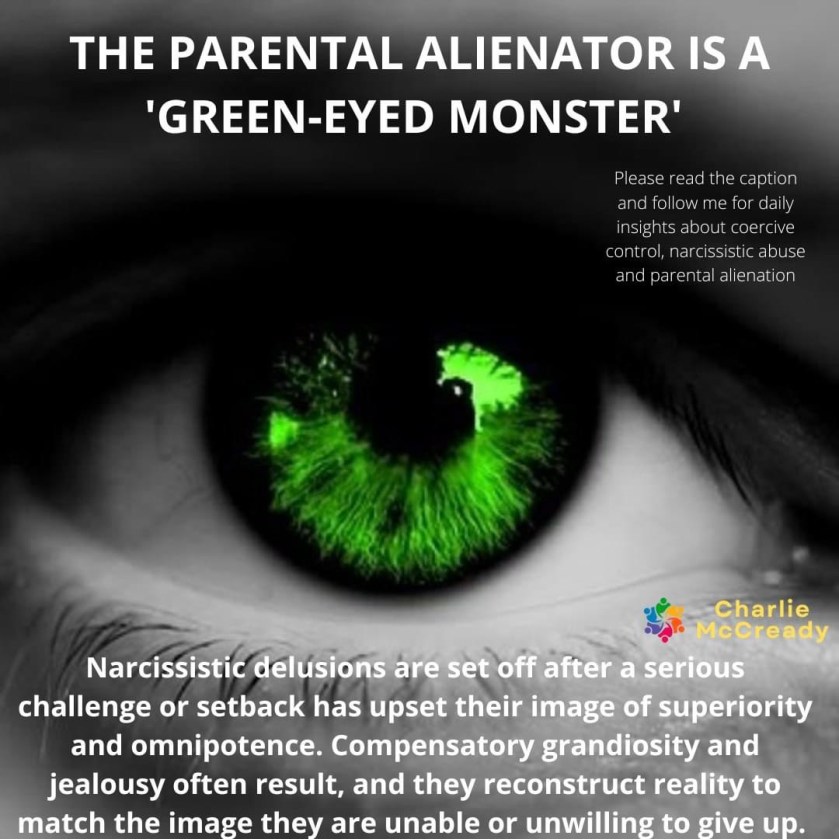
The narcissistic wound – the core sense of inadequacy, an emptiness – is vulnerable to slights, rejection, and criticism. When triggered, it exposes the borderline personality, the grandiosity, superiority, rage, the need to demean and try to re-establish their importance and authority. Narcissistic Personality clinical expert Dr. Martinez-Lewi says that rather than acknowledging their own flaws, imperfections and wrongdoings, these people will blame-shift, and project onto others, cold-heartedly and cruelly. They will then insist that their victims need the help that they refuse to get themselves. This is toxic and psychologically abusive. If they lie (and they do this with ease, it’s a survival technique), they will accuse others of lying. The whole world is wrong, but never the narcissist. Narcissism and parental alienation usually go hand in hand. A narcissistic parent prioritises themselves above their child and is quite capable of using their child to serve their own selfish interests and needs. This will include weaponising the child against the target parent. A parent with a narcissistic personality will typically refuse to recognise an authority or anyone else’s rules. They believe they’re exempt from standards and behaviours, and rules that govern other people. They have a sense of innate superiority, they have no qualms about making their own rules, and they will refuse orders regarding custody and visitation. These views are shared with the child/children, so that the child/children feel the same and start to feel similarly entitled (superior) in their views of the erased parent, believing the resident parent to be right and the erased parent wrong (splitting). The child becomes empowered to disregard contact with the targeted parent. It’s not uncommon for that child, when placed in the care of the targeted parent, to run away and go back to the parental alienator (alignment/identification with the aggressor, I’ve written a post on this). This ‘good’ parent is above the law, a victim, a survivor, whatever they need to be to ‘win’. The pathogenic narcissistic parent actually has a fragile ego. Make sure you put up boundaries. With all the love and compassion, and kindness that has been used and abused, we have to draw a line on any further exploitation. Cut ties, as much as possible, don’t react, and don’t give them more ammunition. Do all you can to avoid being involved in the narcissist’s pathogenic narcissistic dysfunction.
#parentalalienation
#highconflictcoparenting
#alienatedchild
#rejectedparent
#parentalalienationawareness
#charliemccready
#psychologicalabuse

 GreatCosmicMothersUnite