

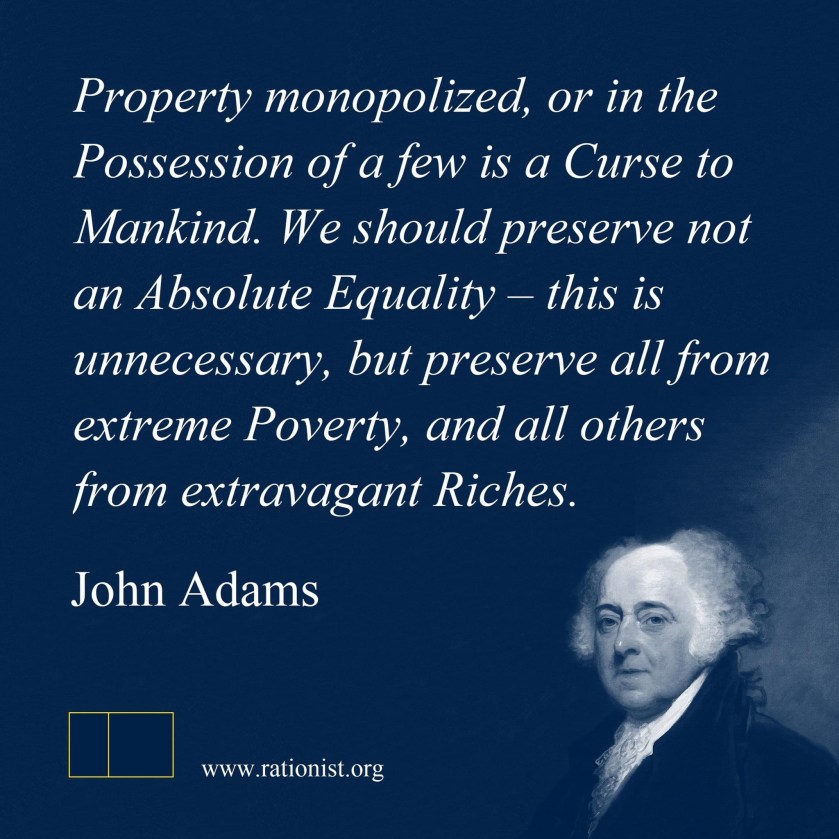
In 1776, America’s top household owned less than 1,000x the national median household net worth. By 1950, that figure increased to around 40,000x. Today, it exceeds 2,000,000x. Since World War II, over $30 trillion has been diverted from labor to capital relative to the 1947 labor share run-rate. The richest 1% is wealthier than the entire middle class. Such extreme wealth concentration subsists at the expense of ordinary workers: After 50 years of stagnation, wages fast fall behind living expenses. The median bank account balance is $5,000. Most Americans live paycheck-to-paycheck and have under $1,000 in savings.
This rising financial insecurity of ordinary households, united with their growing awareness that the economy is corrupt and the government is inept, creates America’s greatest political challenges: The middle class declines. Upward mobility dwindles. Pessimism intensifies. Political faction escalates. Elections lose credibility. The people turn against capitalism. Socialism gains appeal. Violence looms. Crime festers. Mob rule and demagogues and authoritarianism come to destroy democracy, just as the Ancients experienced, and the Founders warned, in each case anticipating an authoritarian political trajectory for America’s future.
This political trajectory generally agrees with ancient Greek historiography on regime change (e.g. ἀνακύκλωσις) (see, e.g., Herodotus (III. 80), Thucydides (VIII. 97), Plato (Rep. VIII. 544 C) (Laws, III. 677 A), Aristotle (Pol. VI. 1293b), Polybius (Hist. VI), Dionysius (Rom. Ant. VII, 54-56)), and shares fundamental uniformities with the evolution of its nearest historical approximation: the Roman Republic (commencing with Tiberius Gracchus and ending with Caesar Augustus, c. 133BC-27BC).
The full weight of history therefore issues this warning: Without a significant and historically-informed intervention to appropriately de-concentrate household wealth, thereby de-polarizing political society and recovering a middling, moderate political disposition, the long-term survival of legitimate popular government in the United States is thus both theoretically and historically improbable.
For more, visit http://www.rationist.org

 GreatCosmicMothersUnite