
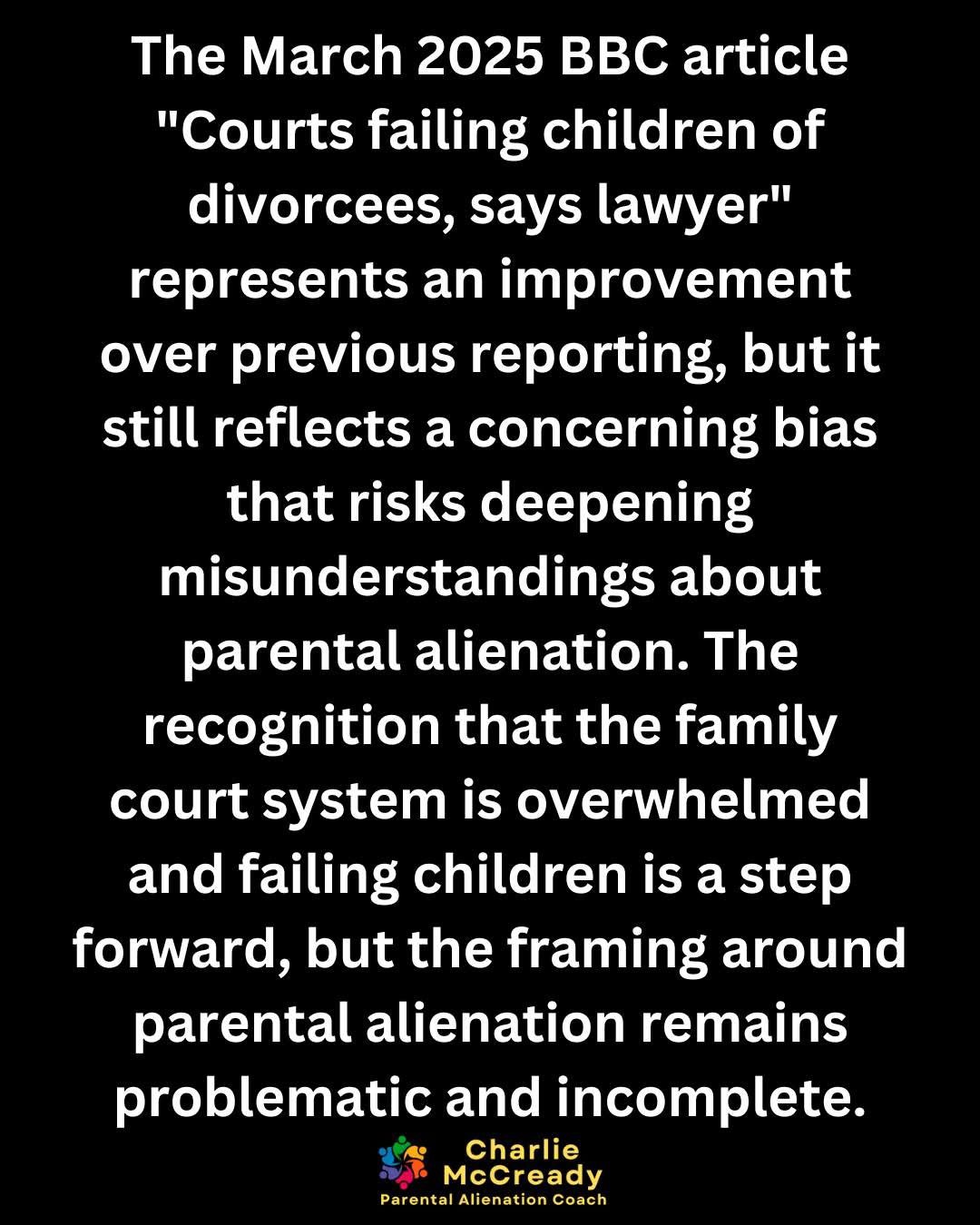
The latest BBC (14 March 2025) article says that parental alienation claims are sometimes used strategically in family court cases and, in doing so, is downplaying the reality that alienation itself is a well-documented form of psychological abuse rooted in coercive control and attachment disruption. Emphasising alienation as a manipulative tactic without properly recognising its legitimate existence harms alienated parents and their children. Alienating behaviours—whether intentional or unconscious—are extensively supported by clinical and legal research. Labelling it as a “pseudoscience” because of its historical association with the outdated “Parental Alienation Syndrome” is both misleading and harmful.
The article repeats the troubling narrative that allegations of domestic abuse should automatically take precedence over claims of alienation. This was the crux of a BBC report in December, and thank you to all of you who wrote in to complain (this is acknowledged in the article). I strongly believe this continuing binary framing creates a false hierarchy of harm. In reality, both domestic abuse and parental alienation can coexist. An abusive parent might falsely claim alienation to deflect from their behaviour, while an alienating parent might fabricate domestic abuse claims to justify cutting off contact. Courts must investigate ALL allegations thoroughly rather than setting up a default presumption that one form of harm outweighs the other. Protecting children requires understanding the complexity of these cases—not reducing them to a simplistic “abuse versus alienation” framework.
I also believe a critical flaw in the Family Justice Council’s recommendations is the suggestion that judges—not psychologists—should determine whether parental alienation has occurred. Judges may lack the specialised training needed to recognise the subtle patterns of psychological manipulation that define alienation. Excluding mental health professionals from these assessments risks leaving children exposed to emotional abuse that may not be immediately visible to a legal professional.
The gendered framing in the article is also concerning. The implication that fathers are more likely to use parental alienation as a weapon and mothers are more often victims of domestic abuse
reflects outdated stereotypes. In reality, I can say my partner and I both suffered, the parents I work with – mothers and fathers – suffer the same. I’d say the differences are in presumed familial relationships and stereotypes, which again are unhelpful. Both mothers and fathers can be victims or perpetrators of alienation and abuse. Alienation is not a gendered issue—it is a psychological and relational one. A gender-neutral, child-centred perspective is essential for understanding the true dynamics of alienation and abuse.
Alienated parents already face immense psychological and emotional strain navigating a system that often fails to recognise the coercive control and emotional abuse they—and their children—are enduring. Until parental alienation is treated with the same seriousness as other forms of abuse, many children will remain trapped in harmful family dynamics, cut off from a loving parent. A balanced and evidence-based approach—grounded in the realities of both domestic abuse and alienation—is essential to ensuring that children’s welfare remains the central focus of family court decisions.
This is not just a legal issue—it’s a safeguarding issue. The failure to adequately address parental alienation means failing the very children the system is supposed to protect.
#charliemccready
#parentalalienationcoach
#highconflictcoparenting
#FamilyCourt
#FamilyCourtReform
#FamilyCourtCorruption
#custodybattle

 GreatCosmicMothersUnite