

Reactive Attachment Disorder (RAD) is a serious condition that can develop in alienated children due to disrupted attachment with one of their parents. They are conditioned to see one parent as all-good and the other as all-bad—a psychological defence known as splitting. This black-and-white thinking creates a deep internal conflict, also referred to as cognitive dissonance, especially as the child’s real experiences with the targeted parent don’t always match the negative portrayal they’ve been given.
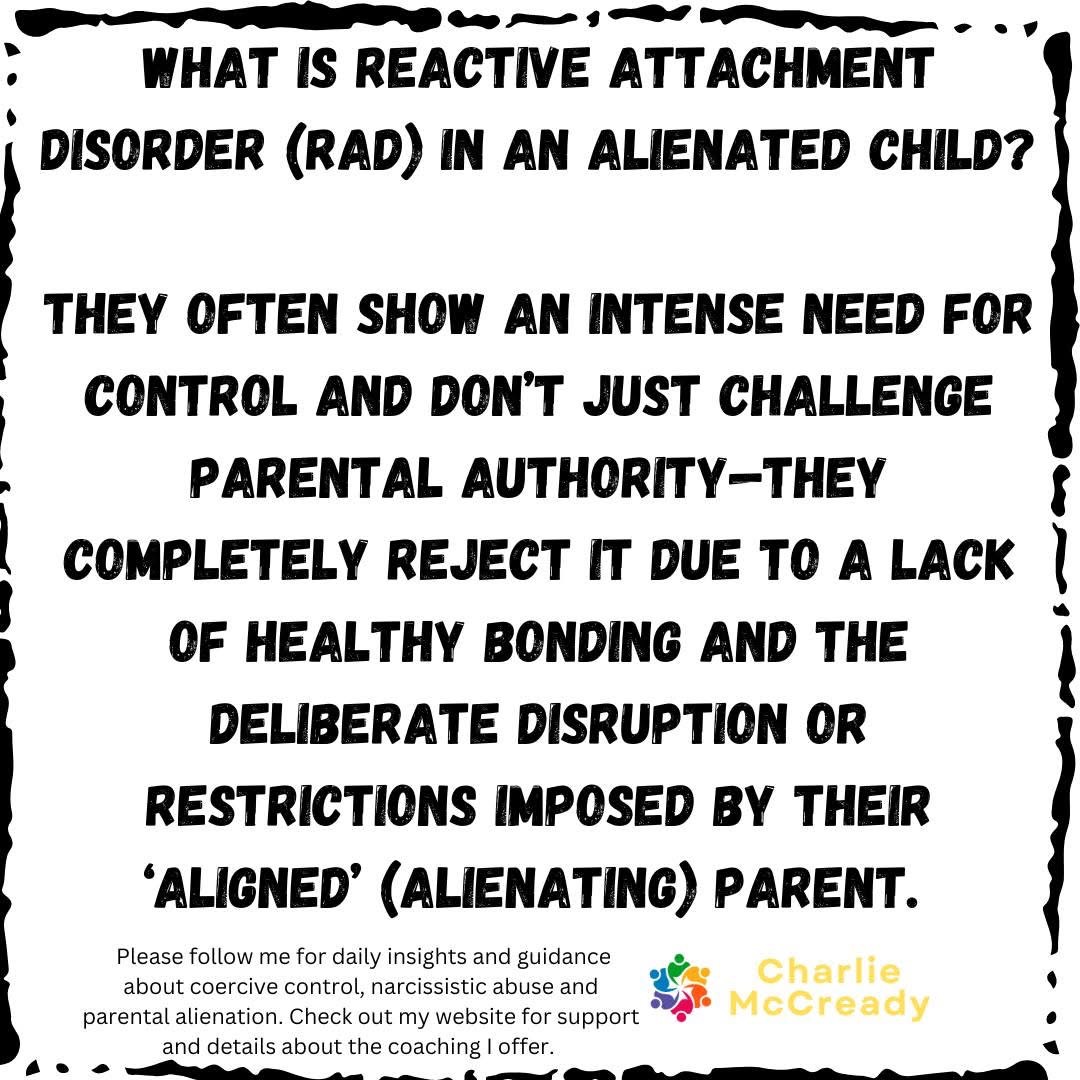
Because they have learned to mistrust or reject the alienated parent—often as a result of manipulation and psychological conditioning—they may show little to no empathy, act emotionally detached, and display an exaggerated sense of independence. Another hallmark of RAD in alienated children is their extreme need for control. Unlike typical children who may test boundaries but still recognise parental authority, those with RAD refuse to accept it altogether. This is not simple defiance; they deny any legitimacy of the alienated parent’s role because the connection was never allowed to fully form or was systematically undermined.
Furthermore, these children may engage in hostile, oppositional, or even aggressive behaviours, seeing the alienated parent not as a caregiver, but as an adversary. They are often highly manipulative, using guilt, threats, or withdrawal of affection to maintain dominance, a behaviour mirroring the alienating parent’s tactics. They might also struggle with trust, display impulsivity, or experience mood swings, which are all signs of emotional dysregulation typical of RAD.
In essence, the alienated child with RAD is trapped in a cycle of relational dysfunction, conditioned to see one parent as unworthy of love and to reject any attempt at reconciliation, while clinging defensively to the alienating parent, even when that relationship is abusive or detrimental.
Over time, many children begin to question their entrenched beliefs. As they mature and gain independence, they may start to recognise the manipulation and emotional inconsistencies in their upbringing leading to a gradual realisation of the truth. Encouragingly, many alienated children eventually start to ‘see the light’ and reach out to the alienated parent. With the right support, patience, and a non-judgemental environment, they can begin to heal, break free from the influence of the alienating parent, and rebuild a genuine relationship.
#charliemccready
#parentalalienationcoach
#coercivecontrol
#pathogenicparent
#abuseinthefamily
#
 GreatCosmicMothersUnite