
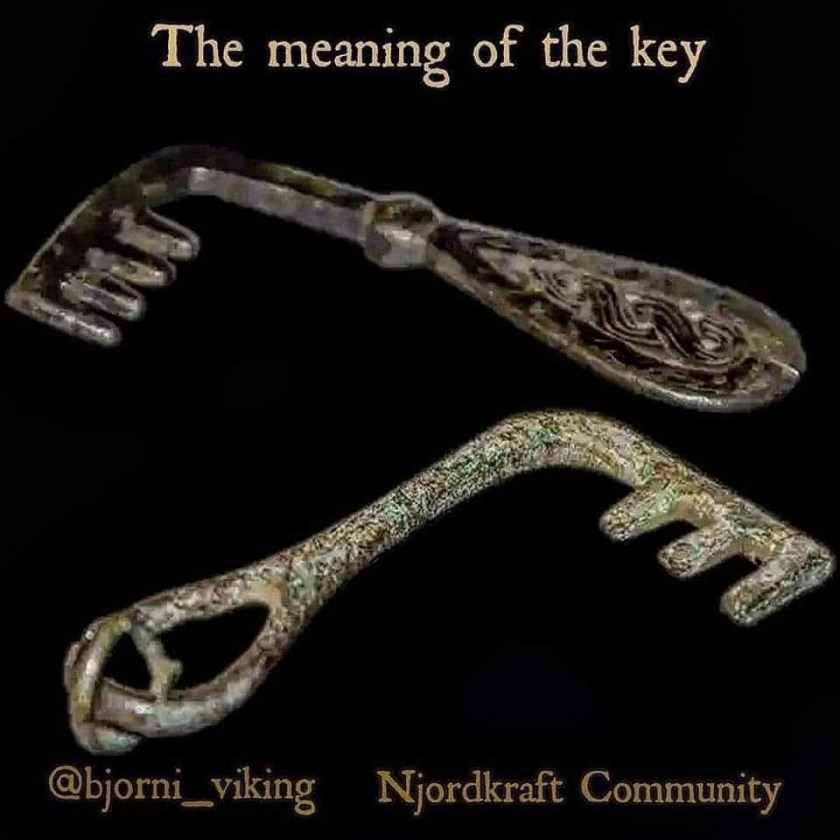
Married women had a very strong position in the pre-Christian era and had pretty much equal rights as the men, and keys helped express this.
Sadly when Christianity took over in Scandinavia, these rights and equality disappeared.
When a couple was married, the wife was given a set of keys to symbolize her new status – “given to lock and key,” as it was called.
The shiny bronze keys hung in full sight on her clothing, along with a small knife or a pair of scissors.
The literature also tells us that all rich married Viking women carried keys amongst their personal items.
The key symbolised the woman’s status as housewife and chief of the household.
The majority of the keys come from women’s graves.
They represent a range of different types, made of iron, bronze, or a combination.
Most of the finds are bronze or iron keys with two bends, which were used in the latter Viking Era.
But the key can also represent just what it does. Unlocking things considering the findings we have from graves.
But did you know that this is also where the old superstition that you should never put your keys on a table because it meant bad luck comes from?
If a man put his Keys on the table, it could considered that he wanted the woman to be his wife and in charge of his household.
Njordkraft Community
@bjorni_viking
Picture:
Keys in bronze found in graves from Viking Age on the Island Gotland, Sweden

 GreatCosmicMothersUnite