
Category: Parential Alienation-Child Abuse
Elderberry and Carbon60 , Fighters
GrandMothersWisdom:MoveForward

My grandmother once gave me a tip:
In difficult times, you move forward in small steps.
Do what you have to do, but little by little.
Don’t think about the future, or what may happen tomorrow.
Wash the dishes.
Remove the dust.
Write a letter.
Make a soup.
You see?
You are advancing step by step.
Take a step and stop.
Rest a little.
Praise yourself.
Take another step.
Then another.
You won’t notice, but your steps will grow more and more.
And the time will come when you can think about the future without crying.
- Elena Mikhalkova
(Image of Tasha Tudor, American Illustrator 1915-2008)
Childress Headed To Courts , Me2
I’m going into the court system. I’m writing reports for court submission, I am testifying as an expert witness in court. I always knew I would arrive here.
Foundations. We establish the foundation for our line of argugment offered to the court, a treatment oriented line not custody.
Custody is a false argument, it’s the pathogen’s framing, who gets “possession” of the child, the child is property, ownership, custody.
We’re re-framing to treatment. We need to fix this, everything. We need to restore to the child a normal-range and healthy childhood – Goal 1.
We need to restore love to the child’s life.
In the courts, my influence is my credibility. I’m evidence.
The attorneys make argument, Ithey are the advocates. I’m not in the court to advocate, that’s not my role, I’m a clinical psychologist, I’m evidence.
And the weight of my evidence is my credibility. I’ve grounded my credibility on the solid and scientifically grounded foundations of professional psychology, Bowlby-Minuchin-Beck, ICD-10, DSM-5,
Who am I, why am I involved?
You already have (ignorant) mental health people involved, why is Dr. Childress also involved?
Specialized knowledge and expertise.
In what? In attachment, in delusional pathology, two separate and independently qualifying domains for my involvement. There’s a third if you need it, Munchausen’s by proxy from my Children’s Hospital background if you think it’s relevant.
But the other two should be entirely enough, each independently and then absolutely both together.
You will not find another psychologist on the planet who is expert in both attachment and delusional pathology.
I am. And that is spot-on relevant to this pathology, an attachment pathology involving a shared persecutory delusion with the allied parent as the primary case.
Attachment and delusion – that’s me.
In another post I described my background of rating delusional pathology for 12 years at a UCLA research project on schizophrenia, and I described the Mental Status Exam.
The MSE covers many brain systems, for delusions that’s the frontal lobe thinking and perception systems. The clinical interview and diagnosis of a delusion is through an MSE of frontal lobe executive function systems.
Google MSE, read the NCBI return, see in Thought and Perception – this MSE domain is “one of the most difficult” and requires “considerable experience” to conduct.
I have that considerable experience – I can conduct an MSE of frontal lobe executive functions, let’s pop that delusion out and look at it’s features directly in the clinical interview.
That’s one qualifying domain. Here’s two; attachment.
The attachment system is the brain system for love and bonding, all things love-and-bonding throughout the lifespan, including grief and loss.
The attachment system is a primary motivational system of the brain, just like for eating and sex – a primary motivational system of the brain.
The professional location where you learn about the attachment system is early childhood mental health, that is entirely the attachment years. The only place you learn about attachment as a psychologist is early childhood.
I also have an early childhood mental health sub-specialization; zero-to-five.
It’s a defined sub-specialty within professional psychology, no one else works zero-to-five but us. There’s a reason for that – it’s because you have to know a lot for early childhood mental health.
I have posted to my website in Assorted Items sub-section of Parents the required knowledge for early childhood specialization:
Early Childhood Competence
https://drcachildress.org/wp-content/uploads/2020/02/early-childhood-competency-guidelines.pdf
I want to note an item with this, it’s on page 15, under Domain 1 – Knowledge, subsection C, right at the bottom: Brain research.- see that? See where it says, “Brain research” at the bottom in Domains of Knowledge.
Note something important about that. Does it say brain research about emotional development? No. Brain research about physical development? No. How about brain research about cognitive and social development? No. It says… all… brain research.
Does that mean brain research on everything? Yes, it does.
Think carefully, we are dealing with the emotional-psychological-cognitive development of an infant and toddler. All sorts of language and cognitive and emotional and self-organization systems are opening up all over the place in infancy – 3-months, 6-months, 9-months, 12-months, and that’s just the first year.
We have to know what’s opening, when, and how they are integrating with each other… at each phase. How is cognitive affecting language, how is language affecting emotional and social, where is self-structure and self-identity in all of that.
At 6-months. At a year. At 18-months. How is that changing, how are those systems interweaving… and then what to do when anything goes wrong – what’s wrong, where, and what do we do about it?
Then one year, and two years, then into preschool and the toddler period; cognitive, language, social, emotional, sesnory-motor, self-systems, arousal regulation, each separate, and all integrated together.
Brain research, all of it.
Look at my AB-PA Reference List, way in the back, last little bit. I added some information on brain research.
Kandel, E. R. (2007), In Search of Memory: The Emergence of a New Science of Mind, New York: W. W. Norton & Company.
That’s an interesting one. He studies sea slugs because they only have like three neurons running the whole show and they’re pretty big neurons, inches long. So Kandel can study the chemical-structural changes that take place in memory by teaching the sea slug stuff.
I understand how memory works at the neuro-structural level of the cell changes, even the way it interacts with the DNA to modulate gene activation.
Stern covers memory formation over in early childhood, it’s organized around a narrative with the emotional content as the core; islands of consistency during the Emerging Self period zero to three months develop into RIGs during the Core Self period, three months to six-months (Representations of Interactions that become Generalized). These Rigs are the unit-core for memory, they are organized around a narrative structure, beginning-middle-end surrounding an emotional core for the Rig.
I know memory; true memory, false memory, your memory, my memory, do you want to know what happens at the cell membrane synaptic sites?
LeDoux, J. (2002). Synaptic Self: How Our Brains Become Who We Are. London: Penguin Books.
This is about the experience-dependent development of our brain systems, our wiring-diagrams so to speak.
Levitin, D. (2006). This is Your Brain on Music: The Science of a Human Obsession. New York: Dutton/Penguin
This is an immensely fascinating one, it’s about the underlying rhythmic organization of our brain networks; the same neuron can be used simultaneously by two systems based on the rhythmic synchrony within the firing patterns. The brain is organized like an orchestra in rhythmic synchronies.
The power-house stuff is Shore’s work and Iacobonno.
Schore A.N. (1994). Affect regulation and the origin of the self: The neurobiology of emotional development. Hillsdale, NJ: Erlbaum.
Iacoboni, M., Molnar-Szakacs, I., Gallese, V., Buccino, G., Mazziotta, J., & Rizzolatti, G. (2005). Grasping the intentions of others with one’s own mirror neuron system. Plos Biology, 3(3), e79.
Brain research.
The entire brain and its integration is related to the developing child in the first year of infancy; brain systems open on a three month rhythm – 3 months – 6 months – 9 months – 12 months, that’s the timing in infancy.
At age 1 and the second year language is now coming on board. Cognitive, emotional, social, self, all change with adaptation to emerging language.
At age 2 and the third year, motor control begins to develop and the child begins more exploration away, cognitive and social, and self systems all adapt and integrate emerging development.
And on it continues, three-year olds into preschool, five-year olds into kindergarten.
Attachment is there prominently throughout – in infancy, in the first year, second year, third year – that’s all about the attachment system, running through everything.
Then… something goes wrong. What? Who knows, anything. They come to me for a diagnosis, what’s wrong, and how do we fix it?
Early childhood mental health, zero-to-five, is a significant sub-specialty in clinical psychology, ask around, no one does early childhood.
And early childhood is attachment. Early childhood zero-to-five is when we develop the basic grammar of our attachment systems.
Attachment is like language, we learn the grammar of language in early childhood, depending on what we hear, English, German, Japanese, but we use language throughout our lifetimes for everything.
The same with our love-and-bonding system of the brain, the attachment system, we learn the grammar in childhood but we use our love-and-bonding system throughout our lifespans.
To understand the attachment system, you have to understand early childhood mental health, what it is, how it functions, how things go wrong, and how to fix them – that’s all early childhood where you learn about the attachment system.
I have that. That’s my background. On my vitae it’s located on page 4, see that section Early Childhood Training.
I know two additional diagnostic systems specific to early childhood besides the ICD-10 and DSM-5 for general people; the DC-03 is stronger on attachment-spectrum diagnoses while the DMIC is stronger on autism-spectrum.
I’ve also been trained in two attachment treatments, Wait, Watch, and Wonder (WWW) and the Circle of Security. WWW is more infant and second year, Circle of Security is preschool-age.
I also have additional certification training in Infant Mental Health, that’s a whole ‘nuther layer of complexity. What is psychopathology in an infant, and how do you fix it?
I meet the standards for early childhood mental health competency – that means attachment, all aspects in full complexity.
Notice on page 19, the Workgroup Members, note the prominence of Dr. Marie Poulsen, CHLA; I did my a year of pre-doc and two yeas of post-doc training at CHLA. Marie Poulsen was my mentor-trainer in early childhood mental health.
Go through all the areas of the competency matrix, pages 31-32, I meet all those standards by background training and experience.
I’m an early childhood clinical psychologist, on top of all my other work. I work the full range of children from birth-to-18 and into launching young adulthood. My favorites are the grumpy adolescents and the wild-n-wacky 3-year-olds, they’re a kick to hang out with..
I’m going into the courts. The influence of my testimony will be based on my credibility. The reason for my involvement is my specialized training, background, and expertise, with two areas of prominence; attachment (early childhood) and delusions (MSE of executive functions).
I know the legal system. My dad was a lawyer through-and-through, he worked the federal courts with judges for 30 years, then went to the state bar as a magistrate hearing malfeasance complaints against attorneys.
I understand the legal system, and I understand my role. I’m not an advocate, I’m evidence, I need to remain contained within my role.
Start by laying the foundations, for your your line of argument, your line of questions, your line of evidence.
For my evidence, I start by laying the foundations for my diagnosis and my treatment plan; diagnosis guides treatment.
I’m not your warrior, I’m your weapon. Time to unsheathe your weapon on your behalf. I am not an advocate for anything – I am a clinical psychologist, I am entirely treatment. We fix things. Everything.
Dr. Childress has reached the savanna now, I’m in the courts with reports and testifying. The world has changed, there’s now a clinical psychologist in court-involved pathology.
Craig Childress, Psy.D.
Clinical Psychologist, PSY 18857
Eviction Protection Under COVID-19
According to an email from Zillow:
“Eviction protection during COVID-19
The first thing you can do is contact your landlord or property manager to discuss your situation. You may be temporarily protected from eviction under the federal CARES Act, which stands for Coronavirus Aid, Relief and Economic Security.
According to the National Housing Law Project, the CARES Act prevents a tenant from being evicted for 120 days if you or the property meet one of the following conditions:
You live in a property that is financed with a federally backed mortgage loan.
You received rental housing assistance through one of the many federal voucher programs including Housing Choice. These resources are outlined here by the National Housing Law Project.
You receive rental housing assistance through a rural housing voucher program.
If you or your rental meet any of these conditions, your landlord can’t initiate a new eviction notice until July 25, 2020, and you must be given an additional 30 days — or until August 24 — to leave the property. During that time, you cannot be charged late fees, penalties or other charges for late rent payments.
While the moratorium provides protection from eviction, the law does not exempt renters from having to pay their rent once the protections expire.
More Resources:
The Department of Housing and Urban Development (HUD) provides assistance at a federal level but also works with state and local agencies. Learn what programs and services are available in your area.”
Momentum Grain in Petition Against Bill Gates
Vibrational Creation of Life
“The Law of Vibration tells us that everything in the Universe vibrates, including our thoughts and emotions.
It also Informs us that
our vibrations act like a Magnet.
Negative thoughts or emotions, which are at the low end of
the scale of vibration, attract –
in equal measure –
people and/or circumstances with similar vibrations.
Fortunately, the same applies
to loving, positive thoughts
or emotions, which are at the high end of the scale.
Low vibrations are destructive to life. Only high vibrations can support and enhance our physical, emotional, mental
and spiritual growth and well-being.
Numerous Masters have stressed that the major obstacles
keeping us from Ascension are the low vibrations of our
fear-based thoughts and emotions. If we wish to progress
spiritually, we need to clear our mental and emotional bodies of the debris of low vibrations.
The Law of Vibration shows us the way to do this.
It teaches that a high vibration transmutes a lower one.
By increasing our vibration we automatically transmute
the low vibrations in our mental and emotional bodies,
thereby accelerating our process of Ascension.” (Unknown)
“To grow spiritually it is important to know you create your own reality.
A major turning point in your growth comes when you begin
to take responsibility for everything that happens.
When you realize that it is possible to create the life you want –
even if you don’t yet know how – you and your Higher Self become the captain of your ship.
You are the source,
the creator of your life.
You are the one who reaches upward, grows spiritually, and
connects with your Higher Self. You create your reality
through your thoughts, emotions, beliefs and intents;
which determine your vibration and thus the people, objects,
events and circumstances
you attract into your life.
Your emotions and your intent determine how fast you get
what you are thinking about. Everything in your life comes
from a thought or feeling you have, for your inner world
of thoughts and feelings creates your outer world of events, objects and relationships. Because you create your own reality, you can choose any
reality you want. Because there is a time lag between your thoughts and their appearance in your reality, some people do not yet realize they create their reality.
Yet you could trace every event that happens to people back
to a thought, picture, belief, emotion or intent they had
at some point in their lives.
Every decision and choice
you make is shaping your reality.
The growing belief that you create your own reality is one of
the major shifts happening right now. Until recently,
the existing mass belief has been that people are at the mercy of vast, uncontrollable forces…
The belief that you create
your own reality is sweeping through the minds of millions.
All those who are searching and awakening to their Higher Self
are becoming more aware that they create their own reality…
As you believe that you create your own reality and take responsibility for your life, your telepathic broadcast of this goes out to others.
Your belief you create your own reality is assisting others in knowing this and taking control of their own lives.
Your beliefs and positive pictures are adding to the collective pool
of consciousness and are then available for others
to tap into as they grow.
Thoughts held in common by masses of people determine
the way your world works.
As more and more people understand that
you create your own reality, many major changes will occur in your society. Understanding that the way you think affects the world you experience around you will create many positive changes in your society.
You have only begun to see the consequences of people taking
responsibility for their lives. Believing that you create
every experience as an opportunity to grow will change
your legal system, your governments, your schools, and
even the products that people manufacture.
When people know they can create what they want and
learn how to do it, they will feel more powerful and in control
of their lives. As they learn more about the principles of creating their own reality, they will begin to have their lives of increasing abundance,love, and spiritual growth. People must believe they have the ability to change their own reality for the better before they will believe they can assist in changing the world for the better.”
~ Orin through Sanaya Roman
Texting Miscommunication Brilliance
Quarantine Makes You Sick
I have a very strong experience to share of ” social distancing ” within marriage , a signal to every one, nay a demand
that partner and psychiatry to dispose of me , as he did.. To fear me, to not hear me, to treat me as if I was invisible …
It began in his home , like a fairy tale, the
3 on committee, only allowed him to marry a ” sister ” for brother .. but he did have free will.
So, in my state of induced mental illness , he made plans , that did not include kids nor I, for his happiness was and still is
the Alpha $ Omega .
#SurvivedSocialDistancingIsolationDisposal 🕊
©️🐸♾♥️
Blessings & Peace,
DonaLuna
Via Jenna via Jason
Quarantine makes you sick
Social Isolation:
A Predictor of Mortality Comparable to Traditional Clinical Risk Factors,” found social isolation as strong a factor in mortality risk as smoking, and higher than having high blood pressure. Another article , “The Pandemic America Forgot About,” concluded:
“Loneliness and social isolation have the same cardiovascular effects as smoking 15 cigarettes per day
& also increase the risk of “all-cause morbidity,”. Loneliness increases the risk of developing dementia by 50% & stroke by 32% while dramatically increasing of cancer risks according to a 1997 JAMA study, “Social Ties and Susceptibility to the Common Cold,” Researchers found that isolation increases susceptibility to the common cold and respiratory infection“More diverse social networks were associated with greater resistance to upper respiratory illness”; a 2015 study found that men experience an 85% increased risk of mortality following losing their jobs. Moreover, a 2020 Lancet study on the “Psychobiological effects of quarantine and how to reduce it,” found”most of the adverse effects (suicide,anger & illness)come from ..restriction of liberty.”& “separation from loved ones.”
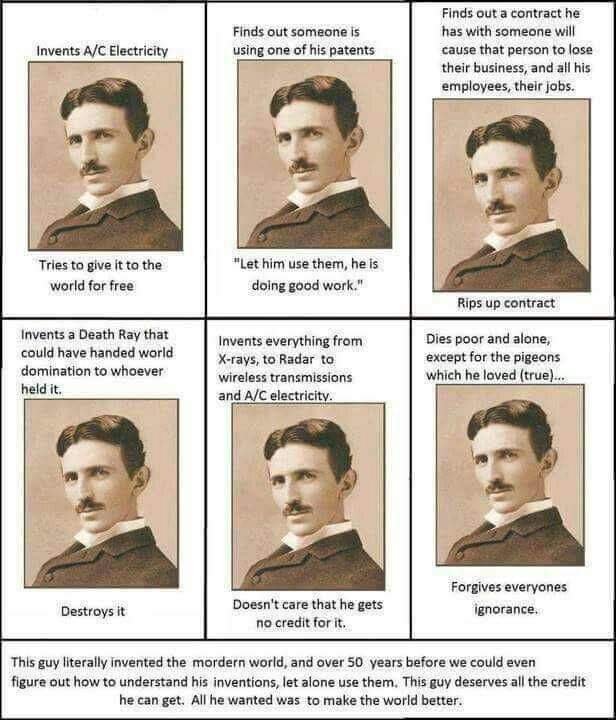
Denied Alive : Ahead of His Time : Tesla
 GreatCosmicMothersUnite