
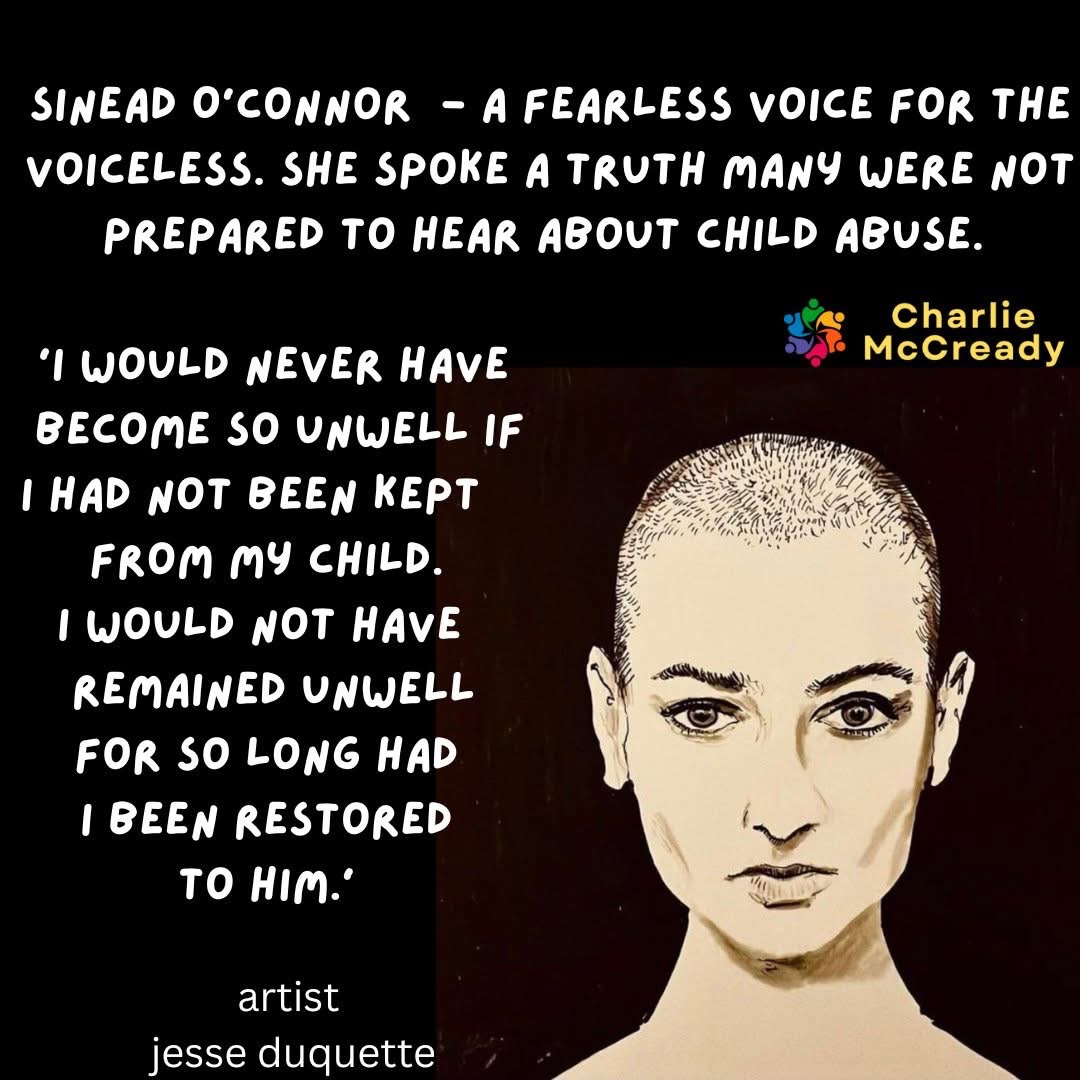
Irish singer and activist Sinéad O’Connor was one of the first artists to go public about being a child abuse survivor. She said that talking about it made people uncomfortable. They were even more so when in 1992, she tore up a photograph of Pope John Paul II during her ‘Saturday Night Live’ performance. The industry shunned her, but her beautiful, powerful, distinctive voice and deeply personal lyrics still found an audience. Her passing greatly saddened me. I loved her 1994 album, ‘Universal Mother’; especially the tracks ‘Fire on Babylon’ where the power and rage in her voice is truly awesome, and the sweet tenderness in ‘My Darling Child’ touches your heart. I sang this lullaby to my children. There’s never a doubt she loved her children (Shane, Jake, Roisin and Yeshua) and she wanted to protect all children. Later when explaining why she risked her career in such a dramatic way, she said it wasn’t an attack on the pope but on the complicity, hypocrisy and systematic cover-up of child abuse within the church’s ranks. Later, she was proven to be right. During a meeting with victims of clerical abuse in Malta, Pope Benedict XVI in 2010 expressed ‘shame and remorse’ for the harm caused by clergy members who had abused children.
Sinéad O’Connor bravely spoke out about her experiences as both a mother and a victim of the flawed child protection system. Through her pain and activism, O’Connor shed light on the urgent need to address child abuse, the wrongful separation of families, and her courageous stand against abuse within the Catholic Church. Her personal experiences of physical and sexual abuse at the hands of her devoutly religious mother resonated deeply with countless victims who felt voiceless and unheard. And her refusal to conform to the commercial pressures of the music industry and her outspoken stance against materialism set her apart from conventional pop stars. She used fame to address pressing social issues, including racism and censorship, challenging the status quo and inspiring others to speak out against injustice.
Sinéad O’Connor’s life took a tragic turn when Family Court took her son Shane from her. In an emotional and tearful Facebook video, she said she’d been severely depressed and suicidal for two years since Family Court took her son away from her. ‘I have two young kids in Ireland…and I can’t even get anywhere near them…How come I can have one kid but not the other?… I’m supposed to be supervised with one child but not with my 10 year-old child? It is a f***ing joke.’ As Sinéad O’Connor said then: ‘I want and deserve to see my baby Shaney any time we want without anyone breathing down our necks…We should never have been separated…You have left me with nothing to lose.’ O’Connor subsequently turned her frustrations on herself, saying, ‘FYI please don’t imagine I am less than keenly aware I failed my child, alongside Tusla and the HSE and the Irish State. And alongside others in his life ….’ This is what we do. Blaming ourselves is an expression of our anger which is how we process grief.
Tragically, Sinéad O’Connor’s son Shane O’Connor died by suicide two days after he had gone missing in January 2022, leaving a profound impact on his grieving mother. He was 17 years old. The Irish singer, who died just over a year later on July 26, 2023, at 56 years old, publicly mourned his death in the days after. ‘My beautiful son, Nevi’im Nesta Ali Shane O’Connor, the very light of my life, decided to end his earthly struggle today and is now with God,’ Sinéad wrote in a since-deleted tweet. ‘May he rest in peace and may no one follow his example. My baby. I love you so much. Please be at peace.’ Just days before her own death, Sinéad shared a post on social media that gave insight into her emotional struggles after losing her son. In a now-deleted tweet, she wrote, ‘Been living as undead night creature since. He was the love of my life ….’
Sadly, her experiences are not isolated; countless parents are in a similar plight after losing their children in Family Court battles. The trauma of such separations often leaves them battling depression, anxiety, and post-traumatic stress disorder (PTSD). Despite being a devoted mother, O’Connor found herself in a harrowing battle with the very agencies entrusted with safeguarding children’s well-being. The lack of sufficient resources, funding, and training within these services can result in grave errors in judgment, leading to wrongful separations and further exacerbating the trauma experienced by vulnerable families. Sinéad O’Connor’s heart-wrenching journey and her advocacy against child abuse in the Catholic Church and Family Court prompt us to question the effectiveness and compassion of our current child protection system. It underscores the urgency for significant reforms, increased funding, and improved training for protective services. In her memory, let us continue the conversation she started on the pressing issue of child abuse, including parental alienation. Parental alienation, a form of emotional abuse that separates children from one of their parents, must be acknowledged and addressed as child abuse to protect the rights and well-being of innocent children. As a society, we must join hands to support vulnerable families and protect children from harm. Only then can we hope to prevent further tragedies and provide a safer, more nurturing environment for future generations where love, support, and understanding prevail and where every child is safe, cherished, and able to thrive.
RIP beautiful Sinéad.
In the UK, the charity Mind is available on 0300 123 3393 and Childline on 0800 1111. In the US, Mental Health America is available on 800-273-8255. In Australia, support is available at Beyond Blue on 1300 22 4636, Lifeline on 13 11 14, and at MensLine on 1300 789 978
#charliemccready
#parentalalienationcoach
#mentalhealthawareness
#parentalalienation

 GreatCosmicMothersUnite