

🍁~ Origins of Halloween: 101 ~🦉
The name ”Hallowe’en” means hallowed or holy evening and the celebration has its origins in ancient Celtic culture. The group of people known as the Celts populated much of Europe—not only Britain and Ireland, but also areas of Spain, France, southern Germany, the Alpine region, Bohemia, Italy, the Balkans and even central Turkey. The Celts are first historically mentioned in Greek texts dating from 500 BC. Within this culture, a Gaelic branch primarily in Ireland and parts of Scotland, celebrated an Autumn festival known as Samhain (SAH win, SOW in, SAV en), or “summer’s end.”
The Celtic year was divided into two halves: the light and the dark, with Beltane beginning on May 1st, and Samhain beginning on November 1st. Samhain was considered the beginning of the new year and villagers preparing for the winter cold and dark ahead used the occasion for feasting on all the good food grown in the summer: turnips, cabbages, apples and other fruits, nuts, berries, and grains. Maize had yet to be introduced from the “new world,” so references to “corn” meant barley, wheat, or rye. Dwellings were decorated with the natural fruits and foliage of the season. Priests and priestesses known as druids guided the culture in its spiritual matters and officiated at this autumnal celebration.
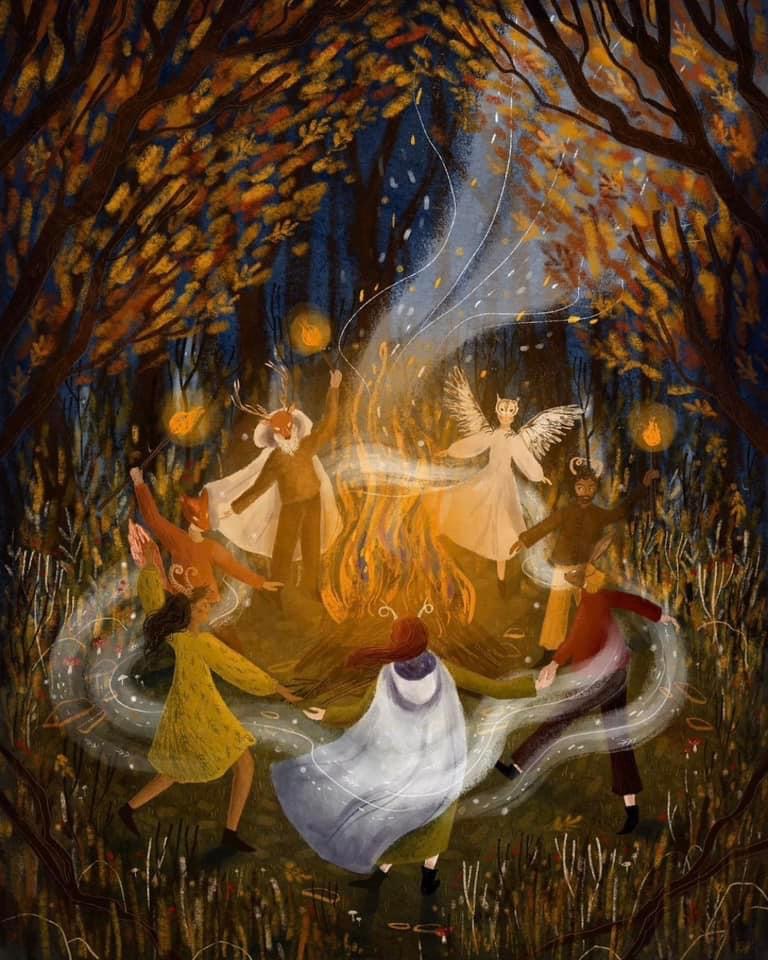
The festivities of each village included a great bonfire (bonefire). The bones of cattle, harvested for the winter months, were cast upon the flames. With the great bonefire burning, the villagers extinguished all other fires. Each household re-lit their hearths from the one common flame, signifying a new beginning, a unity of family and community, and as protection from harm. Ashes from the bonefires were spread over the fields to protect, bless, and fertilize the land for the time of planting.
The prevailing belief and purpose of this ritual was that, at the time of Samhain, the veil between this life and the afterlife was thin, and the spirits of the dead could return to the land of the living. Owls were watched for as messengers between the worlds, and Autumn leaves blown in the wind could also carry messages, as expressed in the old wive’s saying, “catch a leaf, a message brief.” The dead were honored and assured that their legacy was valued. Setting out food and drink (treats) provided hospitality for them. Not all returning spirits were friendly however, and could “trick” or otherwise cause trouble for the living. To ward off harmful spirits, people carved images onto hollowed out turnips, set a light inside, and used these lanterns in doorways and windows. Pumpkins were a product of the American continent and had not yet made their way to Europe. Turnips and swedes could grow nearly as large as some pumpkins and served the purpose well.
The living could also pass into the realm of the Otherworld at this liminal time. Welsh tradition tells of a door to the Otherworld at the foot of Cader Idris above the lake, Llyn-y-Cau, which opens to mortals on the Eve of All Souls each year. Irish tales tell of living heroes crossing into the realm of the dead as well. With the normal laws and boundaries of the world thus suspended, chaos and mischief could abound on Samhain night in the form of pranks and disguises. Gates could be removed from hinges, chimneys blocked with turf, and animals turned loose from pens. Girls could disguise themselves as boys, and boys could dress as girls to add to the confusion. Young people would don costumes made of straw or white cloth; veil, mask, or blacken their faces, and go about the countryside impersonating the returning dead. The disguises also served the purpose of frightening away beings or spirits with harmful intent.
Divination was prevalent in Samhain tradition, and apples and hazelnuts—deeply connected with the Otherworld—figured prominently in prophetic activities. Hazelnuts imparted wisdom, heightened awareness, and led to visions and epiphanies. Interestingly, in current times, the hazelnut has been found to be a “brain food.” The dying King Arthur of Welsh legend is said to have been carried away to Avalon, the Isle of Apples, and the Irish hero, Bran, is welcomed into paradise by a branch of blooming apple that simultaneously bears the fruit as well. Games, such as bobbing for apples (apple dookin’) and snap apple, where one tries to bite an apple suspended from a string, reflected the Celtic belief of the great apple tree growing at the heart of the Otherworld, whose fruit imparted eternal youth. In the waning light of autumn, a ripe golden or red apple was a promise that the strength of the sun would return and in the meantime, the stored fruit would help sustain life until spring.
Many ancient Celtic customs proved compatible with the “new” Christian religion. The Church gave Samhain a Christian blessing in 837 AD when November 2nd was designated All Souls Day, November 1st, All Saints Day, and the eve preceding it became All Hallows E’en, or Hallowe’en.
Gaelic culture was not alone in their festivals for the dead. Many ancient civilizations from Egypt to Cambodia had similar rituals, remnants of which survive in our contemporary society. The traditional Mexican holiday of Los Dias De Los Muertos, or The Days of the Dead, celebrated from November 1st through November 2nd is an example of such, as are: Todos los Santos in Spain; Totensonntag in Germany; Pchum Ben in Cambodia; Chuseok in Korea; The Hungry Ghost Festival in China; Obon Festival in Japan; Ma’nene in Indonesia; Odun Egungun in West Africa; Gai Jatra in Nepal; Snap Apple Night in Newfoundland and Labrador; Hop-tu-Naa on the Isle of Man; Nos Calan Gaeaf in Wales; Kalan Gwav in Cornwall.
Learning the origins and significance of our long-observed holidays (holy days) has the valuable effect of giving meaning to seemingly meaningless traditions. We become connected to our roots and heritage, which provides us with a sense of identity and helps us, in an often fragmented modern world, to reverence relationships, the earth, and a cooperative society.
~ Rebekah Myers
copyright © October, 2016 by Rebekah Myers
Sources: The World of the Celts by Dr. Simon James (lecturer in prehistory for the British Museum’s education department); Celtic Heritage by Dr. Alwyn Rees (director of Extra-Mural Studies at the University College of Wales), and Dr. Brinley Rees (lecturer in Welsh Language and Literature at the University College of North Wales); The Golden Bough by Sir James Frazer (Hon. D.C.I., Oxford; Hon. LITT.D., Cambridge and Durham; Hon. L.L.D., Glasgow; Doctor Honris Causta of the Universities of Paris and Strasbourg); The New Book of Apples by Joan Morgan and Alison Richards; Collectanea de Rebus Hibernicis by Charles Vallancey
Art: Elin Manon, “Dathliad Samhain/Samhain Celebration”
ElinManonIllustration
#SacredSistersFullMoonCircle #Spirituality #Samhain #AllHallowsEen #DayoftheDead #AstheVeilThinneth #WomensWisdom #WomensEmpowerment #RedTent #SacredFeminine #Goddess #GoddessCircle #GoddessStudies #WheeloftheYear #CyclicalLiving #Mythology #Magick #Folklore #FolkTradition

 GreatCosmicMothersUnite