
Cloe Madanes is one of the top family systems therapists on the planet. Mostly she’s worked with the families of abuse – family violence and sexual abuse incest.
Her work in both areas is, in my view, gold standard for the treatment of family violence and sexual abuse pathology in the family, and her Strategic family therapy techniques for the resolution of family issues are wonderful for all forms of family dysfunction.
Here’s from Wikipedia about Cloe Madanes:
From Wikipedia: “She and her former husband, Jay Haley, founded the Family Therapy Institute of Washington, D.C., and the Family Therapy Center of Maryland where she served as the director until their divorce in the 1990s.”
From Wikipedia: “Madanes has written a number of books: Strategic Family Therapy, Behind the One-Way Mirror, Sex, Love and Violence, The Secret Meaning of Money, and The Violence of Men. Her books have been translated into more than twenty languages. She has presented her work at professional conferences around the world. She has won several awards for contribution to psychology and has been featured in Newsweek, Vogue magazine, The Washington Post, and The Boston Globe.
From Wikipedia: “Since 2002, Madanes has worked with Tony Robbins developing the new field of Strategic Intervention. With Robbins, Cloe co-founded the Council for the Human Rights of Children, co-sponsored by the University of San Francisco, which applies the insights of Strategic Intervention for the protection and healthy upbringing of at-risk children.”
I don’t cite Cloe much because her focus is more on treating family violence and sexual abuse incest. Instead, for my quotes regarding your families I rely more on Minuchin and Jay Haley. But she was married to Haley, and she, Jay Haley, and Salvador MInuchin all worked at the same child guidance clinic in Philadelphia during the 80s, and they were the formation people (along with Bowen and couple others) for much of advanced family systems therapy.
In 2018, Cloe Madanes published her most recent book:
Madanes: Changing Relationships: Strategies for Therapists and Coaches.
She opens Chapter 3: Hierarchy on page 21 with a description of the Cross-Generational Coalition. Here’s what she says…
From Madanes: “Cross-Generational Coalition. In most organizations, families and relationships, there is a hierarchy: one person has more power and responsibility than another. Whenever there is a hierarchy, there is the possibility of cross-generational coalitions. A husband and wife may argue over how the wife spends money. At a certain point, the wife might enlist the older son in a coalition against the husband. Mother and son may talk disparagingly about the father and to the father, and secretly plot about how to influence or deceive him. The wife’s coalition with the son gives her power in relation to the husband and limits the husband’s power over how she spends money. The wife now has an ally in her battle with her husband, and the husband now runs the risk of alienating his son. Such a cross-generational coalition can stabilize a marriage, but it creates a triangle that weakens the position of both husband and wife. Now the son has a source of power over both of them.” (p. 21).
Dr. Childress Comment: Notice how Cloe Madanes uses the word “alienation” – it’s the husband who is running the risk of alienating his son” because of the son’s cross-generational coalition with the mother – she’s not using it in the same way all of you and forensic psychology use the term (that it’s the allied parent who is “alienating” the child). That’s because Cloe doesn’t even know your families exist or that there is such a thing as Gardner’s “parental alienation.” I had never hear of the term before I came over here to work with your families. That’s because no one in actual clinical psychology knows your families exist. You’re in “forensic psychology” and in clinical psychology, “I don’t work with high-conflict divorce.” It’s obvious she doesn’t know how the term “alienation” is used over here in “forensic psychology” or she wouldn’t have reversed its usage in that way.
From Madanes: “Cross-generational coalitions take different forms in different families (Madanes, 2009). A grandparent may side with a grandchild against a parent. An aunt might side with a niece against her mother. A husband might join his mother against his wife. These alliances are most often covert and are rarely expressed verbally. They involve painful conflicts that can continue for years.” (p. 21)
From Madanes: “Sometimes cross-generational coalitions are overt. A wife might confide her marital problems to the child and in this way antagonize the child against the father. Parents may criticize a grandparent and created a conflict in a child who loves both the grandparent and the parents. This child may feel conflicted as a result, suffering because his or her loyalties are divided.” (p. 21)
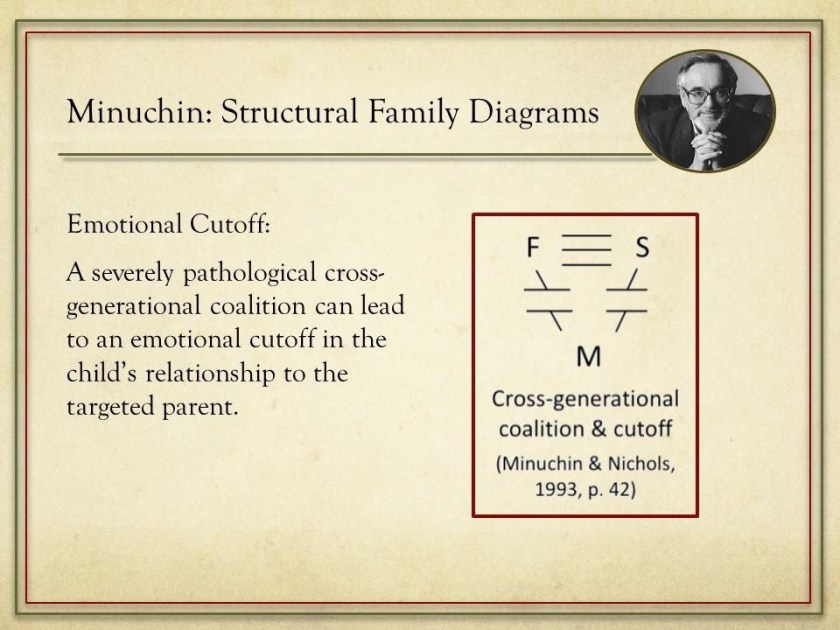
That is your families… a cross-generational coalition of the child with the allied parent against the targeted parent… resulting in an emotional cutoff (Bowen) in the child’s relationship with the targeted parent.
Titelman (2003): Emotional Cutoff: Bowen Family Systems Theory Perspectives.
Bowen Family Therapy:
https://thebowencenter.org/theory/eight-concepts/
In 1994, Salvador Minuchin provided the Structural family diagram for a cross-generational coalition of the child with one parent against the other parent, resulting in the emotional cutoff. Notice the “inverted hierarchy” of the child with the father above the mother – note too that Madanes began her Chapter on Hierarchy with a section discussing the cross-generational coalition.
None of this is Dr. Childress. This is not some “new theory.” Any mental health person who says AB-PA is some “new theory” is just stupid – they are revealing their ignorance. Cloe Madanes, Jay Haley, Murray Bowen, Salvador Minuchin – family systems therapy; one of the four primary schools of psychotherapy and the ONLY one dealing with family problems and family conflict.
Do you think it’d be helpful to know about families if you’re assessing, diagnosing, and treating families? I do.
But forensic psychology doesn’t. They know NOTHING about families or family systems therapy. Nothing. Do you know how I know? They NEVER analyze your family pathology using the constructs and principles of family systems therapy. Never. Do you ever hear them say, “cross-generational coalition” or “emotional cutoff” – no, you don’t.
Why not? Because they are stone-cold ignorant.
And they don’t care.
So you are going to have to become more knowledgeable about family therapy than the therapist is. That’s bizarre. The patient has to learn more than the therapist so the patient can instruct the therapist on how to do therapy. Is that the way it’s supposed to work?
No.
But that’s the situation you are in.
Craig Childress, Psy.D.
Clinical Psychologist, PSY 18857

 GreatCosmicMothersUnite